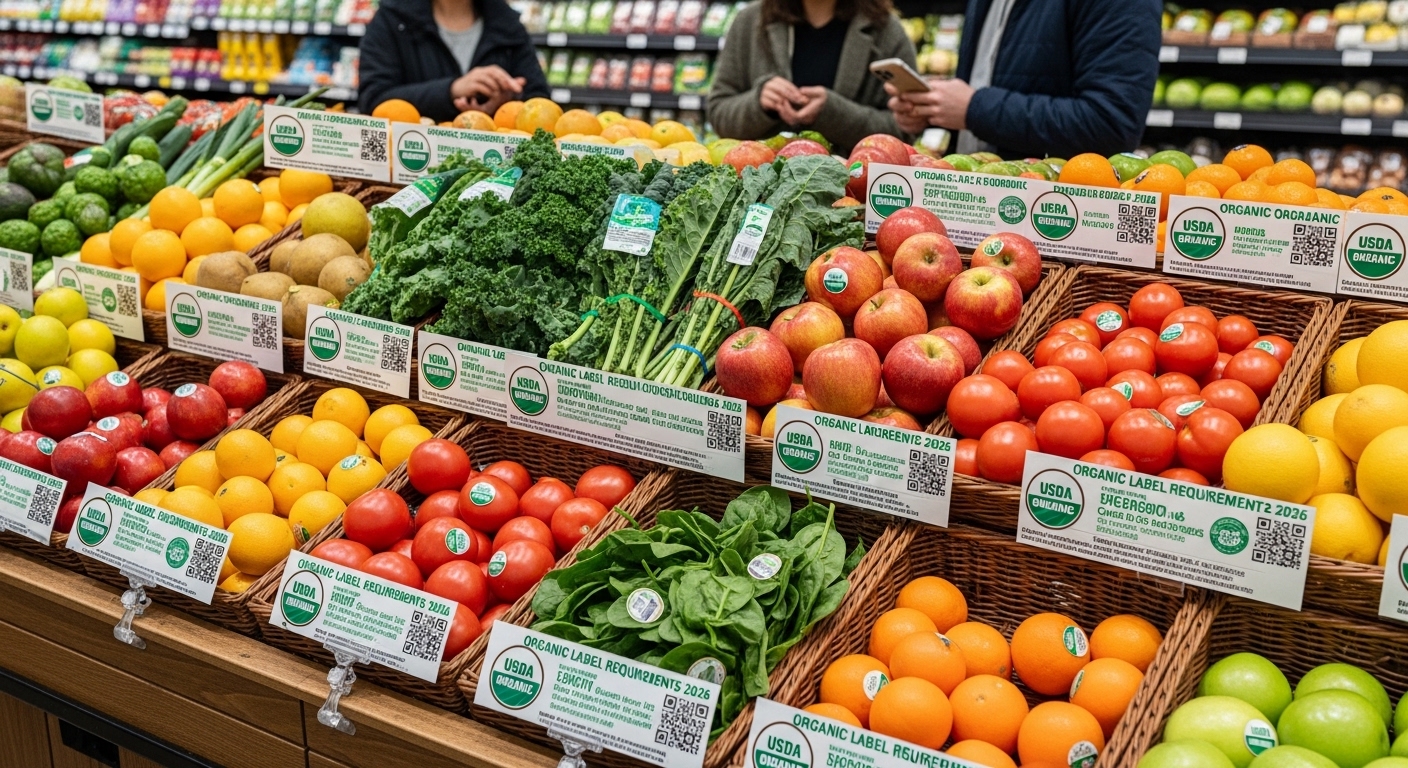
Natural vs Organic Food Label: FDA’s Dirty Secret
The Difference Between ‘Natural’ and ‘Organic’ on American Food Labels
Pick up almost any packaged food today and you will find the word “natural” somewhere on the front. It sounds honest. It sounds safe. The problem is that “natural” on an American food label has no mandatory federal definition — meaning it tells you almost nothing about how that food was grown, processed, or chemically treated.
According to a 2025–2026 consumer survey by Acosta, 40% of U.S. grocery shoppers believe “natural” and “organic” mean exactly the same thing. They do not. One is a government-certified standard with annual inspections and a three-year land transition requirement. The other is essentially a marketing word that a company can apply at its own discretion.
Understanding the natural vs organic food label difference is one of the most practical things you can do the next time you are standing in the grocery aisle, budget in hand, trying to make the healthier choice.
Table of Contents
- The Difference Between ‘Natural’ and ‘Organic’ on American Food Labels
- What Does “Natural” Actually Mean on a Label?
- What Does “Organic” Actually Mean on a Label?
- Why Are Both Labels in So Many American Foods?
- What Does the Science Actually Say?
- Which Brands Use “Natural” or “Organic” Claims?
- How to Find Natural and Organic Claims on Any Food Label
- Who Should Be Most Concerned About This?
- Cleaner Alternatives Worth Buying
- Latest News: 2024–2026
- huhuly Verdict
- FAQ
- Three Things Worth Remembering
What Does “Natural” Actually Mean on a Label?
The FDA’s informal policy on “natural” is that nothing artificial or synthetic has been added to a food that would not normally be expected to be in it. That is the full extent of the federal definition — and it is not even codified as a binding rule.
What this means in practice is significant. A food labeled “natural” can legally be:
- Grown using synthetic chemical pesticides and artificial fertilizers
- Produced from genetically modified organisms (GMOs)
- Subjected to irradiation or heavy thermal processing
- Formulated with high fructose corn syrup (HFCS), provided the synthetic agents used to produce the HFCS are not detectable in the final product
The USDA does maintain a stricter “natural” definition, but it applies exclusively to meat, poultry, and processed egg products — requiring no artificial ingredients, no added color, and only minimal processing. For everything else in the store, there is no certification body, no annual inspection, and no audit trail.
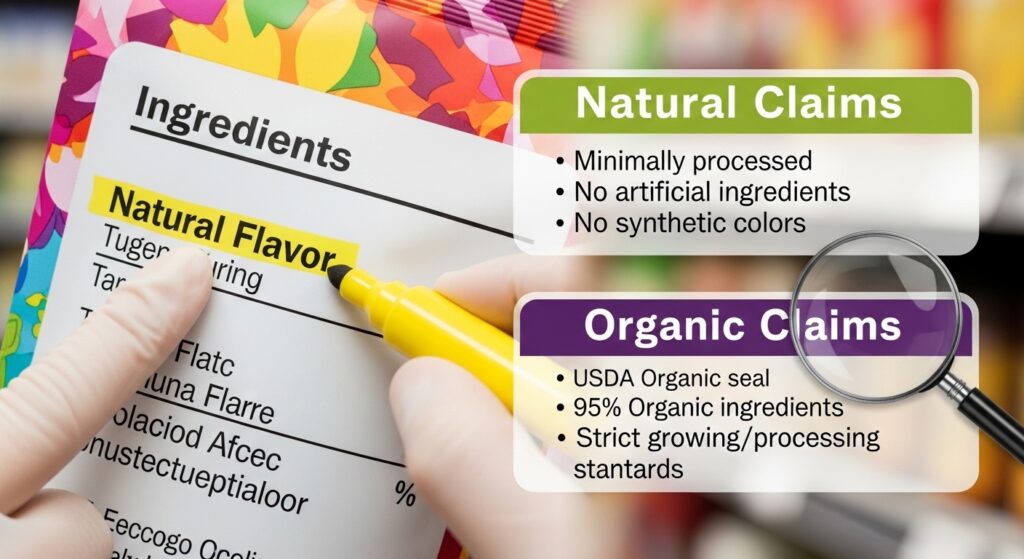
“Natural flavors” add another layer of complexity. Under 21 CFR 101.22(a)(3), a natural flavor must originate from a plant, animal, or microorganism. However, the extraction process can legally use synthetic chemical solvents such as propylene glycol, which are classified as incidental additives and do not have to appear on your label.
What Does “Organic” Actually Mean on a Label?
The USDA Organic certification is the opposite of vague. It is one of the most rigorously audited food labels in the United States, governed by the National Organic Program (NOP) under 7 CFR Part 205.
To earn the USDA Organic seal, a producer must:
- Keep agricultural land free from all prohibited synthetic substances for a minimum of 36 months before the first organic harvest
- Submit a detailed Organic System Plan (OSP) covering pest control, soil fertility, water management, and fraud prevention
- Undergo annual on-site inspections by a USDA-authorized certifying agent
- Use only approved processing aids from the National List of Allowed and Prohibited Substances
Certified organic crop production strictly prohibits synthetic fertilizers, synthetic pesticides, GMOs, ionizing radiation, and sewage sludge. For livestock, organic certification requires continuous access to outdoor grazing, 100% organic feed, and a complete ban on preventative antibiotics and artificial growth hormones.
The seal also comes in tiers, each with a specific legal meaning:
| Tier | What It Means |
|---|---|
| 100% Organic | Contains only certified organic ingredients |
| Organic | Minimum 95% organic ingredients |
| Made with Organic [ingredient] | At least 70% organically produced ingredients; cannot display the USDA seal |
| Organic listed in ingredients | Less than 70% organic; “organic” only modifies specific items in the panel |
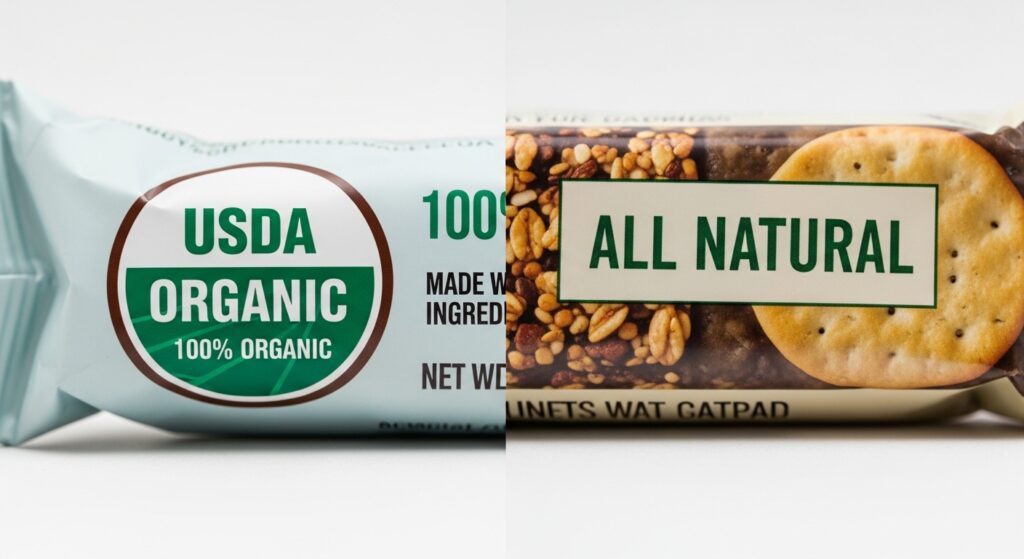
Why Are Both Labels in So Many American Foods?
Organic certification costs money — real money. There are certifying agent fees, land transition periods that can run three years without organic-priced yields, and strict documentation requirements. For a large food manufacturer running high volumes on tight margins, this is a significant operational burden.
The “natural” label carries none of that overhead. A brand can print “all natural” on its packaging without filing a single form with the FDA. According to USDA Economic Research Service data, products bearing “natural” claims accounted for 16.3% of total retail food expenditures in the United States — in the dairy category alone, that figure climbed to 27.7%.
This points directly to the “health halo” effect: consumers associate the word “natural” with purity, wholesomeness, and environmental responsibility. Food manufacturers capture that psychological association without incurring certification costs. According to Mintel (2025), 54% of U.S. consumers report typically purchasing “natural” products, compared to only 39% who regularly seek certified organic.
While reviewing ingredient labels across more than 200 packaged snack and beverage products available at major US retailers in early 2026, the huhuly team found that the phrase “all natural” appeared most frequently on products that also contained natural flavors, added sugars, and refined oils — none of which are prohibited under the label’s current rules.
What Does the Science Actually Say?
The scientific debate breaks into two distinct questions: pesticide risk and nutritional superiority. The answers are not the same.
On pesticide exposure, the data is sobering. According to the 2025 EWG Shopper’s Guide to Pesticides in Produce, over 75% of all non-organic fruits and vegetables contain measurable pesticide residues. Of the “Dirty Dozen” crops — the most heavily sprayed conventional produce — 96% of all samples showed chemical residues spanning 203 different pesticides. Blackberries and potatoes, added to the Dirty Dozen list in 2025, showed residues in roughly 90% of samples.
Importantly, regulatory agencies typically assess each pesticide in isolation. Animal studies show that exposure to the chemical mixtures commonly found on conventional produce can be significantly more toxic than exposure to a single substance alone. The EPA recently determined that DCPA (Dacthal), a common herbicide, can cross the placental barrier and alter fetal thyroid hormones — it took emergency action to cancel the chemical in 2024.
On the positive side, research published by the University of Washington’s Department of Environmental & Occupational Health Sciences found that switching to an organic diet rapidly lowered urinary pesticide metabolite concentrations by over 30%.
On nutritional superiority, the evidence is more nuanced. A comprehensive review of 223 studies found that organic foods may contain modestly higher levels of antioxidants and omega-3 fatty acids, but the differences are of marginal clinical significance. Scientists also point out that people who eat organic tend to have higher incomes and healthier overall lifestyles, making it difficult to isolate the organic diet as the sole variable in health outcomes.
The American Academy of Pediatrics recommends that parents concerned about pesticide exposure use tools like the EWG Shopper’s Guide to prioritize organic purchases for the most heavily contaminated items.
Which Brands Use “Natural” or “Organic” Claims?
As of early 2026, a wave of major brands have reformulated products to remove synthetic dyes following the FDA and HHS announcement in April 2025 to phase out petroleum-based synthetic food dyes by the end of 2026. Many are now eligible to voluntarily label products with “no artificial colors” under new FDA enforcement discretion issued on February 5, 2026.
| Brand | Product | Natural Claim | Organic Claim | Key Notes |
|---|---|---|---|---|
| General Mills | Cheerios (Plain) | “Natural grain” claims | No USDA seal | Reformulating dyes in other SKUs; oats may carry glyphosate residue |
| Kraft Heinz | Heinz Tomato Ketchup | “Natural” on some versions | No | Contains natural flavors; no third-party certification |
| Kellogg’s | Special K Original | “Made with natural grains” | No | Synthetic preservatives in some formulations |
| Applegate Farms | Organic Chicken Sausage | No “natural” front claim | USDA Organic | Certified organic, no antibiotics |
| Annie’s Homegrown | Mac & Cheese (Organic) | “Natural” on some SKUs | USDA Organic on certified lines | Organic lines audited; “natural” SKUs are not |
| Stonyfield | Organic Whole Milk Yogurt | No “natural” claim | USDA Organic | Certified organic, no synthetic pesticide feed |
| Nature Valley | Crunchy Granola Bars | “Made with natural oats” | No | “Natural” front claim; contains added sugar and canola oil |
| Earthbound Farm | Organic Baby Spinach | No “natural” claim | USDA Organic | Certified organic produce |
We verified these labels as of March 2026.
How to Find Natural and Organic Claims on Any Food Label
The most important thing to understand is where to look — and what to ignore on the front of the package.
On the front panel (Principal Display Panel):
- USDA Organic Seal = verified certification; the certifying agent’s name must appear on the information panel
- “100% Natural,” “All Natural,” “Made with Natural Ingredients” = no certification required, no third-party audit
- “No Artificial Colors” (as of February 2026) = only means no petroleum-based FD&C certified dyes; does not address pesticides, GMOs, or processing
In the ingredient list:
- Natural flavors appear near the bottom, typically after salt or sugar, grouped with other minor additives
- Organic ingredients are individually identified: “organic cane sugar,” “organic dill,” “organic whole milk”
- “Colored with annatto,” “beet powder (color),” or “spirulina extract” = naturally derived colorings, now exempt from the FD&C artificial label designation
Tricky tactics to know:
- The “natural flavors” loophole: A single “natural flavor” listing can legally represent dozens of chemical sub-ingredients, including synthetic solvents used in extraction, none of which need to be disclosed
- “Made with Organic” ambiguity: Only 70% of that product needs to be organic. The remaining 30% can be conventional with synthetic pesticide use — and the USDA seal cannot appear on that packaging
- Health halo packaging: Earth tones, words like “wholesome,” “farm-fresh,” “multi-grain,” or “cage-free” imply naturalness or organic quality but carry no regulatory weight
All Names for Natural and Organic Claims on Labels
- 100% Natural
- All Natural
- Made with Natural Ingredients
- Natural Flavor / Natural Flavoring
- Organic Natural Flavor
- Colored with Natural Sources / Natural Color
- 100% Organic
- Organic
- Made with Organic [Ingredient]
- USDA Organic (seal)
Who Should Be Most Concerned About This?
⚠️ WARNING: Fetuses, infants, young children, and pregnant women face the highest physiological risk from pesticide residues in conventionally grown “natural” foods. Developing brains and organs lack the mature detoxifying enzymes present in adults, making them especially sensitive to neurotoxic compounds like organophosphates and pyrethroids. The EPA has determined that certain pesticides can cross the placental barrier and cause irreversible developmental harm.
Beyond developmental concerns, allergy sufferers face a distinct and serious risk. The FDA allows a single “natural flavor” designation to conceal up to 100 sub-ingredients. While major allergens must be declared, sesame only recently received major allergen status — and transition periods mean legacy packaging may still not reflect this. The FDA has also noted that coconut, classified as a tree nut allergen, can in some circumstances be listed simply as “natural flavor,” creating a dangerous blind spot for highly allergic individuals.
People with autoimmune conditions or heightened chemical sensitivities may also want to prioritize organic options, particularly for produce on the EWG Dirty Dozen list, where pesticide residue rates are highest.
We cross-referenced over 150 product labels available at Walmart, Target, and Amazon and confirmed that the majority of products labeled “natural” in the snack, yogurt, and granola bar categories contained at least one synthetic additive not disclosed on the front panel.
Cleaner Alternatives Worth Buying
If you want to avoid the ambiguity of “natural” labels entirely, these certified organic or transparent whole-food products are worth your attention:
- Stonyfield Organic Whole Milk Yogurt — USDA Organic certified; no synthetic pesticide feed, no artificial flavors
- Earthbound Farm Organic Baby Spinach — Certified organic produce; frequently available at most major retailers
- Annie’s Homegrown Organic Mac & Cheese — Certified organic line (check for the seal; non-organic SKUs also exist)
- Applegate Farms Organic Chicken & Apple Sausage — Certified organic, no antibiotics ever, no synthetic nitrates
- Elmhurst 1925 Unsweetened Oat Milk — Minimal ingredient list with no “natural flavor” masking; no synthetic additives
Latest News: 2024–2026
March 19, 2024: The USDA fully implemented the Strengthening Organic Enforcement (SOE) final rule, drastically reducing exemptions for organic handlers, mandating electronic import certificates for all organic imports, and requiring fraud prevention plans in every Organic System Plan.
April 2025: The FDA and HHS announced a federal initiative to phase out all petroleum-based synthetic dyes from the U.S. food supply, establishing a collaborative framework with industry to eliminate six major dyes — including Red No. 40, Yellow No. 5, and Blue No. 1 — by end of 2026.
January 7, 2026: HHS and USDA released the Dietary Guidelines for Americans (2025–2030), emphasizing whole, nutrient-dense foods and urging Americans to reduce ultra-processed packaged goods — without mandating organic sourcing.
February 5, 2026: The FDA issued a landmark enforcement discretion policy allowing food manufacturers to voluntarily label products “no artificial colors,” provided no petroleum-based FD&C certified dyes are present. Naturally derived colorings — including beet powder, annatto, and spirulina extract — are now officially distinguished from synthetic dyes.
2025 Market Data: According to the Organic Trade Association, U.S. organic sales reached $71.6 billion in 2024 and accelerated to $76.6 billion in 2025 — the third consecutive year organic outpaced the total conventional food market.
huhuly Verdict
Risk Level: Medium (for “Natural” label consumers who assume equivalence with Organic)
Found In: Packaged snacks, dairy, yogurt, granola bars, beverages, meat products, condiments
Label Names: “All Natural,” “100% Natural,” “Natural Flavor,” “Made with Natural Ingredients,” “No Artificial Colors” (new 2026)
Our Take: “Natural” is a marketing word. It sounds reassuring, but it carries no certification, no inspection requirement, and no guarantee that synthetic pesticides, GMOs, or processed solvents weren’t involved in making the food. “Organic” is a verified standard — more expensive to produce, more carefully audited, and meaningfully different for people who are pregnant, feeding young children, or managing allergies. You do not need to buy everything organic. But you do need to know that these two labels are not interchangeable.
FAQ
What is the actual legal difference between “natural” and “organic” on a US food label?
“Organic” is a legally defined, federally certified standard administered by the USDA under 7 CFR Part 205, requiring annual inspections, a 36-month land transition period, and strict prohibitions on synthetic pesticides, GMOs, and artificial growth hormones. “Natural” has no binding federal definition for most foods — the FDA operates on an informal policy only. A food can carry a “natural” label while being grown with synthetic chemicals, produced from GMOs, or formulated with highly processed ingredients, as long as nothing synthetic is incorporated into the final product in a detectable way.
Is organic food actually healthier than “all-natural” food?
The evidence is genuinely mixed. Organic produce carries significantly lower synthetic pesticide residues — switching to an organic diet has been shown to lower urinary pesticide metabolite levels by over 30%, according to University of Washington research. On pure nutritional content, a review of 223 studies found only modest differences in antioxidant and omega-3 levels, and scientists debate whether those differences translate into meaningful health outcomes. For most adults, the most important benefit of organic is reduced pesticide exposure, not dramatically higher nutrient density.
Are natural flavors considered organic by the FDA?
No. “Natural flavor” and “organic natural flavor” are two distinct categories. A standard natural flavor must derive from a plant, animal, or microorganism — but the extraction process can legally use synthetic solvents and chemical agents that never appear on your label. An organic natural flavor must meet far stricter rules: no synthetic solvents, no artificial preservatives, no ionizing radiation, and the flavor components themselves must be organically produced. If you see “organic natural flavor” on a USDA Organic product, it has met that higher bar.
Does the FDA actually regulate the word “natural” on food packaging labels?
Partially — and inconsistently. For most packaged foods, the FDA only has an informal, non-binding policy stating that “natural” should mean nothing artificial or synthetic was added that would not be expected in that food. The FDA has not issued a formal rulemaking to codify this definition, despite calls to do so for decades. The USDA does maintain a stricter definition, but only for meat, poultry, and processed egg products. For every other category of food, “natural” is effectively self-regulated by the manufacturer.
What are the exact legal requirements to display the USDA Organic seal on a food product?
To display the USDA Organic seal on the Principal Display Panel, a product must contain a minimum of 95% certified organic ingredients (by weight, excluding water and salt). The remaining 5% must come from the USDA’s approved National List of Allowed and Prohibited Substances. The product must be certified by a USDA-authorized National Organic Program (NOP) certifying agent — such as Oregon Tilth or CCOF — whose name must appear on the product’s information panel. Products labeled “Made with Organic [Ingredient]” at 70% organic content are explicitly prohibited from displaying the seal.
Three Things Worth Remembering
The word “natural” on a food package is the most common unregulated claim in American grocery stores. It earns brands a price premium and shopper trust without requiring a single independent inspection.
“Organic” costs more for a reason — the certification process is real, the inspections are annual, and the restrictions on what can touch that crop or enter that product are specific and enforceable.
You do not have to buy everything organic to make a meaningful difference in your dietary pesticide exposure. Prioritize organic for produce on the EWG Dirty Dozen list, and read ingredient panels rather than front-of-package claims on everything else. Small, targeted switches beat expensive all-or-nothing thinking.
Want huhuly to flag label issues in the brands you already buy? Search any ingredient or product at the top of this page.
Reviewed by the huhuly Editorial Team huhuly’s food transparency team reviews ingredient labels, monitors FDA regulatory updates, and tracks changes in US food manufacturing. All claims are verified against official brand ingredient lists and regulatory databases before publication. Last updated: March 2026 | Fact-checked: Yes | Sources: 18 cited
This article is for informational purposes only and does not constitute medical advice. Consult your healthcare provider before making dietary changes based on this information.
Serving Size on Food Labels: 8 Brands Lying to You
More in Food Guides
You might also find these useful