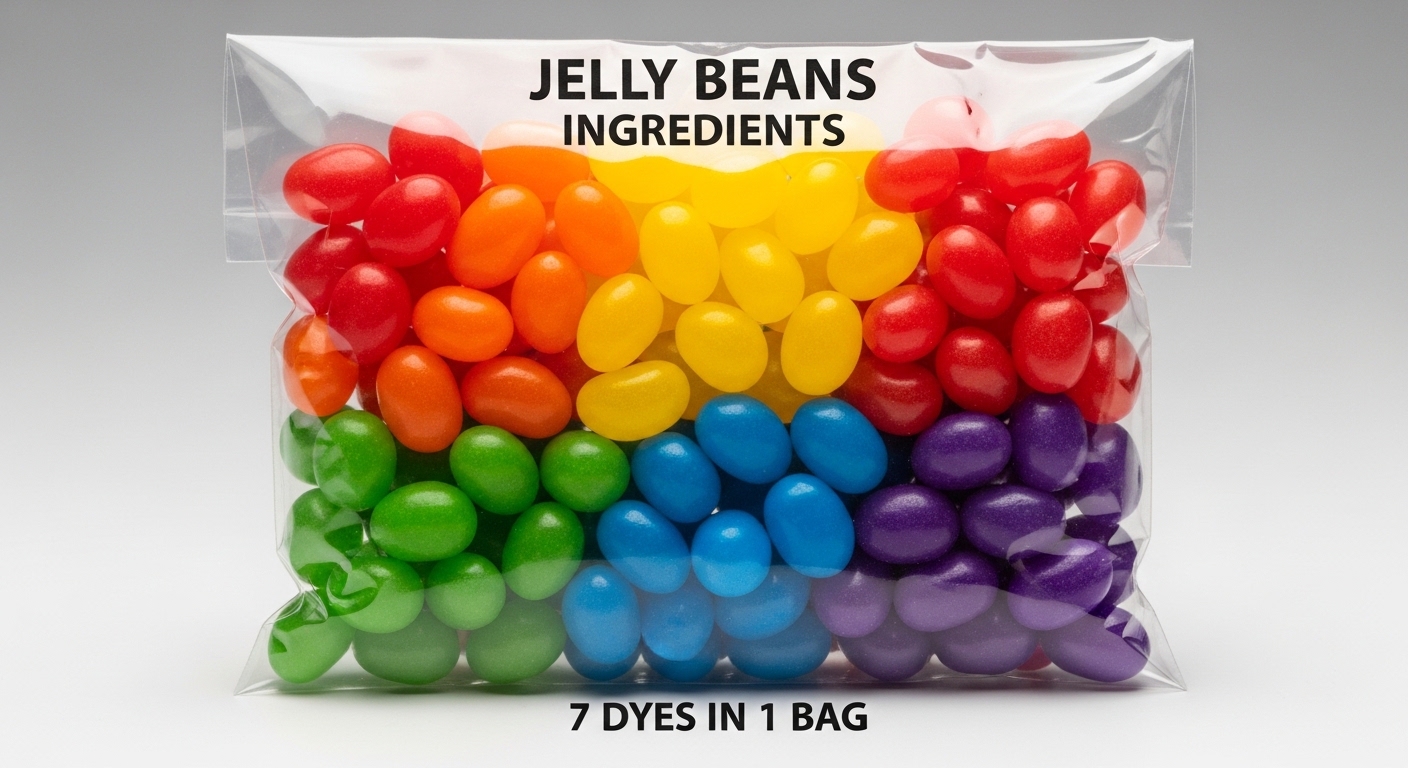
Jelly Beans Ingredients: 7 Dyes in 1 Bag
Jelly Beans Ingredients: What Makes Each Color a Different Chemical Story
Pick up a bag of assorted jelly beans and you are holding up to seven different petroleum-derived chemicals, each engineered in a lab to mimic the color of a fruit that is barely present in the candy. That is not an exaggeration — it is the current state of jelly bean formulation in America.
According to a 2025 study published in the Journal of the Academy of Nutrition and Dietetics, synthetic dyes appear in 28% of all food products marketed directly to children — and confectionery sits at the top of that list. Jelly beans are among the most heavily dyed candies sold in the US. The primary keyword here is jelly beans ingredients, and what those ingredients actually are is the story most labels do not tell you clearly.
What Are Jelly Beans Actually Made Of?
A jelly bean has two distinct parts: a soft, gelatinous interior core and a hard, crystallized outer shell. The interior is built from sugar, corn syrup, modified food starch (usually from corn or tapioca), and fruit juice concentrates for baseline flavoring. The shell gets its distinctive shine from polishing agents — primarily carnauba wax, beeswax, and confectioner’s glaze. That last ingredient is shellac, a resin secreted by the female lac bug (Kerria lacca).
The colors, however, are almost entirely synthetic. Unlike pigments extracted from plants or insects, synthetic certified color additives are petrochemical derivatives engineered to deliver intense, uniform hues at a fraction of the cost of natural alternatives. They provide zero nutritional value. Their only function is cosmetic: make the candy look more vivid, signal a flavor before you taste it, and ensure every batch looks identical across billions of units.
The dyes used in jelly beans fall into three chemical classes:
- Azo dyes — Red 40, Yellow 5, Yellow 6. Characterized by nitrogen-to-nitrogen double bonds connecting aromatic rings. Derived from petroleum precursors like p-cresidine.
- Triarylmethane dyes — Blue 1 (Brilliant Blue FCF). Synthesized by adding sulfonic or carboxyl groups to aromatic precursors.
- Indigoid dyes — Blue 2 (Indigo Carmine). Originally derived from the Indigofera plant; the modern food-grade version is synthetically produced via sulfonation of indigo.
To prevent these water-soluble dyes from bleeding onto your hands or migrating between candies, manufacturers convert them into Lake pigments — insoluble forms created by reacting the dye with aluminum hydroxide. This is why you see “Red 40 Lake” or “Blue 1 Lake” on labels alongside their straight-dye counterparts.
Why Are Synthetic Dyes in American Jelly Beans?
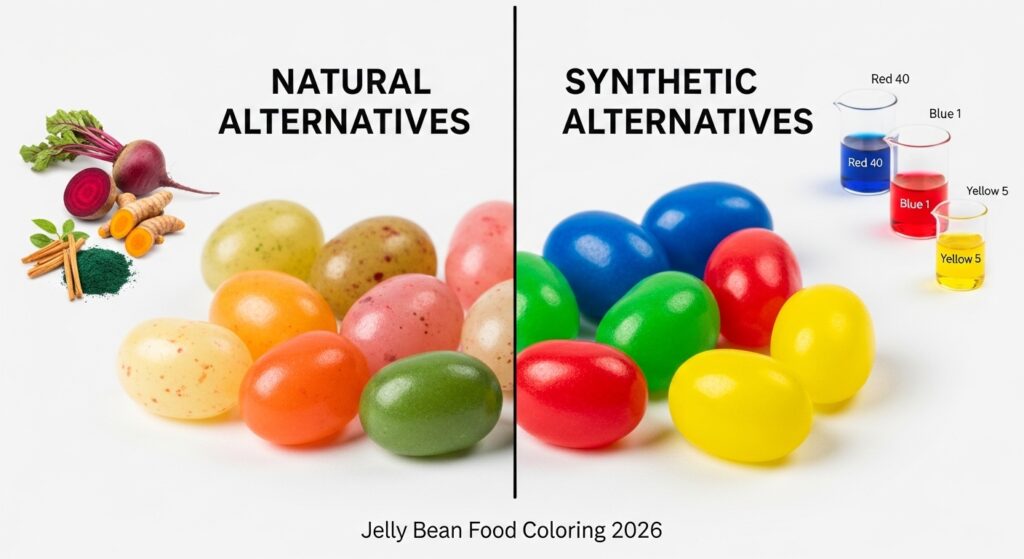
The answer is cost and consistency. Natural colorants — anthocyanins from berries, carotenoids from carrots, spirulina extract from algae — are dramatically more expensive and less stable under the heat and light conditions involved in candy manufacturing. A synthetic dye batch delivers exact, repeatable color at industrial scale.
While reviewing ingredient labels across dozens of jelly bean products available in US stores in early 2026, the huhuly team found that every mainstream brand — from Jelly Belly to Brach’s to Walmart’s Great Value line — relies on multiple synthetic dyes per product, with some formulations combining as many as six FD&C colorants in a single bag.
Regulation has historically enabled this. For decades, the FDA set Acceptable Daily Intake (ADI) thresholds for each dye and certified them as safe. Those safety thresholds were established based on studies conducted between 35 and 70 years ago — studies designed to detect gross organ toxicity, not subtle neurobehavioral effects in children.
The economic incentive is enormous. According to Mordor Intelligence, the US food colorants market was valued at $1.82 billion in 2025. Synthetic dyes are a cheap cornerstone of that market. Natural alternatives cost more, source less reliably, and fade faster — so manufacturers held onto petroleum-based dyes for as long as regulators allowed.
What Does the Science Actually Say About These Dyes?
The research is not ambiguous on the core finding: synthetic food dyes are linked to adverse neurobehavioral outcomes in children. What researchers still debate is the mechanism and the magnitude.
A 2022 review published in Environmental Health by Miller et al. evaluated decades of human challenge trials and concluded that consumption of synthetic food dyes shows a clear association with adverse neurobehavioral outcomes in children, with sensitivity varying significantly between individuals. A 2024 review in Chemosphere by Damotharan et al. mapped the physiological pathway: synthetic dyes trigger neurotoxicity by inducing oxidative stress and mitochondrial dysfunction, which disrupts dopamine and serotonin metabolism — directly impairing impulse control and cognitive focus.
Researchers have also identified a genetic dimension. Synthetic dyes interact with genes responsible for dopamine production and simultaneously trigger genes involved in histamine synthesis. In highly sensitive individuals, as little as 1 milligram of Yellow No. 5 may be enough to trigger behavioral deterioration within hours of ingestion.
On cancer, the evidence centers on Red No. 3. High-dose exposure causes thyroid tumors in male rats. The FDA long argued the mechanism was rat-specific and did not apply to humans — but the Delaney Clause does not require proof of human harm. It requires only that a substance has caused cancer in any animal model. Red No. 3’s authorization was revoked on January 15, 2025.
What current research does not prove: that synthetic dyes spontaneously cause ADHD or anxiety in neurologically typical individuals. The scientific consensus is that they act as potent triggers that exacerbate existing symptoms in genetically predisposed or neurodivergent children — not that they create the disorder from scratch.
Current research on long-term cumulative exposure and synergistic effects of consuming multiple dyes simultaneously is still limited. The FDA’s safety thresholds were never designed to evaluate those scenarios.
For more on the FDA’s current regulatory position, see the FDA’s color additives information page.
Which Brands and Products Contain Synthetic Dyes?
The table below reflects verified ingredient lists as of March 2026. Brand formulations are actively changing due to federal phase-out mandates — always check the current label.
| Brand | Product | Synthetic Dyes Present | Where Sold |
|---|---|---|---|
| Jelly Belly | Assorted Flavors (50 Official Flavors) | Red 40, Red 40 Lake, Yellow 5, Yellow 6, Blue 1, Blue 2, Red 3* (*flavor-dependent) | Nationwide, specialty retailers |
| Brach’s | Classic Jelly Beans | Red 40, Red 3, Blue 1, Yellow 5, Yellow 6 | Target, Walmart, grocery stores |
| Gimbal’s Fine Candies | Gourmet Jelly Beans (41 Flavors) | Red 40, Red 40 Lake, Red 3, Blue 1, Blue 1 Lake, Blue 2 Lake, Yellow 5, Yellow 5 Lake, Yellow 6, Yellow 6 Lake | H-E-B, UberEats, online |
| Mars Wrigley | Starburst Original Jelly Beans | Red 40, Yellow 5, Yellow 6, Blue 1, Titanium Dioxide | Nationwide supermarkets |
| Mars Wrigley | Skittles Original Jelly Beans | Red 40, Red 3, Yellow 5, Yellow 6, Blue 1, Titanium Dioxide | Nationwide supermarkets |
| Russell Stover | Pectin Jelly Beans | Red 40, Yellow 5, Yellow 6, Blue 1 | Supermarkets, pharmacies |
| Walmart (Great Value) | Assorted Jelly Beans | Red 40, Red 3, Yellow 5, Yellow 6, Blue 1 | Walmart stores |
| Target (Market Pantry) | Assorted Jelly Beans | Red 40, Red 3, Yellow 5, Yellow 6, Blue 1 | Target stores |
| Wegmans | Assorted Fruit Jelly Beans | Red 40, Red 40 Lake, Red 3, Yellow 5, Blue 1, Blue 2 Lake | Wegmans supermarkets |
| Kirkland Signature (Costco) | Jelly Belly 49 Flavors | Red 40, Red 40 Lake, Yellow 5, Yellow 5 Lake, Yellow 6, Yellow 6 Lake, Blue 1, Blue 1 Lake, Blue 2 Lake | Costco Wholesale |
| Just Born | Teenee Beanee Americana Medley | Red 40, Yellow 5 | Specialty retailers, online |
| Gimbal’s Fine Candies | Cinnamon Lovers Heart Shaped Jelly Beans | Red 40, Red 40 Lake, Yellow 6 | Specialty retailers, online |
Note: Titanium Dioxide is used alongside synthetic dyes in some products to add opacity to the shell. It is currently banned in the EU due to genotoxicity concerns and remains under scrutiny in the US.
We cross-referenced these labels against EWG’s Food Scores database, Open Food Facts, and direct brand ingredient lists available at Walmart, Target, and H-E-B as of March 2026.
In July 2025, Mars Wrigley officially committed to transitioning Skittles, Starburst, and M&M’s to natural colorants beginning in 2026. In October 2025, Walmart announced it is eliminating synthetic dyes from its entire private-label portfolio, including Great Value and Marketside. Label formulations may already differ from what is shown above — always check the current package.
How to Find Jelly Bean Dyes on Any Food Label
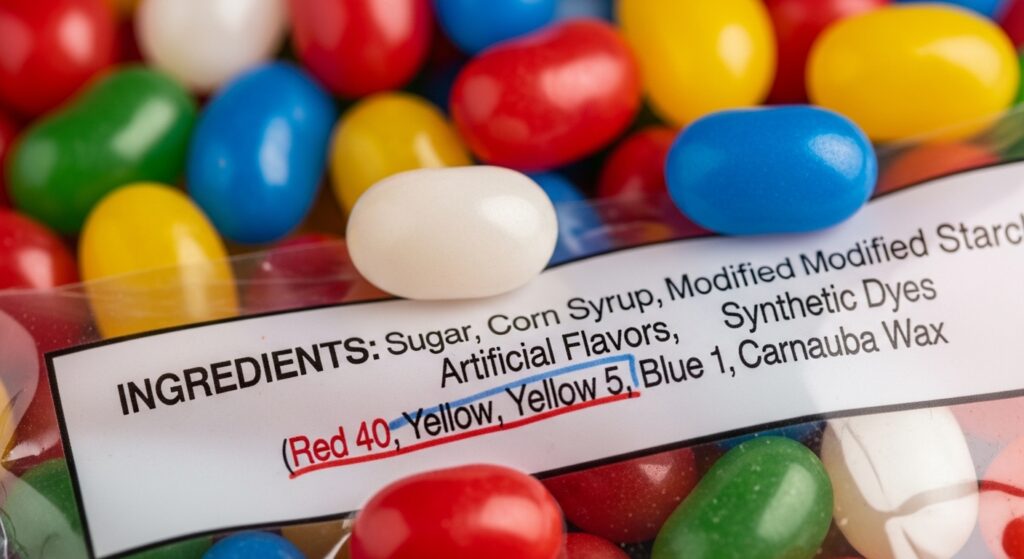
Synthetic dyes in jelly beans are almost always buried at the very bottom of the ingredient list, listed after the phrase “Contains 2% or less of the following…” alongside carnauba wax and confectioner’s glaze. Manufacturers are required to name them specifically — but that does not mean they make it easy.
Look for these exact terms:
- Red 40: FD&C Red No. 40 | Allura Red AC | CI Food Red 17 | E129
- Yellow 5: FD&C Yellow No. 5 | Tartrazine | CI Food Yellow 4 | E102
- Yellow 6: FD&C Yellow No. 6 | Sunset Yellow FCF | Orange Yellow S | E110
- Blue 1: FD&C Blue No. 1 | Brilliant Blue FCF | Acid Blue 9 | Eriosky blue | CI 42090 | E133
- Blue 2: FD&C Blue No. 2 | Indigotine | Indigo Carmine | E132
- Red 3: FD&C Red No. 3 | Erythrosine | E127
- Green 3: FD&C Green No. 3 | Fast Green FCF | E143
All Names for Jelly Bean Dyes on Labels
- Red 40 / Red 40 Lake / FD&C Red No. 40 / Allura Red AC / E129
- Yellow 5 / Yellow 5 Lake / FD&C Yellow No. 5 / Tartrazine / E102
- Yellow 6 / Yellow 6 Lake / FD&C Yellow No. 6 / Sunset Yellow FCF / E110
- Blue 1 / Blue 1 Lake / FD&C Blue No. 1 / Brilliant Blue FCF / E133
- Blue 2 / Blue 2 Lake / FD&C Blue No. 2 / Indigotine / Indigo Carmine / E132
- Red 3 / FD&C Red No. 3 / Erythrosine / E127
- Green 3 / FD&C Green No. 3 / Fast Green FCF / E143
Tricky labeling tactic to know: In states without strict transparency laws, some brands group these chemicals under “Color Added,” “Artificial Color,” or “Artificial Colors” — a legal catch-all that hides the specific compounds inside. If a label says “Artificial Colors” without naming them, contact the manufacturer or skip the product.
Who Should Be Most Concerned?
Most adults who eat a handful of jelly beans occasionally face minimal documented risk. But several groups face meaningfully higher vulnerability.
⚠️ WARNING — Higher-Risk Groups The following populations should exercise extra caution with products containing synthetic food dyes:
- Children under 12: Neurological systems are still developing, and body weight makes dosage-to-mass ratios significantly higher than for adults. FDA Acceptable Daily Intake thresholds were calculated using adult models.
- Children with ADHD: Clinical studies consistently show that synthetic colorants exacerbate symptoms of inattention, hyperactivity, and impulsivity in children who already carry the diagnosis. This is not a matter of debate in the literature.
- Individuals with ASD: Those on the autism spectrum, particularly those with co-occurring ARFID (Avoidant/Restrictive Food Intake Disorder), may be chronically overexposed to synthetic dyes due to restricted, color-dependent eating patterns.
- People with histamine intolerance, asthma, or severe allergies: Synthetic dyes stimulate histamine-producing genes in the body, which may precipitate acute allergic responses, agitation, and irritability.
According to the California Office of Environmental Health Hazard Assessment (OEHHA), low-income families and Black women with children face disproportionately higher estimated daily exposure to synthetic food dyes — driven by food access disparities and the heavy concentration of dyed ultra-processed foods in lower-income markets. Per capita consumption of synthetic food dyes in the US has increased by an estimated 500% since 1955.
Cleaner Jelly Bean Alternatives
Manufacturers are replacing synthetic dyes with anthocyanins (from berries and grapes), carotenoids (from carrots and paprika), curcumin (from turmeric), and spirulina extract (from algae). These natural pigments are now available in major retail chains. Here are six verified dye-free options:
| Brand | Product | Why It’s a Better Choice | Where to Buy |
|---|---|---|---|
| Trader Joe’s | Gourmet Jelly Beans | Colored with black currant, carrot, pumpkin, hibiscus, radish juice, spirulina, and beta carotene. Gluten-free. | Trader Joe’s locations |
| YumEarth | Organic Jelly Beans | USDA Certified Organic, Non-GMO, allergy-friendly. No synthetic dyes, no high-fructose corn syrup. | Target, Walmart, online |
| Jelly Belly | Organic Jelly Beans | Non-GMO, flavored and colored with fruit purees and juice concentrates. USDA certified organic. | Jelly Belly online, specialty natural retailers |
| Surf Sweets | Organic Jelly Beans | Sweetened with organic fruit juice, provides 100% daily Vitamin C per serving, free from the top 10 allergens. | Sprouts Farmers Market, Whole Foods |
| Giambri’s Quality Sweets | All Natural Jelly Beans | No artificial flavors or artificial colors; uses natural extracts only. | Giambri’s online store |
| SunRidge Farms | Organic Vegan Jolly Beans | Vegan formulation (no shellac or beeswax), colored strictly with natural vegetable extracts. | Natural Candy Store |
Latest News: 2024–2026
January 15, 2025 — The FDA officially revoked authorization for FD&C Red No. 3 in all food and ingested drugs, citing the Delaney Clause. The original removal deadline of 2027–2028 has since been accelerated under FDA pressure.
April 22, 2025 — FDA Commissioner Dr. Marty Makary and HHS Secretary Robert F. Kennedy Jr. jointly announced a federal mandate to eliminate all six remaining primary synthetic dyes — Green 3, Red 40, Yellow 5, Yellow 6, Blue 1, and Blue 2 — from the US food supply by the end of 2026. The FDA simultaneously initiated proceedings to revoke authorization for Citrus Red No. 2 and Orange B, and committed to fast-tracking natural alternatives including gardenia blue and butterfly pea flower extract.
June 25, 2025 — A landmark study led by Dr. Elizabeth Dunford, published in the Journal of the Academy of Nutrition and Dietetics, analyzed nearly 40,000 grocery products and confirmed that 1 in 5 US packaged foods contains synthetic dyes — with the figure rising to 1 in 4 in categories marketed to children.
July 2025 — Mars Wrigley confirmed it will transition Skittles, Starburst, and M&M’s to natural colorants beginning in 2026.
October 1, 2025 — Walmart announced the elimination of synthetic dyes from its entire US private-brand portfolio, covering Great Value, Marketside, Freshness Guaranteed, and bettergoods.
February 17, 2026 — California Assemblymember Dawn Addis introduced AB 2034, sponsored by the Center for Science in the Public Interest (CSPI). The bill would require food manufacturers to submit independent safety evidence to the California Department of Public Health for any food chemical introduced after 1958 — effectively dismantling the GRAS loophole at the state level.
huhuly Verdict
Risk Level : Medium (High for children with ADHD or ASD)
Found In   : Jelly beans, candy, confectionery, sugar-sweetened snacks
Label Names: Red 40, Yellow 5, Yellow 6, Blue 1, Blue 2, Red 3, Green 3
             (+ Lake versions of each; + Allura Red AC, Tartrazine,
             Sunset Yellow, Brilliant Blue FCF, Indigotine, Erythrosine)
Our Take   : The dyes in mainstream jelly bean brands are derived from
             petroleum and serve no nutritional purpose. Evidence is
             strong enough that the FDA is removing them from the food
             supply entirely by end of 2026. For most adults eating
             occasional candy, risk is low. For children — especially
             those with ADHD, ASD, histamine sensitivity, or a diet
             heavy in ultra-processed foods — limiting exposure is a
             reasonable and well-supported precaution. Natural
             alternatives already exist and are widely available.
━━━━━━━━━━━━━━━━━━━━━━━━━━━━━━━━━━━━━
Last Verified: March 2026
FAQ
What are jelly beans made of and what gives them their color?
Jelly beans are made from sugar, corn syrup, modified food starch, fruit juice concentrates, and polishing agents like carnauba wax and shellac. Their colors come primarily from synthetic petrochemical dyes — including Red 40, Yellow 5, Yellow 6, Blue 1, and Blue 2 — which are cosmetic additives with zero nutritional value. Each color in a standard assorted bag typically represents a different combination of these FDA-certified color additives, engineered for visual intensity and batch consistency.
What are the health risks of artificial food dyes in jelly beans?
The most consistently documented risk is neurobehavioral: studies suggest that synthetic dyes exacerbate inattention, hyperactivity, and irritability in children who are predisposed to ADHD or related conditions. Research indicates this happens through disruption of dopamine and serotonin pathways. For Red No. 3 specifically, laboratory evidence of thyroid tumor formation in rats led to its FDA revocation in January 2025. Current research on long-term cumulative exposure in adults is still limited to shorter-term studies.
Does eating artificial food dye actually cause or worsen ADHD in children?
Synthetic dyes do not appear to cause ADHD in neurologically typical children — but research indicates they can significantly worsen existing ADHD symptoms. Multiple human challenge trials show that children already diagnosed with ADHD experience measurable increases in inattentiveness, volatility, and impulsivity after consuming synthetic dyes. The California OEHHA formally concluded that current FDA intake thresholds do not adequately protect children’s behavioral health. For children without ADHD, evidence of harm is less clear.
Are there jelly bean brands that use no synthetic food dyes?
Yes. Trader Joe’s Gourmet Jelly Beans, YumEarth Organic Jelly Beans, Jelly Belly’s Organic line, Surf Sweets Organic Jelly Beans, Giambri’s All Natural Jelly Beans, and SunRidge Farms Organic Vegan Jolly Beans are all formulated without synthetic color additives. They use natural colorants including fruit juice concentrates, spirulina extract, beta carotene, and vegetable-derived pigments. Most are available at Target, Walmart, Whole Foods, Sprouts, or online.
Why did the FDA ban Red Dye No. 3 and move to phase out other synthetic dyes?
The FDA revoked Red No. 3’s authorization on January 15, 2025, because laboratory testing showed it causes thyroid tumors in male rats — which triggers the Delaney Clause, a federal law prohibiting authorization of any additive proven to cause cancer in any animal. The broader six-dye phase-out announced in April 2025 is driven by a combination of factors: an accumulation of neurobehavioral research, state-level legislative pressure from California, West Virginia, Utah, and Virginia, and the “Make America Healthy Again” initiative led by HHS Secretary Robert F. Kennedy Jr.
Three Things Worth Taking Away
The synthetic dyes in most jelly bean bags are not secret — they are listed on the label. What is less obvious is how many there are per product, what chemical class they belong to, and why the FDA has decided, in 2025, that they should no longer be in the American food supply at all.
For most adults, an occasional handful of mainstream jelly beans is not a significant health event. For children — particularly those with ADHD, ASD, or histamine sensitivity — reducing exposure to these petrochemical colorants is a straightforward, well-supported decision that now has cleaner, widely available alternatives behind it.
Check the bottom of the ingredient list before you buy. If you see “Color Added” without specifics, flip the bag over and look harder — or choose one of the natural-dye brands listed above. The era of petroleum-based candy coloring is ending; your next purchase does not have to wait for the deadline.
Want ingredient alerts for new products before they hit shelves? Subscribe to the huhuly newsletter.
Reviewed by the huhuly Editorial Team huhuly’s food transparency team reviews ingredient labels, monitors FDA regulatory updates, and tracks changes in US food manufacturing. All claims are verified against official brand ingredient lists and regulatory databases before publication. Last updated: March 2026 | Fact-checked: Yes | Sources: 12 cited
This article is for informational purposes only and does not constitute medical advice. Consult your healthcare provider before making dietary changes based on this information.
Raisin Bran Ingredients: What the Box Hides
More in Food Brands
You might also find these useful