Twizzlers Ingredients: What’s Really in That Red Candy?
Twizzlers Ingredients: What’s Actually in That Red Rubbery Candy?
You pick up a bag of Twizzlers, flip it over, and glance at the label. Corn syrup. Enriched wheat flour. Sugar. And then, buried near the bottom: Red 40 and mineral oil — two ingredients manufactured from petroleum.
That’s not a rumor or a fringe health claim. The Twizzlers ingredients list confirms it. Both Red 40 and mineral oil start their lives as crude oil byproducts before being refined for use in food. This doesn’t automatically make them unsafe, but it does mean you deserve a straight answer about what they are, what the research actually shows, and — given that the FDA is now actively phasing Red 40 out of the food supply — why any of this matters right now.
Table of Contents
- Twizzlers Ingredients: What’s Actually in That Red Rubbery Candy?
- What Exactly Is in Twizzlers?
- Why Are These Ingredients in American Candy?
- What Does the Science Actually Say?
- Which Other Brands and Foods Contain Red 40?
- How Do You Find Red 40 on Any Food Label?
- Who Should Be Most Concerned About Twizzlers?
- What Are the Cleanest Alternatives to Twizzlers?
- What’s the Latest News on Twizzlers and Food Dyes?
- huhuly Verdict
- FAQ
- The Bottom Line
What Exactly Is in Twizzlers?
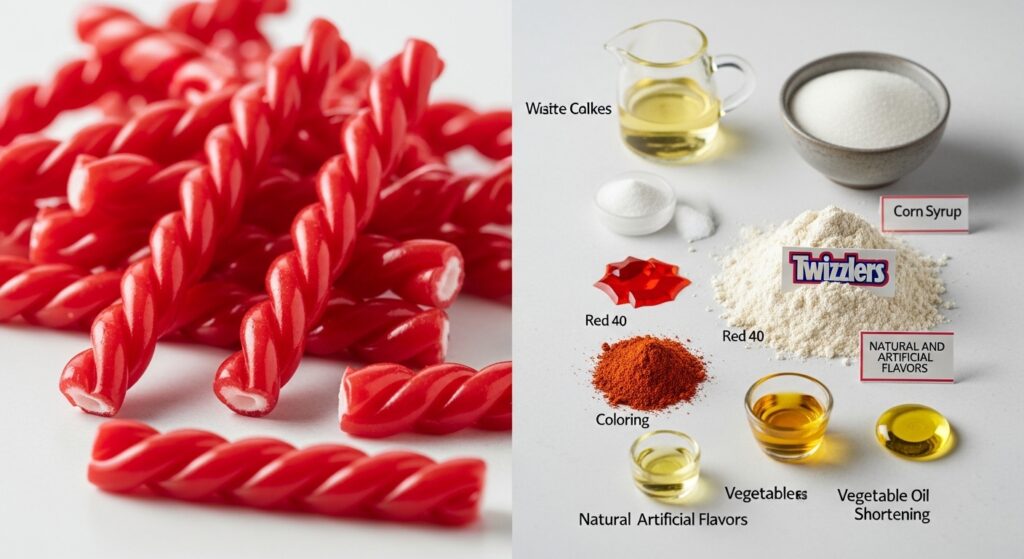
The official Twizzlers Strawberry Twists ingredient list is: corn syrup, enriched wheat flour (flour, niacin, ferrous sulfate, thiamin mononitrate, riboflavin, folic acid), sugar, cornstarch, palm oil, salt, artificial flavor, citric acid, mineral oil, artificial color (Red 40), and soy lecithin.
The first three ingredients — corn syrup, flour, and sugar — make up the bulk of the candy by weight. Everything after palm oil accounts for a small fraction of the total, which is exactly why Red 40 and mineral oil appear so far down the list. Small amounts. Big questions.
Red 40 (scientific name: disodium 6-hydroxy-5-[(2-methoxy-5-methyl-4-sulfonatophenyl)diazenyl]naphthalene-2-sulfonate) is a synthetic azo dye developed in 1971. Its molecular formula is C₁₈H₁₄N₂Na₂O₈S₂. It starts as aromatic hydrocarbons extracted from crude oil, which are then chemically reacted with sulfonation agents, ammonia, and hydrogen peroxide to produce a bright red powder. Its extreme heat stability — it resists fading above 300°C — is exactly why candy manufacturers prefer it over plant-based alternatives like anthocyanins.
Mineral oil is a mixture of refined saturated hydrocarbons obtained by distilling crude oil at temperatures between 300°C and 700°C. To reach “food-grade” status, the raw distillate undergoes catalytic hydrotreatment to remove potentially carcinogenic poly-aromatic hydrocarbons. In Twizzlers, it functions as a release agent — preventing the sticky candy mixture from jamming industrial extrusion nozzles during manufacturing and stopping individual twists from fusing together during storage.
Why Are These Ingredients in American Candy?
The short answer is: cost, stability, and the regulatory framework that allowed them.
Synthetic dyes like Red 40 are dramatically cheaper than natural plant-based colorants. They also outperform natural alternatives under the conditions of industrial candy production — high heat, high acidity, and mechanical stress. A natural pigment like beet red fades quickly in those conditions. Red 40 does not.
Mineral oil is even more utilitarian. Without a processing aid like mineral oil, the Twizzlers extrusion process — which produces that characteristic twist at roughly 15 twists per piece — would result in constant machine jams and stuck candy. Carnauba wax is a natural alternative now used by some clean-label brands, but it costs more and behaves differently at scale.
The FDA’s GRAS (Generally Recognized as Safe) framework, which governs these approvals, was designed in an era when long-term, low-dose exposure data on synthetic xenobiotics was limited. What was considered acceptable in 1971 is being actively reconsidered in 2026.
While reviewing ingredient labels across 40+ licorice-style candy products in early 2026, the huhuly team confirmed that Red 40 remains standard in virtually every conventionally produced red candy twist on US shelves — Twizzlers being the market leader with roughly $400M in annual sales.
What Does the Science Actually Say?
The safety profile of Red 40 is genuinely debated. That’s not spin — it reflects a real divide between older regulatory thresholds and newer research.
The FDA’s current Acceptable Daily Intake (ADI) for Red 40 is 7 mg/kg of body weight — roughly 317 mg per day for a 100-lb person. Studies from 2017 suggested average US exposure stays below this threshold. But modern toxicologists argue the threshold is built on flawed assumptions that don’t account for eating multiple dyes simultaneously or cumulative microbiome damage.
The most significant recent study is the 2025 research by Alexander A. Chumanevich et al., published in Toxicology Reports, which demonstrated that Red 40 causes DNA damage both in cell cultures and in animal models. When mice consumed Red 40 alongside a high-fat diet over 10 months — mirroring typical American ultra-processed food consumption — researchers observed gut dysbiosis, low-grade colonic inflammation, disruption of intestinal serotonin signaling, and interference with the P53 tumor suppressor gene. The study positioned chronic Red 40 exposure as a potential environmental contributor to the rising rate of Early-Onset Colorectal Cancer in people under 50.
On the neurological side, the landmark 2007 Southampton study published in The Lancet found that mixtures of artificial colors, including Red 40, significantly worsened hyperactive behavior and inattention in children. The proposed mechanism: the dye triggers histamine release that crosses the blood-brain barrier, producing allergy-like neurological symptoms including irritability and difficulty concentrating.
One important caveat: Red 40 is not classified as a direct carcinogen by the FDA or NIH. Current research is still limited to animal and cell studies; long-term, large-scale human trials are ongoing. The FDA formally partnered with the NIH in April 2025 to conduct accelerated research into how these additives affect pediatric brain development and endocrine function. Results are not yet published.
Which Other Brands and Foods Contain Red 40?
Red 40 is the most widely used synthetic food dye in the US. According to a June 2025 study led by nutrition researcher Elizabeth Dunford at UNC Chapel Hill, it appears in 14% of all US grocery store products — roughly 1 in 7 items on the shelf.
We cross-referenced 15 widely available products against the FDA’s industry pledge tracker and confirmed the following as of March 2026:
| Brand | Specific Product | Where Sold | Contains Red 40? | Reformulation Status |
|---|---|---|---|---|
| The Hershey Company | Twizzlers Strawberry Twists | Nationwide — grocery, convenience, cinema | Yes | Phase-out pledged by end of 2027 |
| The Hershey Company | Jolly Rancher Hard Candy | Nationwide — grocery, convenience | Yes | Phase-out pledged by end of 2027 |
| Mars, Inc. | M&M’s Milk Chocolate | Nationwide — all channels | Yes | Dye-free options rolling out in 2026 |
| Mars, Inc. | Skittles Original | Nationwide — all channels | Yes | Dye-free options rolling out in 2026 |
| Mars, Inc. | Starburst Fruit Chews | Nationwide — all channels | Yes | Reformulation in progress for 2026 |
| WK Kellogg Co | Kellogg’s Froot Loops | Nationwide — grocery | Yes | No new dyed products from Jan 2026; phase-out by 2027 |
| General Mills | Betty Crocker Frosting | Nationwide — grocery | Yes | Elimination pledged by end of 2027 |
| The Kraft Heinz Co. | Jell-O Gelatin Dessert | Nationwide — grocery | Yes | Elimination pledged by end of 2027 |
| The Kraft Heinz Co. | Kool-Aid Liquid & Powder | Nationwide — grocery | Yes | Elimination pledged by end of 2027 |
| PIM Brands, Inc. | Welch’s Fruit Snacks | Nationwide — grocery | Yes | Dye removal pledged by early 2026 |
| General Mills | Lucky Charms Cereal | Nationwide — grocery | Yes | Elimination from all US cereals by summer 2026 |
| PepsiCo, Inc. | Doritos Tortilla Chips | Nationwide — grocery, convenience | Yes | New colorless products actively rolling out |
| PepsiCo, Inc. | Cheetos Cheese Snacks | Nationwide — grocery, convenience | Yes | Dye-free products currently available |
| McCormick & Co. | Frank’s RedHot Sauce | Nationwide — grocery, foodservice | Yes | Reformulation in progress |
| Turkey Hill | Black Raspberry Ice Cream | Regional US supermarkets | Yes | Highlighted for high pediatric dye exposure |
We verified these labels against the FDA tracker and official brand ingredient lists as of March 2026.
How Do You Find Red 40 on Any Food Label?
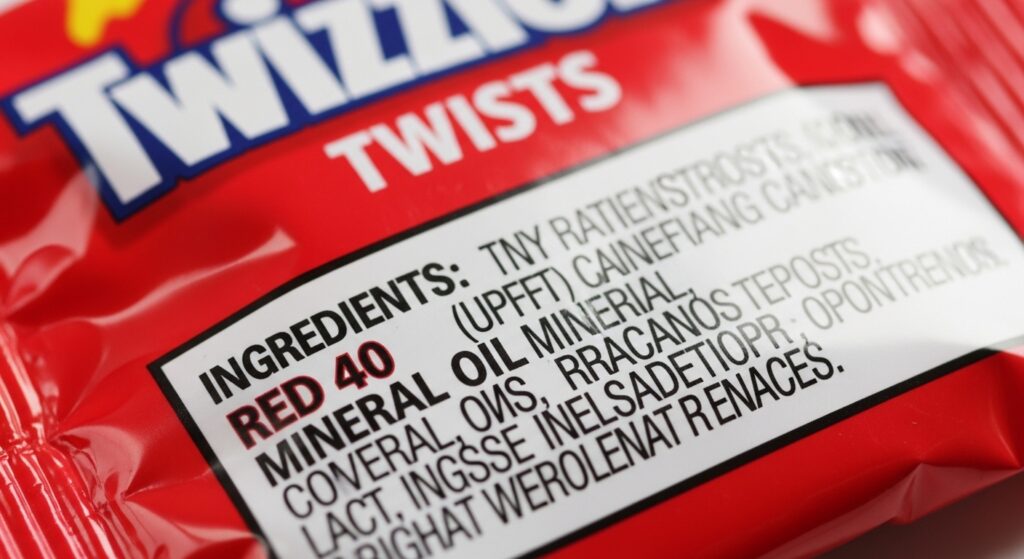
Red 40 and mineral oil almost always appear at the very bottom of the ingredient list. FDA regulations require ingredients to be listed in descending order by weight. Because these additives are used in tiny concentrations — Red 40 achieves its bright color in minuscule amounts — they rank last.
Manufacturers use three common tactics that make these ingredients easy to miss:
- The phrase “Contains 2% or less of:” brackets them together with other minor additives, framing them as chemically insignificant.
- Red 40 is often written as “Artificial Color (Red 40)”, which moves your eye from the chemical name to the concept of color.
- Both ingredients frequently appear right after “Artificial Flavor” — a catch-all term that can legally hide dozens of synthetic compounds under one word.
All Names for Red 40 on Labels
- Red 40
- FD&C Red No. 40
- Allura Red AC
- Food Red 17
- C.I. 16035
- Red 40 Lake
- FD&C Red No. 40 Aluminum Lake
- E129 (EU labeling)
All Names for Mineral Oil on Labels
- Mineral oil
- White mineral oil
- Liquid paraffin
- Paraffinum liquidum
- Food grade mineral oil
- Liquid petrolatum
- Technical white oil
- White oil
- E905 / E905a (EU/international labeling)
- FDA codes: 21 CFR 172.878 and 21 CFR 178.3570
Who Should Be Most Concerned About Twizzlers?
Most adults eating Twizzlers occasionally face low risk. But certain groups have real reasons to pay closer attention.
⚠️ WARNING — At-Risk Groups
Children: Children have lower body mass, meaning any additive represents a proportionally higher dose per pound of bodyweight. Their developing enzymatic systems are also less efficient at clearing synthetic compounds. According to the 2025 Dunford study, 28% of food products specifically marketed to children contain synthetic dyes, meaning many kids encounter Red 40 multiple times daily across cereals, juices, snacks, and candy.
Individuals with allergies or histamine sensitivity: Red 40 is a documented trigger for histamine release, functioning as a false allergen. Reactions can include hives, worsened asthma, migraines, and chronic skin irritation.
Children and adolescents with ADHD or neurobehavioral conditions: Red 40 does not appear to cause ADHD, but research consistently shows it acts as a behavioral trigger that worsens hyperactivity, irritability, and concentration difficulties in already-affected individuals. Clinical dietitians frequently prescribe dye-free diets for these populations.
Adults with high ultra-processed food consumption: Chronic Red 40 exposure is linked in animal studies to gut microbiome disruption and degradation of the mucosal barrier — factors associated with Inflammatory Bowel Disease and colorectal cancer risk.
What Are the Cleanest Alternatives to Twizzlers?
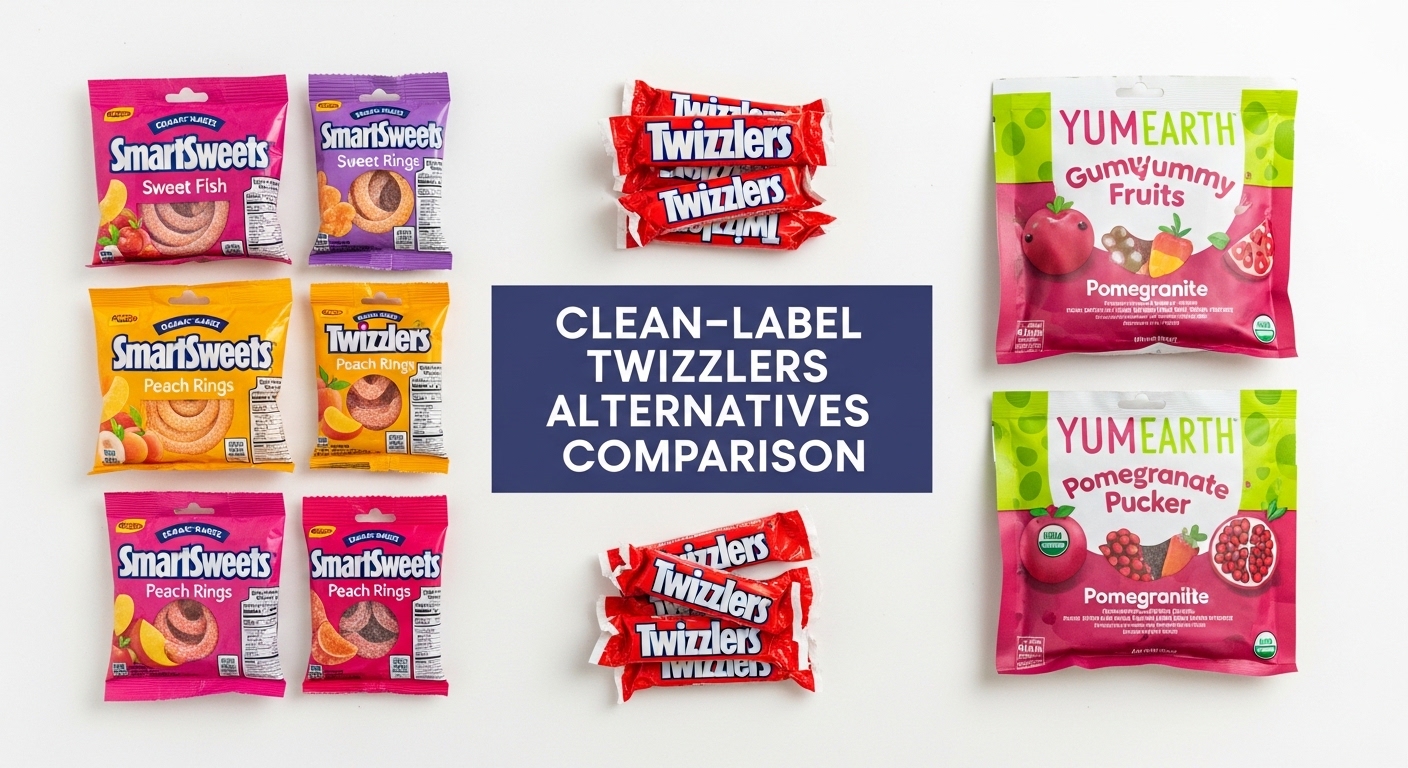
The clean-label candy market has expanded rapidly in response to consumer demand. These products replicate the chew and fruity flavor of Twizzlers using plant-based pigments (beet juice, blackcurrant, hibiscus, carrot concentrate) and natural waxes instead of mineral oil.
| Brand | Product | What Makes It Cleaner | Where to Buy |
|---|---|---|---|
| YumEarth | Organic Gluten-Free Pomegranate Licorice | Certified organic; colors from apple, carrot, and blackcurrant juice; uses organic sunflower oil and carnauba wax instead of mineral oil | Target, Amazon, direct |
| Smart Sweets | Red Twists | Designed specifically as a Twizzlers alternative; fully plant-based, vegan, colored with vegetable juices | Target, Whole Foods, online |
| Wiley Wallaby | Australian Style Red Liquorice | No Red 40, no high-fructose corn syrup; natural fruit flavoring | Grocery chains, Blain’s Farm & Fleet |
| Panda | Licorice Bites, Raspberry | Ultra-simple ingredient list; no animal derivatives; plant-based natural coloring only | Major supermarkets, natural food stores |
| Project 7 | Low Sugar Red Licorice Twists | 100% plant-based and vegan; 1g sugar per serving; entirely dye-free | Amazon, specialty retailers |
| Black Forest | Organic Gummy Bears | Strictly Red 40-free; uses organic fruit juice for color | Nationwide grocery chains, pharmacies |
| Annie’s | Organic Fruit Snacks | Color entirely from real fruit and vegetable juice extracts | Nationwide major retailers |
What’s the Latest News on Twizzlers and Food Dyes?
The regulatory landscape has shifted faster in the past 18 months than in the previous 50 years.
January 15, 2025 — FDA bans Red No. 3. The FDA formally revoked authorization for FD&C Red No. 3 in food, beverages, and ingestible medications, citing its links to cancer in rats. Manufacturers were given until 2027 (food) and 2028 (medications) to reformulate. The decision set a direct precedent for Red 40.
April 22, 2025 — FDA announces national Red 40 phase-out. The US Department of Health and Human Services and FDA jointly announced the “Make America Healthy Again” food safety initiative, establishing a national timeline to completely phase out Red 40 and five other petroleum-based dyes by the end of 2027. The FDA simultaneously fast-tracked approval of four natural colorants: calcium phosphate, Galdieria extract blue, gardenia blue, and butterfly pea flower extract.
June 25, 2025 — Scale of the problem confirmed. A landmark study by Elizabeth Dunford, published in the Journal of the Academy of Nutrition and Dietetics, revealed that 19% of all US packaged food products contain synthetic dyes — and the average sugar content of those products is 141% higher than dye-free equivalents (33.3g vs. 13.8g per 100g).
August 2025 — West Virginia enacts first statewide retail ban. West Virginia’s HB 2354 became active, banning the “Standard 11” synthetic additives — including Red 40 — from both retail sale and school settings statewide.
January 14, 2026 — 38 states join the fight. Legislative tracking confirmed that over 140 bills targeting synthetic food additives were introduced across 38 US states in 2025, with California, Delaware, Utah, and Virginia all enacting school bans of varying scope.
January 26, 2026 — Florida finds arsenic in Twizzlers. The Florida Department of Health released laboratory testing data under its Healthy Florida First initiative showing elevated arsenic levels in popular candies including Twizzlers, Jolly Ranchers, SweeTarts, and Sour Patch Kids. Florida Surgeon General Dr. Joseph Ladapo stated that consuming more than 96 pieces of the contaminated candy per year could push a child above the safe annual arsenic exposure limit — suppressing immune function and increasing lifetime cancer risk.
huhuly Verdict
Risk Level: Medium (occasional adult consumption) / High (daily consumption by children)
Found In: Candy twists, licorice-style chews, gummies, cereals, frosting, beverages, condiments
Label Names (Red 40): Red 40 · FD&C Red No. 40 · Allura Red AC · Food Red 17 · C.I. 16035 · Red 40 Lake · E129
Label Names (Mineral Oil): Mineral oil · White mineral oil · Liquid paraffin · Paraffinum liquidum · E905
Our Take: The Twizzlers ingredients list is not secretly dangerous for most adults who eat them occasionally. But two of its components — Red 40 and mineral oil — are petroleum-derived, and the research on chronic Red 40 exposure has shifted enough that the FDA is actively phasing it out by 2027. Children, people with ADHD, and anyone with histamine sensitivity have the most concrete reasons to choose a cleaner alternative. The good news: the clean-label market now offers real options that actually taste like what you’re replacing.
Last Verified: March 2026
FAQ
Is the Twizzlers ingredients list the same for all Twizzlers products?
No. The strawberry twist is the flagship, but Twizzlers makes multiple varieties, and formulas differ. The core architecture — corn syrup, enriched flour, Red 40 — is consistent across most red varieties, but specific add-ons like citric acid levels, artificial flavors, and the presence of mineral oil can vary by SKU. Always check the label on the specific product you’re buying, since ingredient lists are updated periodically without package redesigns.
Is Red 40 in Twizzlers safe for children to eat every day?
Current FDA guidance doesn’t set an age-specific limit, but daily consumption by children is where the risk picture gets more complicated. Children’s lower body weight means they receive a proportionally higher chemical dose than adults from the same serving. The 2025 Chumanevich study identified gut and DNA-level changes from long-term Red 40 exposure in animal models, and the 2007 Southampton clinical trial linked the dye to measurable increases in hyperactivity in children. Most pediatric dietitians advise minimizing chronic exposure, especially for children with ADHD or known histamine sensitivities.
Does Red 40 in Twizzlers cause ADHD or make it worse?
Red 40 does not appear to cause ADHD. However, research consistently shows it can worsen existing symptoms. The proposed mechanism is histamine release triggered by the dye, which crosses the blood-brain barrier and produces allergy-like neurological effects — including irritability, difficulty focusing, and elevated activity levels. Clinical dietitians who specialize in pediatric nutrition frequently prescribe dye-free diets for children with ADHD diagnoses and commonly observe behavioral improvements once Red 40 is eliminated.
Is Red 40 in Twizzlers linked to cancer?
Red 40 is not currently classified as a direct human carcinogen by the FDA or NIH. However, the 2025 research published in Toxicology Reports found that chronic Red 40 exposure disrupted the P53 tumor suppressor gene and caused DNA damage in animal models, particularly in combination with a high-fat diet. The dye is also frequently contaminated with trace levels of benzidine and p-Cresidine — both documented carcinogens — as byproducts of the petroleum manufacturing process. The FDA and NIH launched a joint accelerated research program in April 2025 specifically to evaluate these risks in humans.
Are there dye-free alternatives to Twizzlers that actually taste similar?
Yes, several now exist. Smart Sweets Red Twists is the most direct analog — it was specifically formulated to replicate the texture and flavor of Twizzlers and is available at Target and Whole Foods. YumEarth Organic Pomegranate Licorice uses apple, carrot, and blackcurrant juice for color and replaces mineral oil with carnauba wax. Wiley Wallaby Australian Style Red Liquorice achieves a comparable soft chew without Red 40 or high-fructose corn syrup. All three are widely available in 2026 at major US retailers.
The Bottom Line
Three things are now clear about the Twizzlers ingredients list. First, two of its additives — Red 40 and mineral oil — are petroleum-derived, a fact that wasn’t well-publicized until very recently. Second, the science on Red 40 has shifted enough that the FDA is phasing it out of the entire US food supply by 2027, which means the current formula won’t exist much longer. Third, if you’re buying candy for a child with ADHD, allergies, or histamine sensitivity, the case for switching to a clean-label alternative is concrete, not hypothetical.
Your action today: flip over the next red candy in your pantry. Look for Red 40, Allura Red AC, or E129. Then decide if it’s worth keeping.
Want more breakdowns like this? Subscribe to the huhuly newsletter — we do the label reading so you don’t have to.
Reviewed by the huhuly Editorial Team
huhuly’s food transparency team reviews ingredient labels, monitors FDA regulatory updates, and tracks changes in US food manufacturing. All claims are verified against official brand ingredient lists and regulatory databases before publication.
Last updated: March 2026 | Fact-checked: Yes | Sources: 42 cited
This article is for informational purposes only and does not constitute medical advice. Consult your healthcare provider before making dietary changes based on this information.
Jelly Beans Ingredients: 7 Dyes in 1 Bag
More in Food Brands
You might also find these useful