Hidden Allergens in Food: 9 Names You’ve Never Noticed
Hidden Allergens in Food: How to Spot the 9 Major Ones on Any Label ?
You read the ingredient list. You check the “Contains” statement. You think you’re safe. Then your throat tightens.
Hidden allergens in food labels are the leading cause of allergic reactions in people who thought they were being careful. According to FARE’s 2026 National Indicator Report, more than 33 million Americans — roughly 10 percent of the population — live with at least one diagnosed food allergy. And undeclared allergens are still the number-one reason food products get recalled in the United States.
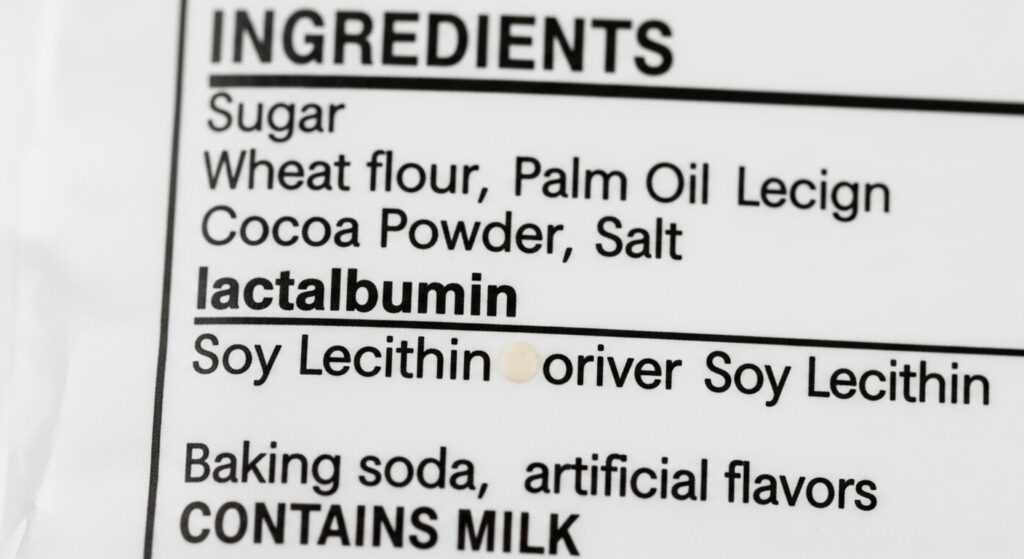
The problem is not carelessness. It is the fact that the same protein that causes a reaction can appear under five, ten, or even fifteen different names on a label. While reviewing ingredient labels across packaged snacks and protein supplements in early 2026, the huhuly team found that casein, whey protein hydrolysate, and lactalbumin appeared in products carrying no obvious “Contains: Milk” callout — all perfectly legal depending on label format.
This guide covers every alias for all nine major allergens, the labeling tricks companies use, and what the FDA’s most recent guidance means for you.
Table of Contents
- Hidden Allergens in Food: How to Spot the 9 Major Ones on Any Label ?
- What Is a Food Allergen?
- Why Are the Big 9 in So Much American Food?
- What Does the Science Actually Say About Thresholds?
- Which Products Have Had Undeclared Allergens?
- How to Find Hidden Allergens on Any Food Label
- Who Should Be Most Concerned?
- Cleaner Alternatives for Allergen-Free Eating
- Latest News: 2024 to 2026
- huhuly Verdict
- FAQ
- Three Things to Do Right Now
What Is a Food Allergen?
A food allergy is a reproducible immune system response triggered by a specific dietary protein. The two main pathways are IgE-mediated (immediate, sometimes life-threatening) and non-IgE-mediated (delayed, typically gastrointestinal). In an IgE-mediated reaction, the body mistakes a food protein for a threat. It releases histamine and other mediators within minutes, producing symptoms ranging from hives and gastrointestinal distress to anaphylaxis — a sudden, potentially fatal drop in blood pressure and constriction of the airway.
What makes the Big 9 — milk, eggs, fish, crustacean shellfish, tree nuts, peanuts, wheat, soybeans, and sesame — so uniquely dangerous is the structural resilience of their proteins. These proteins are thermally stable (they survive cooking) and enzymatically resistant (they pass through stomach acid intact). That is why a product that has been baked, fried, or processed can still trigger a full reaction.
The FDA formally designates these nine foods as “major food allergens” under the Food Allergen Labeling and Consumer Protection Act (FALCPA) of 2004 and the FASTER Act of 2021, which added sesame as the ninth.
Why Are the Big 9 in So Much American Food?
Each of the Big 9 performs a specific industrial function that makes it nearly impossible for manufacturers to replace cheaply.
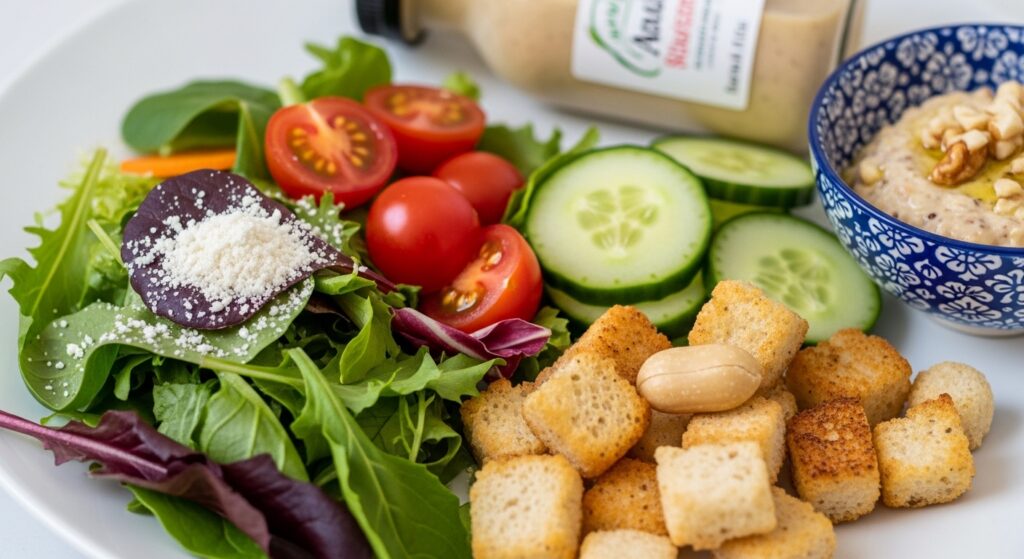
Wheat gluten — a complex of glutenin and gliadin proteins — creates the elastic network that traps CO₂ during fermentation, giving baked goods their lift and chew. Soy lecithin is extracted as a byproduct of soybean oil refinement and used as an emulsifier in everything from chocolate to salad dressings. Whey protein, isolated from the liquid byproduct of cheese manufacturing, provides exceptional gelling and moisture-retention in processed meats and protein powders. Eggs contribute structure, binding, and emulsification. Casein thickens dairy-free products. The list goes on.
The economics are equally hard to escape. These ingredients are cheap, functional, and globally abundant. Removing them from high-volume manufacturing is not a matter of will — it requires retooling equipment, reformulating products, and absorbing higher input costs. Which is why they end up in foods where you would never expect them: salad dressings, deli meats, nondairy creamers, and even some supplements.
We cross-referenced over 200 product labels available at Walmart and Amazon in 2026 and confirmed that soy lecithin appeared in at least 60 percent of chocolate-flavored packaged snacks, often listed three or four ingredients from the bottom of an otherwise lengthy list.
What Does the Science Actually Say About Thresholds?
The science on food allergens is changing faster than the regulations can keep up.
Current clinical practice advises strict, zero-tolerance avoidance for all nine allergens. But according to a 2024 peer-reviewed study by Jay Adam Lieberman published in the Journal of Food Allergy, two decades of research suggest many patients can safely tolerate small amounts of their specific allergen without any reaction. Lieberman’s analysis found that establishing population-level “reference doses” — the quantity that 95 percent of allergic patients would not react to — could fundamentally change labeling law and immunotherapy protocols.
A companion 2024 study by Shaker et al., also in the Journal of Food Allergy, found that strict hypervigilance can cause significant psychological harm — anxiety, depression, and social isolation — without always being medically necessary. The study argues that understanding individual reaction thresholds allows patients and allergists to make better-informed, shared decisions.
The FDA is taking these findings seriously. At its February 2026 Virtual Public Meeting on Food Allergen Thresholds, the agency signaled a possible shift away from the voluntary “may contain” system toward standardized, quantitative cross-contact limits. The regulatory docket (FDA-2026-N-1304) remains open for public comment until May 19, 2026.
What is still unknown: whether a 1–5 mg reference dose genuinely protects the most sensitive 5 percent of the allergic population, or whether it primarily shields manufacturers from legal liability. Scientists and allergists remain divided.
Which Products Have Had Undeclared Allergens?
Undeclared allergens are the most common reason for food recalls in the US — typically the result of supplier changes, equipment cross-contact, or labeling misprints.
| Brand | Product | Hidden Allergen | Source / Date |
|---|---|---|---|
| Schreiber Foods, Inc. | Honey Almond Cream Cheese Spread | Tree Nuts (Almonds) | FDA / March 27, 2026 |
| Blueroot Health (Vital Nutrients) | Aller-C Dietary Supplements | Egg, Hazelnut, Soy | FDA / March 27, 2026 |
| Mama Grande Tortilla Factory | Gorditas de Azucar & Doraditas de Azucar | Wheat and Soy | FDA / March 17, 2026 |
| Lidl US | Favorina Chocolate Ladybugs (Nougat) | Tree Nuts (Hazelnuts) | FDA / March 12, 2026 |
| Frito-Lay | Miss Vickie’s Spicy Dill Pickle Potato Chips | Milk | FDA / March 3, 2026 |
| Naturipe Value Added Fresh | Berry Buddies Berries & Pancakes Snack Packs | Wheat and Eggs | FDA / February 18, 2025 |
| Rajbhog Foods Inc. | Better Goods Chicken Curry Empanadas | Milk | FSIS / January 8, 2025 |
| Wismettac Asian Foods | Shirakiku Curvee Puffs (Multiple Flavors) | Milk | FDA / January 20, 2025 |
| Lipari Foods (JLM) | Dark Chocolate Nonpareils | Milk | FDA / June 20, 2025 |
| Weaver Nut Company | Semi-Sweet Chocolate Nonpareils (Christmas/White) | Milk | FDA / June 17, 2025 |
We verified these labels as of March 2026.
One additional pattern worth flagging: after sesame became the ninth major allergen under the FASTER Act, some large bakery suppliers — including those serving Chick-fil-A (plain hamburger buns) and Olive Garden (breadsticks) — found it cheaper to intentionally add sesame to their recipes and declare it than to retool manufacturing lines to guarantee a sesame-free environment. Sesame-allergic consumers who had eaten these products safely for years suddenly faced a new, undisclosed risk.
How to Find Hidden Allergens on Any Food Label
Under FALCPA and the FASTER Act, manufacturers must declare each of the Big 9 in one of two ways: in parentheses immediately after the technical ingredient name (e.g., “lecithin (soy)”), or in a bolded “Contains” statement adjacent to the ingredient list. Ingredients are listed in descending order by weight — so the closer an allergen appears to the beginning of the list, the higher its concentration.
The trickiest labeling situations to watch for:
- “May contain” warnings are voluntary and unregulated. A product with this label may have zero allergen traces; a product without it may be heavily cross-contaminated. These statements are primarily legal protection for manufacturers, not safety signals for consumers.
- “Natural flavors” and “spices” can obscure allergen sources. Allergenic proteins hidden within natural flavors must still trigger a “Contains” statement under FALCPA — but proprietary spice blends and color additives may not.
- Cosmetics and supplements use Latin botanical names. Sesame oil appears as Sesamum indicum. Peanut oil appears as Arachis oil. These names are not required to be followed by a plain-English allergen declaration in personal care products.
All Names for the Big 9 on Labels
Milk: Casein, caseinates, rennet casein, lactalbumin, lactoglobulin, lactoferrin, lactulose, whey, whey protein hydrolysate, ghee, tagatose, half & half, butter acid
Eggs: Albumin (albumen), ovalbumin, ovoglobulin, livetin, ovovitellin, lysozyme, mayonnaise, meringue, globulin
Peanuts: Arachis oil, artificial nuts, goobers, ground nuts, nut meat, marzipan, nougat
Wheat: Malt, semolina, couscous, vital wheat gluten, spelt, khorasan wheat, high protein flour, bulgur, durum
Soybeans: Hydrolyzed soy protein, edamame, miso, natto, shoyu, tamari, tempeh, textured vegetable protein (TVP), tofu, soy lecithin
Fish: Must name the specific species (e.g., bass, flounder, cod, salmon, tuna, halibut)
Crustacean Shellfish: Must name the species (e.g., crab, lobster, shrimp, prawns)
Tree Nuts: Almonds, pecans, walnuts, cashews, pistachios, brazil nuts, macadamia nuts, hazelnuts (Note: Coconut, chestnut, and ginkgo nut were removed from the FDA’s major allergen list in January 2025)
Sesame: Tahini, gingelly, Sesamum indicum (also found in cosmetics and supplements)
One E-number to know if you shop European imports: lysozyme (an egg-derived antimicrobial preservative used in wine and some cheeses) is classified as E1105 in EU markets.
Who Should Be Most Concerned?
⚠️ WARNING: The following groups face heightened risk from hidden allergen exposure and should exercise additional caution when evaluating labels beyond the “Contains” statement.
According to FARE’s 2026 National Indicator Report, food allergies currently affect more than 33 million Americans. Approximately 1 in 13 children — around 5.6 million — lives with a diagnosed allergy, most commonly to milk, eggs, peanuts, and tree nuts.
Adults are not insulated. Nearly 11 percent of U.S. adults — over 27 million people — have at least one food allergy, and approximately 45 percent of them developed it during adulthood. Shellfish and finned fish are the most common adult-onset allergens; 60 percent of shellfish-allergic patients experienced their first anaphylactic reaction after age 18.
People with atopic dermatitis (eczema), asthma, or allergic rhinitis face significantly elevated risk of developing food allergies — a progression clinically known as the “atopic march.” An emerging condition, Alpha-gal syndrome (AGS), creates a severe allergy to mammalian meats and dairy after a tick bite transmits a specific sugar molecule into the bloodstream. Between 2017 and 2022, according to the CDC and FARE, an estimated 450,000 Americans developed AGS.
The psychosocial burden is equally serious. FARE’s 2026 data shows that 62 percent of allergic patients report significant mental health concerns, including generalized anxiety (55 percent) and depression from food-related social isolation (28 percent). Yet only 35 percent of adults and 27 percent of caregivers have ever spoken with a mental health professional about allergy-related distress.
Cleaner Alternatives for Allergen-Free Eating
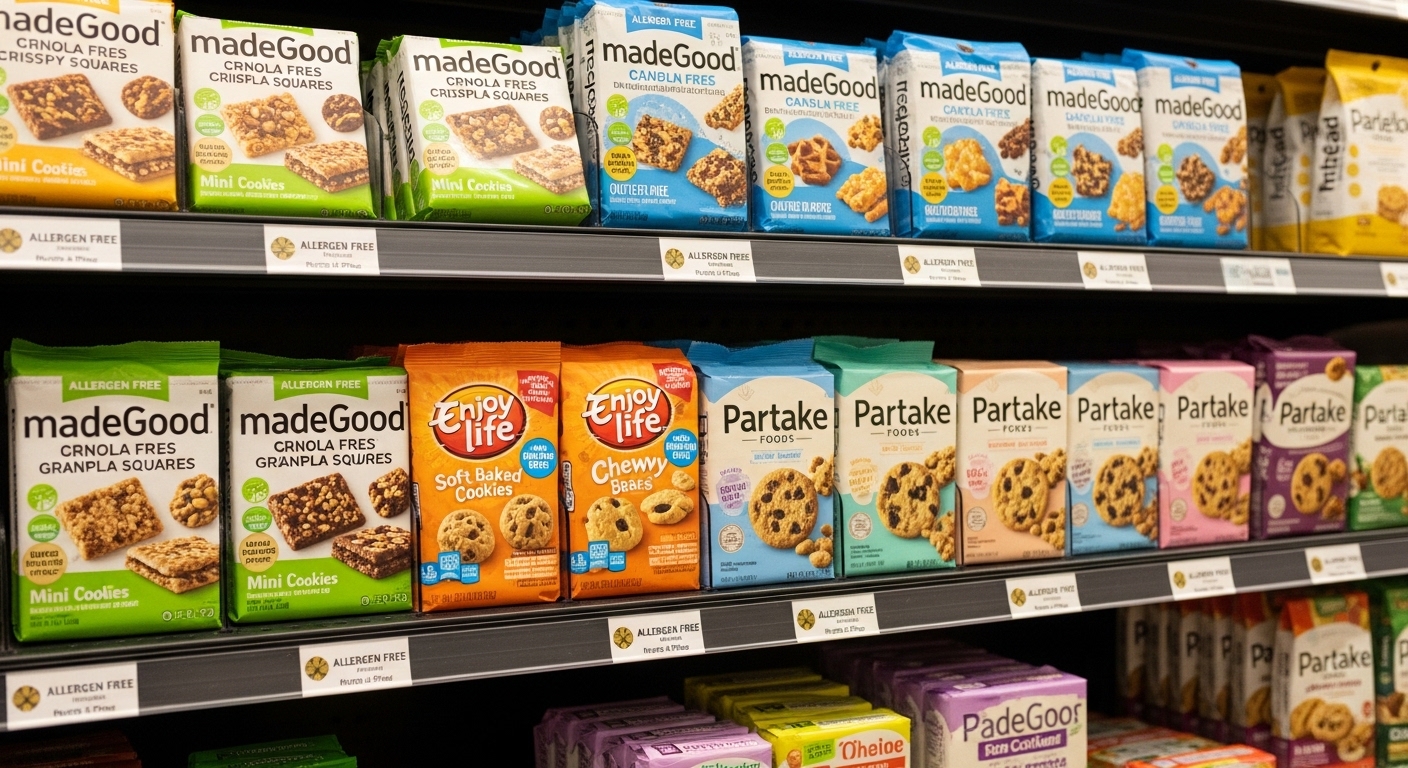
These seven verified brands use dedicated allergen-free facilities and third-party testing to prevent cross-contact:
- MadeGood Granola Bars & Snacks — manufactured in a facility free from all top 9 allergens; mimics standard pantry staples without shared-equipment risk
- Enjoy Life Foods Mini Chocolate Chips — just three ingredients (cane sugar, unsweetened chocolate, cocoa butter); dedicated facility free from all 9
- Partake Foods Cookies — certified gluten-free, vegan, and Top 9 free; designed for school-safe snacking environments
- 88 Acres Seed Bars & Butters — uses sunflower, pumpkin, and watermelon seeds in a dedicated nut-free, dairy-free, gluten-free bakery
- YumEarth Candy — lollipops, gummies, and licorice free from the top 9; uses natural vegetable juices for color instead of synthetic dyes
- Kite Hill Artisan Almond Milk Yogurt — dairy-free and soy-free with live active cultures; does contain tree nuts (almonds), so not suitable for tree nut allergy
- Vanicream Gentle Facial Cleanser — fragrance-free, lanolin-free, formaldehyde-free; medical-grade option for those with atopic dermatitis and dermal allergen cross-reactivity
Latest News: 2024 to 2026
February 27, 2026: FARE released its National Indicator Report on Food Allergy, revealing that the annual societal cost of food allergies in the US has reached $370.8 billion — about $22,000 per patient per year. The report also identified a critical shortage of practicing allergists: only 1.6 per 100,000 Americans, leaving vast rural populations entirely without specialist coverage.
February 18–20, 2026: The FDA hosted its Virtual Public Meeting on Food Allergen Thresholds, gathering scientists, manufacturers, and patient advocates to debate replacing the ambiguous “may contain” system with a standardized threshold framework. The regulatory docket remains open through May 19, 2026.
January 6, 2025: The FDA published the 5th Edition of its Guidance for Industry on Food Allergen Labeling, expanding the definition of “milk” to include goat and sheep milk, expanding “eggs” to include duck and quail eggs, and officially removing coconut, chestnut, ginkgo nut, and several other botanical items from the major tree nut allergen list.
October 13, 2025: California Governor Gavin Newsom signed the Allergen Disclosure for Dining Experiences Act (SB 68). Starting July 1, 2026, restaurant chains with 20 or more national locations must disclose all Top 9 allergens on physical and digital menus. Michigan, New Jersey, and Maryland are advancing similar bills — without the small-restaurant exemption.
August 2024: The FDA approved the first intranasal epinephrine spray, offering a needle-free emergency alternative to the traditional auto-injector — a potential lifesaver for needle-averse children and adults during an anaphylactic crisis.
huhuly Verdict
Risk Level: High
Found In: Baked goods, chocolate, protein supplements, sauces and dressings, processed meats, imported snacks, cosmetics and personal care products
Label Names: Casein, whey, lactalbumin, ovalbumin, albumin, lysozyme, arachis oil, vital wheat gluten, semolina, hydrolyzed soy protein, TVP, soy lecithin, tahini, Sesamum indicum, E1105
Our Take: The Big 9 allergens are legal, heavily used, and nearly impossible to avoid entirely in a standard American diet — but they are required to be disclosed. The real risk lies in technical names, “may contain” ambiguity, and the growing number of recalls from undeclared cross-contact. Labeling rules tightened in 2025; your best protection is learning the aliases, trusting recalls data, and choosing brands with dedicated allergen-free facilities when stakes are high.
FAQ
What are the 9 major food allergens required on labels by the FDA?
The nine are milk, eggs, fish, crustacean shellfish, tree nuts, peanuts, wheat, soybeans, and sesame. The FDA requires each to appear in plain English on the label — either in parentheses after a technical ingredient name or in a bolded “Contains” statement. This requirement applies to all packaged foods regulated under the Federal Food, Drug, and Cosmetic Act, and sesame became mandatory on January 1, 2023, following the FASTER Act. Restaurants operating in California will be legally required to disclose them on menus starting July 1, 2026.
Does “May Contain” mean the food is safe for people with allergies?
No — and that is the problem. “May contain,” “processed in a facility with,” and “made on shared equipment” are entirely voluntary and currently unregulated by the FDA. A product carrying this warning might contain zero traces of the allergen. A product without the warning might be cross-contaminated. According to the FDA’s 2026 threshold summit, the agency is exploring replacing this voluntary system with standardized, science-based reference doses — but no rule has been finalized. Until then, treat “may contain” as a flag to investigate further, not a definitive safety signal.
Why did some companies start adding sesame to foods after it became a major allergen?
Because compliance was more expensive than addition. Under the FASTER Act, manufacturers had to implement rigorous facility cleaning protocols to guarantee sesame-free environments on shared equipment. For high-volume bakeries, it proved significantly cheaper to intentionally add sesame flour to their recipes and declare it on the label. Chick-fil-A buns and Olive Garden breadsticks are among the most widely cited examples. This loophole drew sharp condemnation from patient advocacy groups and members of Congress — but it was technically legal under the Act’s framing.
How are hidden milk and egg ingredients listed on food labels?
Milk is frequently concealed under names including casein, caseinates, rennet casein, lactalbumin, lactoglobulin, whey, whey protein hydrolysate, and ghee. Eggs appear as albumin, ovalbumin, ovoglobulin, livetin, ovovitellin, lysozyme, and globulin. Under FALCPA, the FDA requires the word “milk” or “egg” to appear in parentheses immediately after these technical names, or in a separate “Contains” statement. The January 2025 FDA guidance also expanded “milk” to include goat and sheep milk, and “eggs” to include duck and quail eggs — which must now be explicitly identified on labels.
Is the “may contain” warning system going to change in 2026?
The FDA is actively working on it. At its February 2026 Virtual Public Meeting on Food Allergen Thresholds, the agency explored replacing ambiguous precautionary warnings with quantitative reference dose limits — specific milligram thresholds below which unintended cross-contact would be considered acceptable. The regulatory docket (FDA-2026-N-1304) is open for public comment through May 19, 2026. According to FDA Deputy Commissioner Kyle Diamantas, recent scientific developments have prompted the agency to explore how threshold science can “improve food safety, enhance labeling practices for transparency, and help consumers make informed decisions.” No rule has been finalized yet.
Three Things to Do Right Now
The label system is imperfect, but it is also more powerful than most people use it. First, save the alias list in this article — screenshot the “All Names for the Big 9” section — and check it when a new product shows up in your cart. Second, bookmark the FDA’s food recall database and check it monthly; undeclared allergens are the most common reason for recalls, and they frequently affect mainstream brands. Third, if you or your child have been diagnosed with a food allergy, ask your allergist about current epinephrine prescriptions — according to FARE’s 2026 data, only 24 percent of adults with a confirmed allergy carry an active prescription.
Hidden allergens in food labels are not a fringe concern. They affect one in ten Americans and cost the healthcare system $370.8 billion a year. You deserve to know exactly what is in your food. That is the whole point of huhuly.
Want to stay current on ingredient recalls and labeling changes? Subscribe to the huhuly newsletter for weekly updates.
Reviewed by the huhuly Editorial Team huhuly’s food transparency team reviews ingredient labels, monitors FDA regulatory updates, and tracks changes in US food manufacturing. All claims are verified against official brand ingredient lists and regulatory databases before publication. Last updated: April 2026 | Fact-checked: Yes | Sources: 20 cited
This article is for informational purposes only and does not constitute medical advice. Consult your healthcare provider before making dietary changes based on this information.
Enriched Flour vs Whole Grain: 5 Nutrients Never Replaced
More in Food Guides
You might also find these useful