Kellogg’s Corn Flakes Ingredients: Is BHT in There?
Kellogg’s Corn Flakes Ingredients: The 2026 Label Check
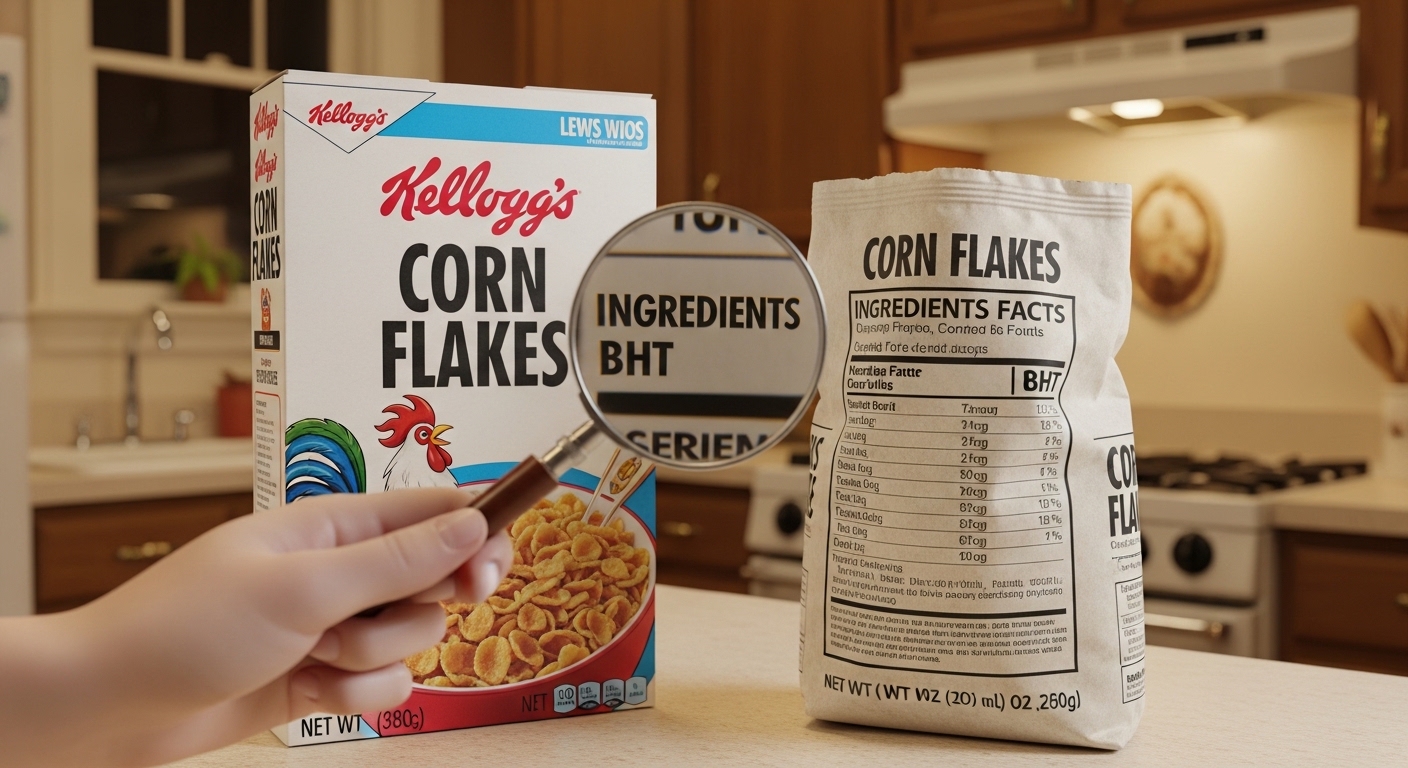
You picked up a box of Kellogg’s Corn Flakes and wondered: is BHT hiding in there? It’s a fair question — and the answer is more nuanced than a yes or no.
The classic Corn Flakes box does not contain BHT in its ingredient list. The verified 2026 U.S. label lists only milled corn, sugar, malt flavor, salt, and a blend of vitamins and minerals. That’s it. But if you’re worried about does kellogg’s corn flakes contain BHT in 2026, you also need to know what’s happening with other Kellogg’s cereals — and why this preservative is suddenly front-page news.
While reviewing ingredient labels across popular breakfast cereals in 2026, the huhuly team confirmed that BHT is absent from classic Corn Flakes but present in several other Kellogg’s products that are still widely sold at Walmart and Target.
Table of Contents
- Kellogg’s Corn Flakes Ingredients: The 2026 Label Check
- What Is BHT?
- Why Is BHT in American Food?
- What the Science Actually Says
- Which Brands and Foods Contain BHT?
- How to Find BHT on Any Food Label
- Who Should Be Most Concerned?
- Cleaner Alternatives
- Latest News — 2024 to 2026
- huhuly Verdict
- FAQ
- The Bottom Line
What Is BHT?
Butylated hydroxytoluene (BHT) is a synthetic antioxidant used to prevent fats and oils from going rancid. It doesn’t occur naturally. It’s manufactured through a controlled chemical reaction between two petroleum-derived precursors — p-cresol and isobutylene.
Its job in food is simple: extend shelf life. Because BHT dissolves in fat, it’s either mixed directly into oily products or sprayed onto the inner surface of packaging liners. In breakfast cereals, it stops the trace oils in milled grain from oxidizing — which is what causes that stale, rancid taste in old cereal.
BHT has been classified as Generally Recognized as Safe (GRAS) by the FDA since 1959. In the EU, it is regulated under Regulation (EC) No 1333/2008 and evaluated by the European Food Safety Authority (EFSA). In Europe, the safety bar is considerably higher than in the U.S.
Why Is BHT in American Food?
For manufacturers, BHT solves a real problem cheaply. Corn-based cereals contain trace oils that turn rancid within weeks at room temperature. BHT extends that window to 12 months or more — critical for a product sitting in a warehouse, then a truck, then a store shelf, then your pantry.
The FDA permits BHT at a maximum of 0.02% of the food’s total fat content. At that concentration, it costs almost nothing to add and saves millions in product spoilage.
But here’s where it gets complicated. Kellogg’s reformulated its products for the European market years ago, removing BHT and artificial dyes. Those same products are still sold with BHT in the U.S. That double standard became a flashpoint in 2024 and 2025 as consumer backlash intensified.
We cross-referenced product labels available at Walmart and Target and confirmed that the discrepancy between U.S. and European formulations applies specifically to Kellogg’s extruded sugary cereals — not to classic Corn Flakes, which appears to have a simpler, cleaner formulation on both sides of the Atlantic.
What the Science Actually Says
The honest answer: the science on BHT is genuinely mixed, and anyone who tells you it’s perfectly safe or definitely harmful is overstating what we actually know.
Animal studies have linked chronic BHT exposure to liver and kidney harm. Pulmonary toxicity studies found that subcutaneous doses ranging from 0 to 250 mg/kg induced significant changes in lung weight in male mice — though those doses are far above typical dietary exposure. A 2025 ecotoxicology study published in Environmental Research documented oxidative stress, neurotoxicity, and immunotoxicity in clams exposed to BHT.
On the other side, a peer-reviewed study in mice found that dietary BHT actually reduced the severity of allergic anaphylaxis — decreasing IgE response and mast cell degranulation. That finding directly contradicts clinical reports of BHT triggering histamine release in humans with atopic conditions.
According to the FDA’s Human Foods Program, BHT is explicitly slated for rigorous re-evaluation in 2026 following the launch of a formal post-market safety assessment program. The National Toxicology Program has not yet assigned BHT a carcinogenic designation, though closely related BHA is listed as “reasonably anticipated to be a human carcinogen.”
The French food safety agency ANSES went further in 2021, issuing a formal opinion that BHT may function as an endocrine disruptor by interfering with thyroid hormone metabolism in rats. Whether that translates to human risk at dietary exposure levels is still unproven.
Current research on BHT’s endocrine effects in humans at typical dietary concentrations is still limited to animal models and theoretical frameworks. That gap matters.
Which Brands and Foods Contain BHT?
Kellogg’s Corn Flakes: No BHT. The verified April 2026 U.S. ingredient list contains no BHT. But several other Kellogg’s cereals do.
| Brand | Product | Category | Contains BHT? | Verified |
|---|---|---|---|---|
| Kellogg’s | Corn Flakes | Breakfast Cereal | No | WK Kellogg Co. / SmartLabel, April 2026 |
| Kellogg’s | Froot Loops | Breakfast Cereal | Yes | Texas AG Investigation / EWG |
| Kellogg’s | Frosted Flakes | Breakfast Cereal | Yes | Texas AG Investigation |
| Kellogg’s | Rice Krispies | Breakfast Cereal | Yes | Texas AG Investigation |
| Kellogg’s | Apple Jacks | Breakfast Cereal | Yes | EWG Analysis |
| Quaker Oats | Cap’n Crunch | Breakfast Cereal | Yes | EWG Analysis |
| Cheez-It | Cheez-It Crackers | Snack Crackers | Yes | Manufacturer label |
| Biscoff | Biscoff Cookies | Baked Goods | Yes | Manufacturer label |
| Boulder Canyon | Potato Chips | Snack Foods | Yes | Manufacturer label |
| Betty Crocker | Packaged Snack Mixes | Baked Goods | Yes | Manufacturer label |
| Black Forest | Fruit Snacks | Candy/Snacks | Yes | Manufacturer label |
We verified these labels as of April 2026.
How to Find BHT on Any Food Label
BHT almost always appears at the very end of the ingredient list — after vitamins, minerals, and fortification blends — because FDA rules cap it at 0.02% of fat content, making it one of the smallest-quantity ingredients by weight.
Names BHT appears under on U.S. labels:
- BHT (most common — almost always the acronym)
- Butylated hydroxytoluene
- 2,6-di-tert-butyl-4-methylphenol
- 2,6-di-tert-butyl-p-cresol
- Dibutylhydroxytoluene
- 3,5-di-tert-hydroxytoluene
EU and regulatory documents may also use:
- E321 (European E-number)
All Names for BHT on Labels
- BHT
- Butylated hydroxytoluene
- 2,6-di-tert-butyl-4-methylphenol
- 2,6-di-tert-butyl-p-cresol
- Dibutylhydroxytoluene
- 3,5-di-tert-hydroxytoluene
- E321
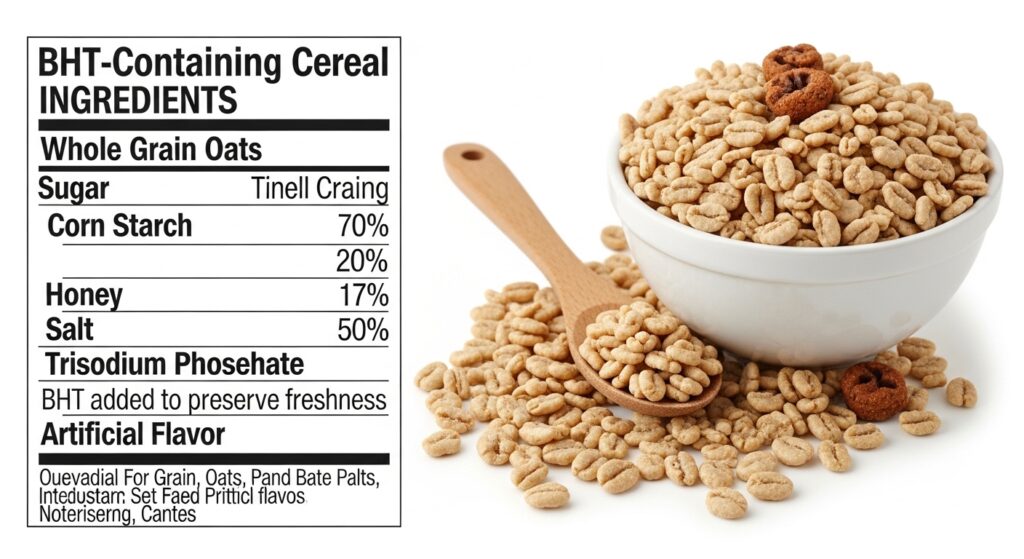
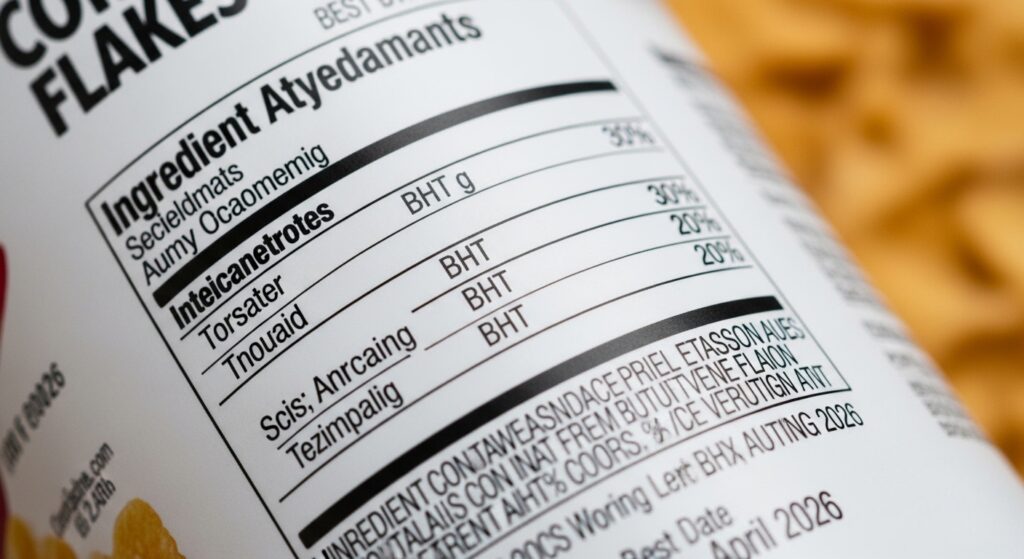
Watch for this tricky tactic: BHT can be applied to the interior of cereal bag liners rather than added directly to the food. When that happens, manufacturers are permitted to list it parenthetically at the very end of the ingredient deck using phrases like “BHT added to packaging to preserve freshness” or “Freshness preserved by BHT.” That phrasing reframes a synthetic chemical additive as a benign packaging feature — and most shoppers scan right past it.
Who Should Be Most Concerned?
Most healthy adults consuming BHT at typical dietary levels face low immediate risk. But two groups warrant extra caution.
⚠️ WARNING — At-Risk Groups
Children: BHT is lipophilic, meaning it accumulates in fat tissue over time. Pediatric populations have lower body mass, faster metabolisms, and rapidly developing endocrine and reproductive systems — making them more vulnerable to prolonged, low-dose synthetic antioxidant exposure from daily cereal consumption.
People with atopic conditions: Individuals with chronic asthma, allergic rhinitis, or a history of idiopathic urticaria (hives) show significantly higher reactivity to BHT. Placebo-controlled clinical trials have linked BHT ingestion to acute onset of hives, headaches, and fever in sensitive individuals by triggering histamine and leukotriene release from mast cells.
Pregnant women: Given the unresolved endocrine disruption hypothesis from ANSES and the bioaccumulation concern, limiting unnecessary BHT exposure during pregnancy is a reasonable precaution while research continues.
One more exposure route most people don’t think about: indoor dust. A study analyzing 339 dust samples from homes across 12 countries found BHT in 99.5% of them. Estimated daily intake from inadvertent dust ingestion alone ranges from 0.40 to 222 ng/kg of body weight per day — completely separate from anything you eat.
Cleaner Alternatives
If you want to avoid BHT in your cereal bowl entirely, these verified options are free of synthetic antioxidants:
| Brand | Product | BHT-Free Reason | Where to Buy |
|---|---|---|---|
| Nature’s Path | Organic Corn Flakes | Certified organic; uses no synthetic preservatives or processing chemicals | Whole Foods, major grocers |
| Cascadian Farm | Organic Purely O’s | 100% organic, non-GMO; no synthetic dyes or preservatives | Major grocers, online |
| Seven Sundays | Oat Protein Cereal (Simply Honey) | Uses upcycled oat protein; free of refined sugars, BHT, and artificial flavors | Whole Foods, Thrive Market |
| Lovebird | Grain-Free Cereal | Formulated for Paleo/AIP diets; whole-food ingredients only | Specialty grocers, online |
| Purely Elizabeth | Superfood Granola | Natural whole grains and superfoods; no synthetic antioxidant preservatives | Major grocers |
| Kashi | Go Vegan Toasted Berry Crisp | Explicitly free of BHA, BHT, and artificial preservatives | Major grocers |
| Bob’s Red Mill | Muesli (Hot & Cold) | Whole-grain blend with no synthetic extrusion chemicals | Major grocers |
Latest News — 2024 to 2026
February 10, 2026 — FDA launches formal review of BHA, confirms BHT is next. The FDA’s Human Foods Program announced a post-market safety assessment of BHA and confirmed BHT is explicitly queued for re-evaluation. FDA Commissioner Dr. Marty Makary stated the agency would remove chemicals that fail modern safety standards. HHS Secretary Robert F. Kennedy Jr. called it the end of the “trust us” era in food safety.
January 20, 2026 — EFSA tightens food additive standards. The European Food Safety Authority published updated Scientific Guidance on Food Additives requiring comprehensive toxicology, genotoxicity, and exposure data for all synthetic additives. New rules apply to all submissions from July 20, 2026 onward — far outstripping current U.S. testing requirements.
February 16, 2026 — Texas and West Virginia food additive laws blocked by federal courts. Texas (SB 25) and West Virginia (HB 2354) both passed legislation restricting BHT and other synthetic additives in food. Both were halted by federal preliminary injunctions — Texas citing First Amendment compelled-speech concerns, West Virginia on vagueness grounds. West Virginia is appealing to the Fourth Circuit as of April 2026.
April 2025 — Texas AG opens investigation into Kellogg’s. Attorney General Ken Paxton announced a consumer protection investigation into WK Kellogg Co., alleging the company markets cereals like Froot Loops and Apple Jacks as “healthy” while including BHT and artificial dyes — ingredients already removed for the European market.
October 2024 — 400,000 petitions delivered to Kellogg’s headquarters. Food investigator Vani Hari, following viral testimony before a U.S. Senate Roundtable in September 2024, delivered petitions directly to Kellogg’s Battle Creek headquarters demanding BHT removal from cereal packaging.
huhuly Verdict
Risk Level: Medium (for BHT broadly) / Low (for Corn Flakes specifically) Found In: Breakfast cereals, snack crackers, baked goods, cured meats, chewing gum, packaged snack mixes Label Names: BHT, Butylated hydroxytoluene, 2,6-di-tert-butyl-4-methylphenol, 2,6-di-tert-butyl-p-cresol, Dibutylhydroxytoluene, E321 Our Take: Kellogg’s Corn Flakes doesn’t contain BHT — the classic recipe is simpler than most people assume. But other Kellogg’s cereals, especially the brightly colored extruded varieties, do. BHT itself sits in genuine scientific uncertainty right now: decades-old GRAS approval, mounting regulatory scrutiny, and unresolved questions about endocrine effects and pediatric exposure. It’s not an ingredient to panic over — but it’s one worth checking the label for, especially if children are eating it daily.
FAQ
Does Kellogg’s Corn Flakes have BHT in the ingredients?
No — as of April 2026, Kellogg’s classic Corn Flakes does not contain BHT. The verified U.S. ingredient list is limited to milled corn, sugar, malt flavor, salt, and fortified vitamins and minerals. This was confirmed against the WK Kellogg Co. official product page and SmartLabel disclosure. Some other Kellogg’s cereals — including Froot Loops, Frosted Flakes, Rice Krispies, and Apple Jacks — do contain BHT and should be checked separately.
Why does Kellogg’s use BHT in the United States but not in Europe?
Kellogg’s removed BHT and certain artificial dyes from its European product formulations years ago to comply with stricter EU food additive regulations under EFSA. The U.S. FDA’s legacy GRAS classification — which has allowed BHT since 1959 — created no comparable pressure to reformulate. The Texas Attorney General’s 2025 investigation specifically highlighted this double standard, noting the company prioritizes regulatory compliance in markets that demand it while maintaining cheaper formulations elsewhere.
What are the long-term health side effects of eating BHT regularly?
Current research is still limited, and no direct causal link to human disease has been established at typical dietary doses. Animal studies suggest potential liver and kidney effects at high exposures. The French food safety agency ANSES hypothesizes that BHT may disrupt thyroid hormone metabolism by inducing Cytochrome P450 enzymes — a potential endocrine disruption pathway. Whether these findings translate to harm at 0.02% fat-content concentrations in humans remains scientifically unresolved and actively under FDA review in 2026.
Is BHT in cereal packaging dangerous for children?
The science doesn’t yet support calling it dangerous, but pediatric populations are considered higher-risk. BHT bioaccumulates in fat tissue, and children have lower body mass and rapidly developing endocrine systems. Daily consumption of multiple BHT-containing products — cereal, crackers, snack bars — creates cumulative exposure that regulators are now scrutinizing. Research indicates indoor dust is an additional BHT exposure source independent of diet entirely, found in 99.5% of home dust samples analyzed across 12 countries.
Which popular breakfast cereals are completely free of BHT and artificial dyes?
Several clean-label options are widely available. Nature’s Path Organic Corn Flakes, Cascadian Farm Organic Purely O’s, Kashi Go Vegan Toasted Berry Crisp, and Bob’s Red Mill Muesli are all verified BHT-free options sold at major grocers. Seven Sundays and Lovebird grain-free cereals are available at Whole Foods and online. The key rule: look for “certified organic” or “USDA Organic” on the box — organic certification prohibits synthetic antioxidants like BHT and BHA by definition.
The Bottom Line
Three things to remember: Kellogg’s Corn Flakes does not contain BHT — the classic cereal is simpler than its siblings. BHT is present in several other Kellogg’s products and dozens of common snack brands, so checking the end of the ingredient list remains the only reliable move. And BHT’s regulatory future is genuinely uncertain — the FDA has committed to re-evaluating it in 2026, and the science on endocrine effects is still catching up.
Your action today: flip over any cereal box in your home and scan the last three ingredients. If you see BHT — especially for a child eating it daily — swapping to an organic alternative is straightforward and widely available.
Want ingredient alerts like this in your inbox? Subscribe to the huhuly newsletter for weekly label checks on the foods your family actually eats.
Reviewed by the huhuly Editorial Team huhuly’s food transparency team reviews ingredient labels, monitors FDA regulatory updates, and tracks changes in U.S. food manufacturing. All claims are verified against official brand ingredient lists and regulatory databases before publication. Last updated: April 2026 | Fact-checked: Yes | Sources: 18 cited
This article is for informational purposes only and does not constitute medical advice. Consult your healthcare provider before making dietary changes based on this information.
Are Cheerios Healthy? What the Box Doesn’t Tell You
More in Food Brands
You might also find these useful