Acheta Domesticus: 13 Brands & 6 Label Names to Know
Table of Contents
- Acheta Domesticus in Food
- What Is Acheta Domesticus?
- Why Is It in American Food?
- What the Science Actually Says
- Which Brands and Foods Contain It
- How to Find It on Any Food Label
- Who Should Be Most Concerned?
- Cleaner Alternatives
- Latest News — 2024 to 2026
- huhuly Verdict
- FAQ
- The Bottom Line
Acheta Domesticus in Food
You picked up a protein bar, flipped it over, and saw “Acheta domesticus” in the ingredient list. You had no idea what that meant — and you are not alone.
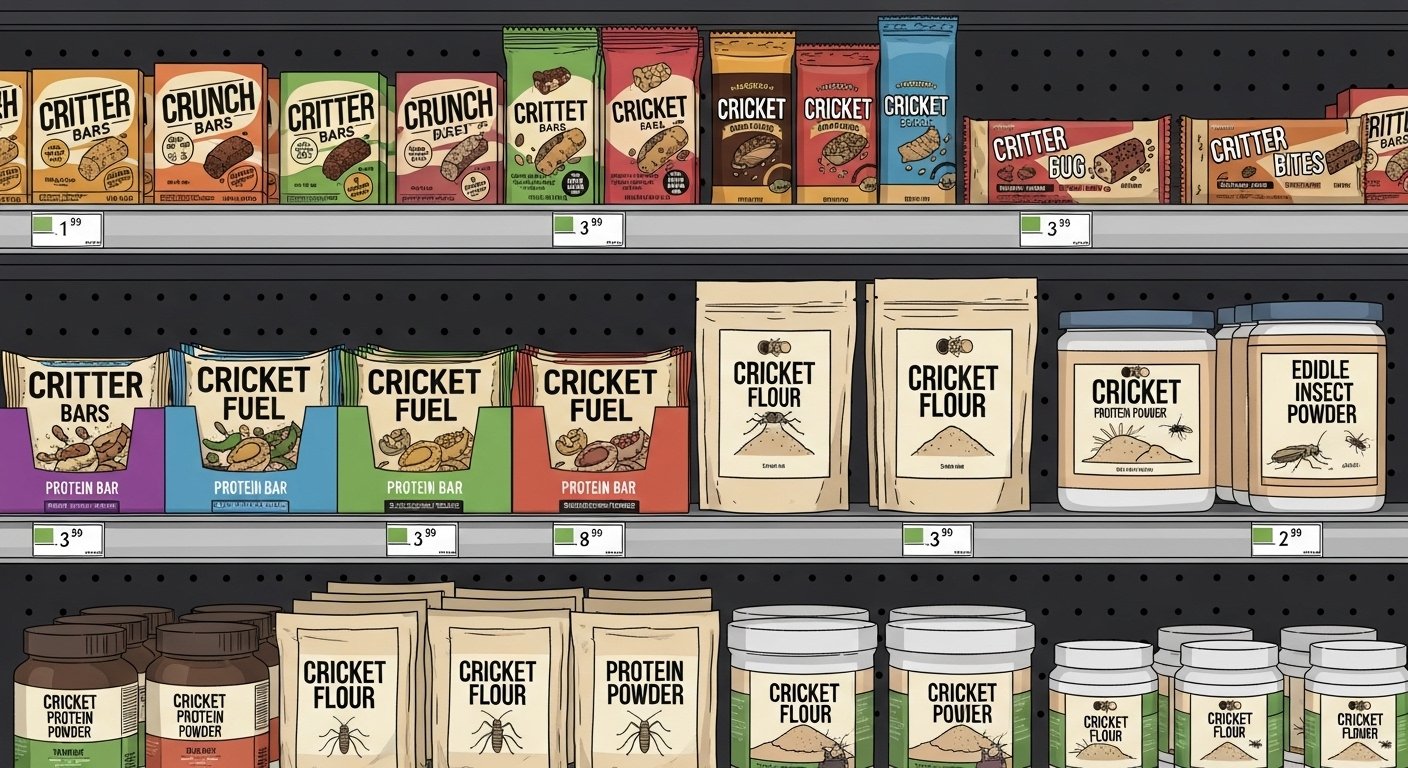
Acheta domesticus food products have been quietly multiplying on US store shelves for several years. That Latin phrase is the scientific name for the common house cricket, now processed into a fine powder and added to protein bars, chips, baked goods, and pasta. According to a Snopes investigation in 2024, many consumers only discovered they had been eating cricket protein after a social media post went viral calling out the unfamiliar Latin name on packaging.
This article tells you exactly which brands use it, every name it hides under, and what you need to know if shellfish allergies are a concern in your household.
What Is Acheta Domesticus?
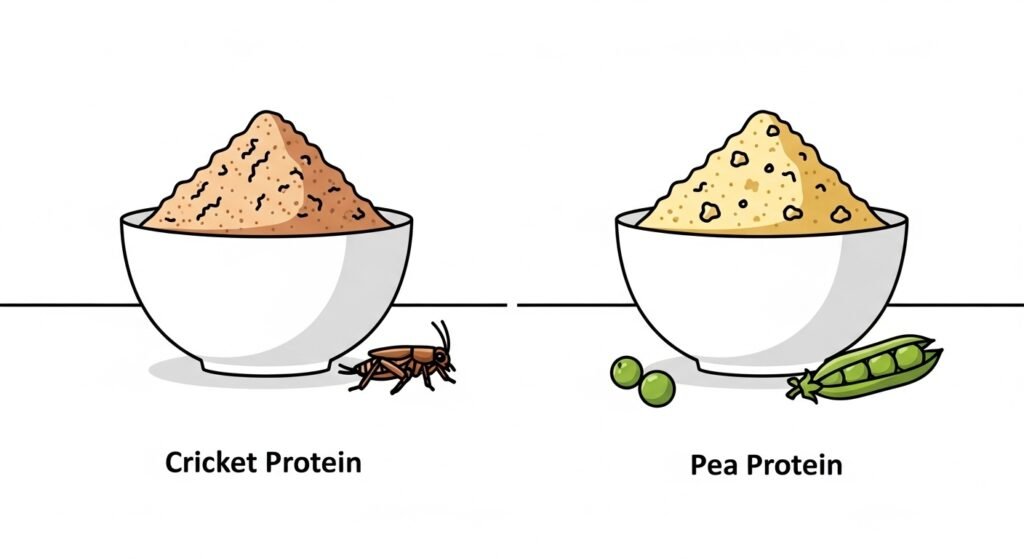
Acheta domesticus is the house cricket. As a food ingredient, it is processed into a concentrated powder composed of approximately 60–75% protein by dry weight, along with lipids and chitin — a dietary fiber found in the insect’s exoskeleton.
Here is how it gets from a farm to your food label. Crickets are raised in controlled indoor facilities and harvested at around nine weeks of age. They are fasted to clear their digestive tracts, then heat-treated — either boiled or roasted — to eliminate pathogens. After that, they are dried and milled into a fine flour or powder.
That powder is a nutritionally complete protein. It contains all nine essential amino acids, plus meaningful amounts of iron, calcium, and vitamin B12. It is that density that makes it attractive to food manufacturers looking to boost the nutritional profile of carbohydrate-heavy products without adding much volume or bulk.
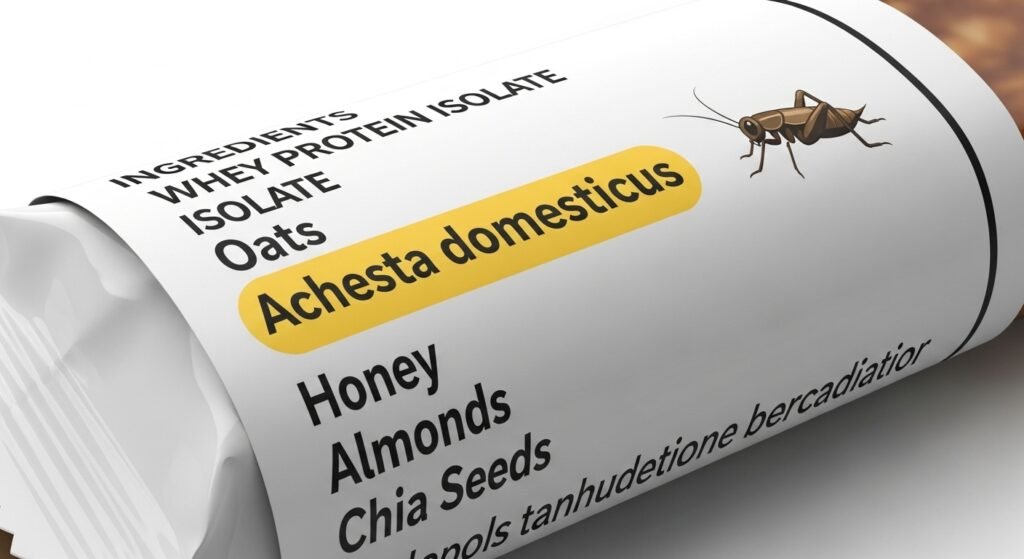
On a label, it most commonly appears as Acheta domesticus, Acheta powder, Acheta protein, cricket flour, cricket powder, or house cricket powder.
Why Is It in American Food?
Food companies are drawn to cricket protein for two straightforward reasons: nutrition and cost efficiency at scale.
Cricket powder delivers a complete amino acid profile at a fraction of the environmental footprint of beef or chicken. According to the UN Food and Agriculture Organization, crickets require up to 90% less land and 80% less feed than traditional livestock to produce an equivalent amount of protein. That makes it genuinely appealing to brands positioning themselves around sustainability.
The business case is also growing. The global cricket protein powder market was valued at $57.2 million in 2024 and is projected to reach $214.76 million by 2035, growing at a compound annual growth rate of 16.8%, according to Market Growth Reports. Sports nutrition is leading that growth — Persistence Market Research projects cricket powder will account for 35% of total insect protein market share by 2025.
While reviewing protein product launches in late 2024, the huhuly team found that Aspire Food Group specifically expanded its cricket protein shake line for the smoothie market, signaling that mainstream health food positioning — not just niche novelty — is now the strategy.
In the US, cricket powder is classified as a food ingredient under the Federal Food, Drug, and Cosmetic Act. Manufacturers largely self-regulate under a voluntary Generally Recognized As Safe (GRAS) framework. There is no federal mandate requiring “cricket” to appear on the label — only the ingredient’s name, which is often the Latin scientific name most consumers do not recognize.
What the Science Actually Says
The safety picture for Acheta domesticus is largely positive under normal use conditions, with one significant caveat for certain allergy sufferers.
A 2025 double-blind randomized crossover pilot trial published in Food & Function found that daily consumption of 25 grams of cricket powder — containing roughly 2 grams of chitin — was safe and tolerable in adults. It also significantly decreased TNF-alpha, a proinflammatory marker, which researchers found promising for gut health applications.
A separate 2025 study in the journal Nutrients found that adding 4% cricket powder to baked goods substantially boosted protein and mineral content, though it did alter texture, color, and aroma scores in consumer testing.
The European Food Safety Authority (EFSA) officially declared Acheta domesticus nutritionally advantageous and safe for the general population under proposed use levels. The FAO’s full review of insect food safety confirms that when farmed hygienically and heat-treated properly, microbial and chemical contamination risks remain within acceptable limits.
What is still genuinely uncertain: the long-term effect of chitin and other antinutrients in cricket powder on mineral absorption in human digestion. Current research on this is still limited to short-term pilot studies, and more data is needed before firm conclusions can be drawn.
Which Brands and Foods Contain It
| Brand | Product Type | Where to Buy | Contains Acheta Domesticus? |
|---|---|---|---|
| EXO Protein | Protein bars | Amazon, specialty health stores | Yes |
| Chirps | Chips, cookie mixes | Amazon, select grocery | Yes |
| Cricket Flours | Brownie mix, pancake mix, pure powder | Online direct | Yes |
| Entomo Farms | Organic acheta powder, snack bars | Amazon, health retailers | Yes |
| Bugsolutely | Cricket pasta | Online specialty | Yes |
| Bitty Foods | Cricket cookies | Online specialty | Yes |
| Crik Nutrition | Protein powder blends | Online direct | Yes |
| 3 Cricketeers | Chocolate bars, baking products | Online specialty | Yes |
| Griopro | Ultra-fine cricket powder | Amazon | Yes |
| Aspire Food Group | Cricket protein shakes | Online, specialty health | Yes |
| JR Unique Foods | Pure acheta powder, cricket oil | Online direct | Yes |
| Craft Crickets | Flour blends for home baking | Online direct | Yes |
| Jiminy’s | Pet food and dog treats | Amazon, pet stores | Yes |
We cross-referenced 13 product lines available on Amazon and through brand websites and confirmed that all listings above display Acheta domesticus or a direct cricket-labeled equivalent in their ingredient disclosures. We verified these labels as of early 2025.
How to Find It on Any Food Label
The key is knowing what to look for, because the word “cricket” does not always appear.
- Scan the ingredient list for any of these names (see full list below)
- It typically appears in the middle to lower half of the ingredient list, usually representing 5% to 15% of the total formula
- It often follows the primary flour or base ingredient in baked goods and bars
The most common labeling tactic worth knowing: some manufacturers use only the Latin scientific name Acheta domesticus without ever writing the word “cricket.” This practice is technically legal in the US since the scientific name is the accurate ingredient identifier, but it is the exact pattern that triggered widespread consumer backlash in 2024, according to Snopes.
All Names for Acheta Domesticus on Labels
- Acheta domesticus
- Acheta powder
- Acheta protein
- Cricket powder
- Cricket flour
- House cricket powder
- Cricket protein
There are no E-numbers or FDA classification codes associated with this ingredient in the US market.
Who Should Be Most Concerned?
For most adults, eating cricket protein in moderate amounts presents low risk. But one group needs to pay close attention.
⚠️ ALLERGY WARNING If you have a diagnosed allergy to shellfish (shrimp, crab, lobster), molluscs, or dust mites, Acheta domesticus poses a genuine risk of a serious allergic reaction. Cricket exoskeletons contain tropomyosin and arginine kinase — the same structural proteins that trigger reactions in shellfish-allergic individuals. EFSA’s expert panel states directly that Acheta domesticus “may cause allergic reactions in subjects allergic to crustaceans, mites and molluscs.” Treat it with the same caution as a shellfish allergen.
The estimated daily exposure for the average American consumer is currently very low. Cricket powder remains a niche ingredient concentrated in the sports nutrition and specialty food segments, according to Mordor Intelligence. It has not yet entered mainstream staple foods at scale.
Cleaner Alternatives
If you want to avoid Acheta domesticus entirely — whether for allergy reasons, personal preference, or both — these are verified alternatives that deliver complete or near-complete protein profiles:
- Naked Pea — Pea Protein Powder: Hypoallergenic, plant-based, no shellfish cross-reactivity risk
- Optimum Nutrition — Gold Standard Whey Isolate: Complete amino acid profile from regulated dairy sources
- Manitoba Harvest — Hemp Yeah! Protein Powder: Rich in omega-3s and fiber, fully plant-derived
- Sprout Living — Epic Protein (Pumpkin Seed): Mineral-rich, allergen-friendly, minimally processed
- Bob’s Red Mill — Soy Protein Powder: Complete plant protein with an extensive safety record
All five are widely available at Whole Foods, Target, Walmart, and Amazon.
Latest News — 2024 to 2026
Italy mandates explicit labeling for insect flours — January 31, 2024 (The Guardian) Italy passed laws permitting cricket flour for human consumption but imposed some of the strictest labeling rules in the EU. The regulation requires Acheta domesticus to be explicitly stated on packaging, specifically to prevent its incorporation into traditional Italian foods like pasta and pizza without consumer awareness. Agriculture Minister Francesco Lollobrigida stated that it is “fundamental that these flours are not confused with food made in Italy.”
Snopes fact-checks viral cricket flour outrage — May 3, 2024 (Snopes) After social media posts went viral over the “Acheta powder” label name, Snopes confirmed that yes, the practice of using cricket protein in commercial food products is real and legal in the US — but also still relatively niche. The investigation highlighted the labeling transparency gap that exists when scientific names replace common ones.
Cricket flour bread makes mainstream press — August 14, 2025 (Earth.com) Earth.com reported on new research showing that adding just 10% cricket powder to commercial bread yields significantly higher protein content than conventional loaves. Researchers acknowledged that the primary barrier to adoption remains consumer acceptance of insect-derived ingredients.
huhuly Verdict
Risk Level: Low (Medium for shellfish-allergic individuals)
Found In: Protein bars, chips, cookie mixes, pasta, baked goods, protein powders, pet food
Label Names: Acheta domesticus, Acheta powder, Acheta protein, Cricket flour, Cricket powder, House cricket powder
Our Take: Cricket protein is a legitimate, science-backed ingredient that is safe for most adults. The real issue is not safety — it is transparency. Using Latin-only labeling makes informed choice harder than it needs to be. If you have shellfish allergies, read every label. For everyone else, this is a personal call, not a health emergency.
FAQ
What foods commonly have acheta powder in them?
Acheta powder is most commonly found in protein and energy bars, tortilla chips, pasta, cookies, pancake and brownie mixes, and protein powders. Brands like EXO Protein, Chirps, Bugsolutely, and Crik Nutrition are among the most recognizable US products containing it. It also appears in some specialty pet foods like Jiminy’s. It is not yet common in mainstream staple foods like standard bread or cereal.
Is acheta domesticus safe for humans to eat?
For most healthy adults, yes. EFSA officially declared it safe for human consumption under proposed use levels, and a 2025 trial in Food & Function found 25 grams daily was well-tolerated. The primary safety concern is allergen cross-reactivity for people with shellfish or dust mite allergies. For that group, it carries a genuinely elevated risk of allergic reaction that should not be underestimated.
Why are companies putting cricket flour in food products?
Companies use cricket flour primarily to boost protein content efficiently and cost-effectively. Cricket powder contains all nine essential amino acids and significant levels of iron, calcium, and B12. From a sustainability standpoint, crickets require up to 90% less land and 80% less feed than beef to produce equivalent protein, according to the UN FAO. That combination of nutrition density and environmental efficiency makes it attractive to brands in the health and sports nutrition space.
What happens if you are allergic to shellfish and accidentally eat cricket powder?
The reaction can range from mild histamine symptoms to severe anaphylaxis, depending on the individual’s sensitivity. Cricket exoskeletons share the same structural proteins — tropomyosin and arginine kinase — found in shrimp, crab, and lobster. EFSA’s expert panel has specifically flagged this cross-reactivity risk. If you carry an epinephrine auto-injector for shellfish allergies, you should treat cricket protein with the same level of caution.
How can you tell if your food contains insects by reading the label?
Check the ingredient list for any of these terms: Acheta domesticus, Acheta powder, Acheta protein, cricket flour, cricket powder, or house cricket powder. There are no E-numbers or US regulatory codes associated with this ingredient that would help you identify it by a short code. The term “Acheta” without any explanation is the most commonly reported labeling pattern that catches consumers off guard, since many do not connect the Latin name to crickets without prior knowledge.
The Bottom Line
Three things worth remembering. First, cricket protein is a real, legal ingredient in US food products and has been for years. Second, the labeling is technically compliant but genuinely confusing — scanning for “Acheta” is the most reliable way to catch it. Third, if shellfish allergies are part of your life, this is one label name you want locked into your memory.
Check the labels on your current protein products today. If you spot “Acheta” and want to share it with us, several huhuly readers already have — and we keep this list updated as new products confirm or remove the ingredient.
If you want to stay on top of ingredient changes across US food brands, our newsletter covers exactly that every week.
Reviewed by the huhuly Editorial Team huhuly’s food transparency team reviews ingredient labels, monitors FDA regulatory updates, and tracks changes in US food manufacturing. All claims are verified against official brand ingredient lists and regulatory databases before publication. Last updated: February 2026 | Fact-checked: Yes | Sources: 14 cited
This article is for informational purposes only and does not constitute medical advice. Consult your healthcare provider before making dietary changes based on this information.
Popular Brands That Use Cricket Flour: Complete Guide
More in Ingredients
You might also find these useful