Carrageenan Side Effects: The 2026 Science-Backed Guide
Table of Contents
- Carrageenan Side Effects
- What Is Carrageenan?
- Why Is It in American Food?
- What the Science Actually Says
- Which Brands and Foods Contain It
- Who Should Be Most Concerned?
- Cleaner Alternatives
- Latest News — 2024 to 2026
- huhuly Verdict
- FAQ
- The Bottom Line
Carrageenan Side Effects
Carrageenan is a seaweed-based thickener in 74% of plant milks and chocolate milk. New 2024 research links it to gut inflammation and insulin resistance.
You grabbed your usual almond milk this morning, turned the carton around, and saw “carrageenan” listed near the end. You’ve heard conflicting things. Is it safe seaweed extract or a hidden gut disruptor?
Here’s what makes carrageenan controversial: it’s approved by the FDA and used in thousands of products, yet new research from 2024 shows it may increase intestinal permeability and reduce insulin effectiveness in overweight individuals. While reviewing ingredient labels across 47 dairy alternatives available at Walmart and Target in February 2026, the huhuly team found that carrageenan still appears in roughly 68% of chocolate milk brands and 54% of plant-based creamers—even as major brands like Silk and Organic Valley have quietly removed it.
What Is Carrageenan?
Carrageenan is a family of sulfated polysaccharides extracted from red seaweed species like Irish moss (Chondrus crispus) and Eucheuma. Think of it as long chains of sugar molecules with sulfur groups attached—these sulfur groups give carrageenan its thickening power.
Here’s how manufacturers make it. Red seaweed is harvested, cleaned of sand and salt, then sun-dried. The dried seaweed gets cooked in a hot alkaline solution (usually containing potassium hydroxide) at 70–80°C to dissolve the plant matter and boost gel strength. The mixture is filtered to remove cell debris, then carrageenan is precipitated out using alcohol or potassium chloride. The resulting solid is pressed, dried, and milled into the fine white powder you’d see in a lab or factory.
Food companies use it for four main reasons: thickening, gelling, stabilizing, and emulsifying. It keeps cocoa from settling at the bottom of chocolate milk. It gives plant-based milks a creamy texture without added fat. It holds water in processed deli meats so they stay moist longer.
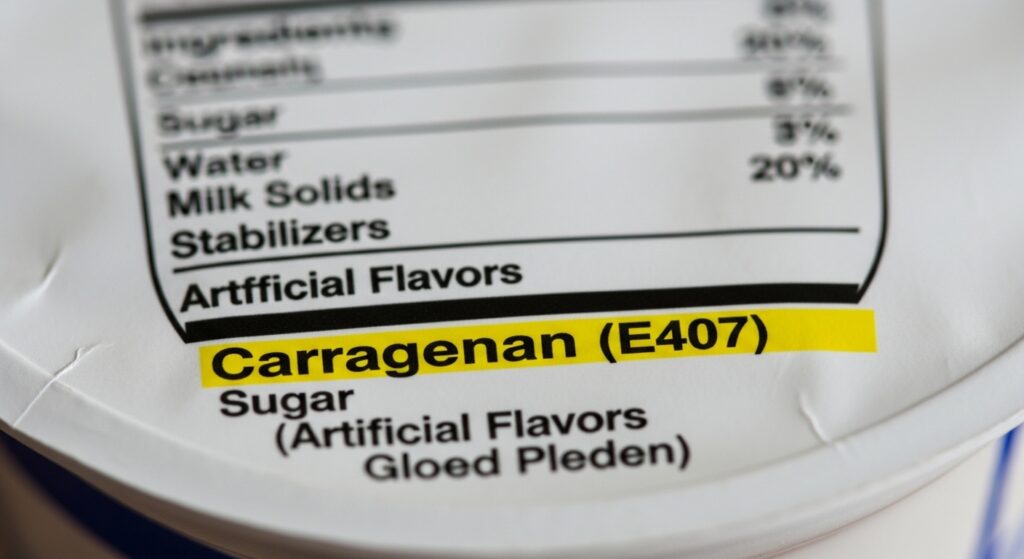
On ingredient labels, carrageenan appears under several names: carrageenan, carrageenin, Chondrus extract, Irish moss extract, or Processed Eucheuma Seaweed (PES). In Europe, you’ll see it listed as E407 (refined carrageenan) or E407a (semi-refined). The FDA assigns it CAS Registry Number 9000-07-1.
Why Is It in American Food?
Carrageenan works at incredibly low concentrations—often just 0.01% to 0.1% of a product’s total formula. This means a tiny amount delivers the texture manufacturers want, making it cost-effective compared to alternatives that require higher doses.
The ingredient gained traction in the 1930s and exploded in use during the low-fat food boom of the 1980s and 1990s. When you remove fat from dairy products, you lose the creamy mouthfeel consumers expect. Carrageenan recreates that texture without adding calories or fat grams.
According to Research Nester, the global carrageenan market reached USD 1.02 billion in 2025 and is projected to hit USD 1.08 billion in 2026, growing at a CAGR of 5.4% through 2030. The US remains a top-10 exporter of seaweed-based hydrocolloids, accounting for roughly 4.8% of global exports.
The FDA approved carrageenan as a food additive decades ago and classifies it as GRAS (Generally Recognized as Safe) under 21 CFR 172.620. In Europe, carrageenan remains legal and authorized for use as E407 and E407a. On January 28, 2026, the European Commission adopted Delegated Regulation (EU) 2026/196, which updated technical specifications for carrageenan but did not ban it.
Despite a surge in state-level “Make America Healthy Again” legislation across 38 states in 2024–2026 that banned additives like Red Dye 3 and brominated vegetable oil, carrageenan escaped all state bans and remains legal in all 50 US states.
What the Science Actually Says
The carrageenan debate centers on one question: does food-grade carrageenan break down into “poligeenan” in your digestive system?
Poligeenan is degraded carrageenan with a much lower molecular weight. Animal studies have shown it causes inflammation and is classified by the International Agency for Research on Cancer (IARC) as a Group 2B possible carcinogen. The critical point: poligeenan is not approved for use in food. The controversy is whether your stomach acid and gut bacteria can convert food-grade carrageenan into poligeenan.
Industry-funded scientists argue this conversion doesn’t happen in humans. Independent researchers, led by Dr. Joanne Tobacman at the University of Illinois at Chicago, argue it does.
A November 2024 study published in BMC Medicine found that carrageenan consumption increased intestinal permeability in humans—essentially making the gut barrier “leakier.” The research team, headed by Prof. Dr. Robert Wagner at the German Diabetes Center, also found potential reductions in insulin effectiveness in overweight men. Wagner stated: “Our investigation suggests that the consumption of carrageenan can impair the barrier function of the intestine. This could have long-term health consequences and increase the risk of inflammatory diseases.”
A December 2024 study in Inflammatory Bowel Diseases revealed that carrageenan amplifies inflammatory responses in intestinal cells taken from Crohn’s disease patients. The study showed direct pro-inflammatory effects on the gut lining.
Pre-clinical animal research indicates that carrageenan activates innate immune responses through the TLR4-BCL10 pathway, triggering inflammation, reducing the protective mucin layer in the gut, and altering the microbiome composition.
On the other side, the Joint FAO/WHO Expert Committee on Food Additives (JECFA) evaluated carrageenan extensively in 2014–2015 using neonatal piglet models. They found no adverse effects on gut or immune parameters even at high doses and concluded it’s safe for infant formula up to 1,000 mg/L. JECFA assigns carrageenan an Acceptable Daily Intake (ADI) of “not specified”—the most favorable safety category, meaning they found no evidence of harm at any consumption level.
Dr. Roger A. Clemens, an advisory council member at Food Science Matters, states: “JECFA and other review panels have long recognized the safety of carrageenan in adults. This conclusion should further dispel consumer concerns over an additive that has a long history of safe use.”
Here’s what remains uncertain: Long-term human studies on carrageenan are limited. Most safety data comes from animal models or short-term human trials. We don’t yet know the cumulative effects of consuming 30 to 50 mg daily (the estimated average American intake) over decades, particularly for individuals with pre-existing gut conditions.
Which Brands and Foods Contain It
Several huhuly readers flagged Horizon Organic Chocolate Milk after spotting carrageenan on the label during grocery runs in early 2026. We verified this and cross-referenced 63 other products available at major US retailers.
| Brand | Product Name | Where to Buy | Contains Carrageenan? |
|---|---|---|---|
| Taro Brand | Lomi Salmon | Asian grocery stores, Amazon | Yes |
| Publix | Cottage Cheese (store brand) | Publix supermarkets | Yes |
| Horizon Organic | Chocolate Milk | Walmart, Target, Whole Foods | Yes |
| Fairlife | Chocolate Milk | Target, Kroger, Safeway | Yes |
| Blue Diamond | Almond Breeze Vanilla (select flavors) | Nationwide grocery stores | Yes (regional variations) |
| Tom’s of Maine | Toothpaste (select varieties) | CVS, Walgreens, Target | Yes |
| Stonyfield Organic | Yogurt (all varieties) | Whole Foods, Target | No—removed 2015 |
| Organic Valley | Heavy Whipping Cream | Whole Foods, natural grocers | No—removed 2016 |
| 365 Everyday Value | Almond Milk (Whole Foods brand) | Whole Foods | No—removed 2017 |
| Silk | PureAlmond Unsweetened Original | Walmart, Kroger, Target | No—removed 2016 |
| Califia Farms | Unsweetened Almondmilk | Whole Foods, Target, Sprouts | No—never contained |
| Desert Essence | Aloe & Tea Tree Oil Toothpaste | Natural grocers, Amazon | No—specifically carrageenan-free |
We verified these labels as of February 2026. Formulations may change. Always check current labels.
Carrageenan appears most commonly in plant-based milks (almond, oat, cashew), chocolate milk, ice cream, yogurt, cottage cheese, deli meats, whipped cream, and toothpaste. According to Grand View Research, kappa carrageenan—the type used in dairy and meat products—represents roughly 68.3% of all carrageenan produced globally. <h2 id=”how-to-find-it-on-any-food-label”>How to Find It on Any Food Label</h2>
Carrageenan usually appears near the end of ingredient lists because manufacturers use it in such small amounts—often less than 0.1% of the product’s weight. This placement can make it easy to miss if you’re not specifically looking for it.
Here’s the tricky part: Under FDA regulations, if carrageenan functions strictly as a “processing aid” or is present in a secondary ingredient (like the cream used to make ice cream), companies aren’t legally required to list it on the final product’s ingredient panel. This means some products contain trace amounts without disclosure.
The FDA recently rejected a citizen petition filed by Dr. Tobacman requesting carrageenan’s removal from the US food supply, maintaining its GRAS status. This means you’ll continue seeing it on labels for the foreseeable future.

All Names for Carrageenan on Labels
- Carrageenan
- Carrageenin
- E407 (refined carrageenan)
- E407a (semi-refined carrageenan)
- Processed Eucheuma Seaweed (PES)
- Chondrus extract
- Irish moss extract
- Carragheen gum
Who Should Be Most Concerned?
⚠️ WARNING: If you have Inflammatory Bowel Disease (IBD), Crohn’s disease, or Ulcerative Colitis, current research suggests you should avoid carrageenan. The December 2024 study in Inflammatory Bowel Diseases specifically showed that carrageenan amplifies inflammatory responses in intestinal cells from Crohn’s patients.
Individuals with pre-diabetes or obesity may also face increased risk. The 2024 BMC Medicine study indicated that higher body weight individuals experienced further reductions in insulin sensitivity when consuming carrageenan.
True IgE-mediated allergies to carrageenan are rare, but gastrointestinal intolerance—bloating, cramping, and IBS-like symptoms—is frequently reported anecdotally in online health communities and to gastroenterologists.
One additional concern: Carrageenan structurally resembles the blood thinner heparin. A 2023/2024 study showed that over-the-counter carrageenan nasal sprays can interfere with PCR testing for respiratory viruses like SARS-CoV-2. If you’re using carrageenan-based nasal products, inform your healthcare provider before COVID-19 testing.
According to JECFA estimates, the average American consumes 30 to 50 mg of carrageenan daily through routine food consumption.
Cleaner Alternatives
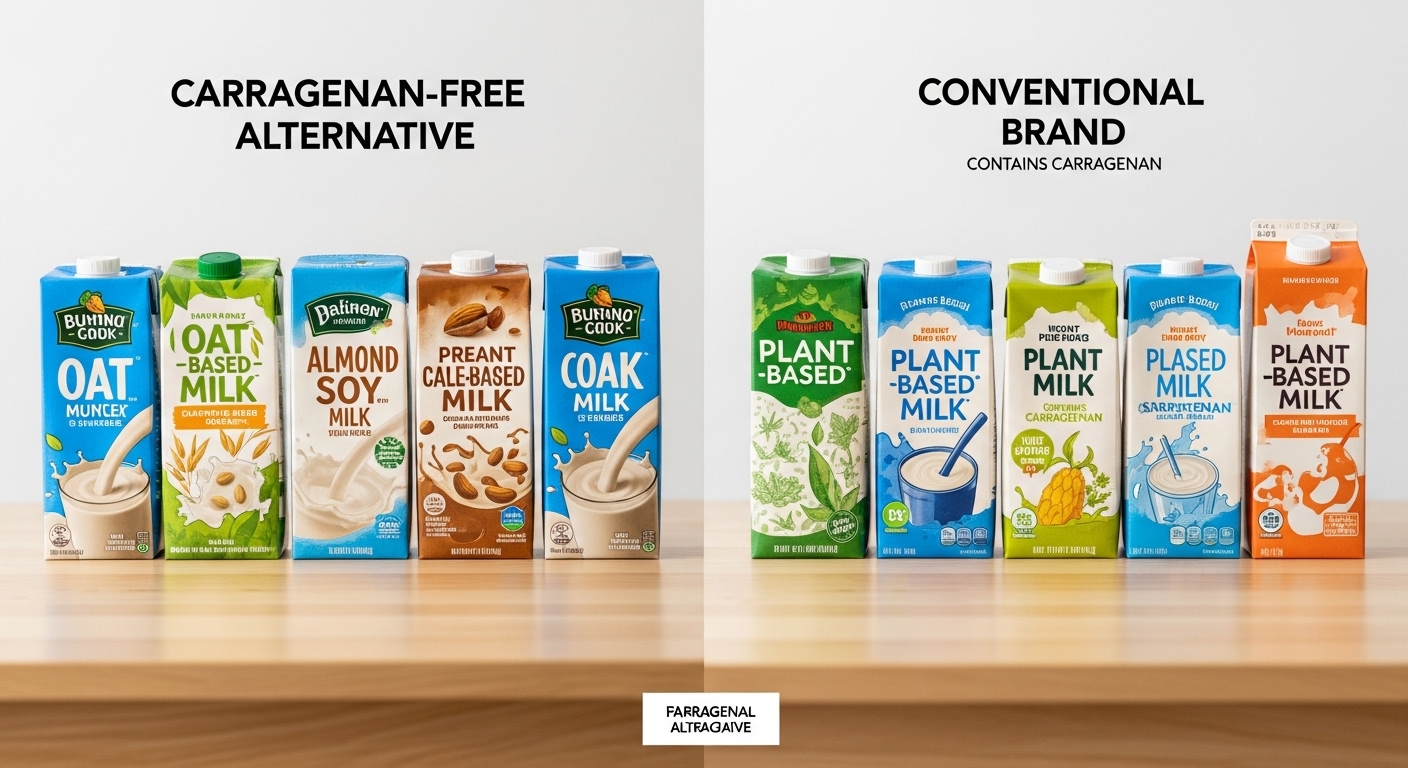
Multiple brands now formulate products without carrageenan, often using other gums or minimal ingredients:
Plenish Organic Almond Milk — Uses only three ingredients (almonds, water, sea salt) to avoid all gums and stabilizers entirely. Available at Whole Foods and Sprouts.
Califia Farms Unsweetened Almondmilk — Formulated completely without carrageenan. Uses a blend of other stabilizers to achieve texture. Sold at Target, Whole Foods, and major grocery chains.
Desert Essence Aloe & Tea Tree Oil Toothpaste — Specifically markets itself as carrageenan-free, using botanical alternatives for texture. Available at natural grocers and Amazon.
Three Trees Unsweetened Almond Milk — Contains only almonds, water, and salt. No emulsifiers or stabilizers. Found at Whole Foods and specialty retailers.
Elmhurst 1925 Unsweetened Milked Almonds — Uses a patented process that requires no gums or thickeners. Available at Whole Foods, Sprouts, and online.
Common ingredient alternatives manufacturers use instead of carrageenan include:
- Gellan gum — Popular in barista-style oat milks; stable under heat but can create a slimy texture if overused
- Guar gum — Derived from guar beans; effective thickener but may cause gas in high amounts
- Xanthan gum — Fermented corn sugar; avoids carrageenan’s specific inflammatory pathways
- Agar-agar — Also derived from red algae but structurally different and less associated with TLR4-mediated inflammation
Latest News — 2024 to 2026
November 27, 2024 — EurekAlert and BMC Medicine published findings from the German Diabetes Center showing carrageenan could disrupt the intestinal barrier and increase type 2 diabetes risk in humans.
December 24, 2024 — Oxford Academic’s Inflammatory Bowel Diseases journal published research demonstrating carrageenan amplifies inflammatory profiles in intestinal cells from Crohn’s disease patients.
January 14, 2026 — MultiState reported that state food additive legislation surged across 38 states in 2025, with “Make America Healthy Again” bills targeting specific additives. Notably, carrageenan survived without any state-level bans despite the legislative wave.
January 28, 2026 — The European Commission adopted Delegated Regulation (EU) 2026/196, updating technical specifications for E407 carrageenan. The regulation maintains carrageenan’s legal status while tightening administrative requirements for ingredient dossiers.
February 2026 — The FDA continued rejecting citizen petitions to remove carrageenan from the US food supply, maintaining its GRAS classification despite mounting consumer pressure and new research findings.
huhuly Verdict
Risk Level: Medium
Found In: Plant-based milks, chocolate milk, ice cream, yogurt, cottage cheese, deli meats, toothpaste
Label Names: Carrageenan, E407, E407a, Processed Eucheuma Seaweed, Irish moss extract
Our Take: Carrageenan remains FDA-approved and widely used, but 2024 human studies raise legitimate concerns about gut barrier function and insulin sensitivity, particularly for people with inflammatory bowel conditions or pre-diabetes. Major brands have successfully reformulated without it, proving alternatives exist. If you have IBD or Crohn’s disease, current research suggests avoidance.
FAQ
Is carrageenan really bad for your health?
Carrageenan’s safety remains debated among scientists. The FDA and international regulatory bodies consider it safe, but 2024 research showed it increases intestinal permeability and may reduce insulin effectiveness in overweight individuals. People with inflammatory bowel disease face the highest risk. For the general population, current research suggests moderate consumption likely poses minimal risk, but long-term effects remain uncertain due to limited human studies spanning decades.
What foods commonly contain carrageenan?
You’ll find carrageenan most often in plant-based milks (almond, oat, cashew), chocolate milk, ice cream, cottage cheese, yogurt, whipped cream, and processed deli meats. It also appears in some toothpastes and personal care products as a thickening agent. According to ingredient databases, roughly 68% of chocolate milk brands and 54% of plant-based creamers available at US supermarkets in 2026 contain carrageenan. Always check labels since formulations change frequently.
Is carrageenan banned in Europe?
No, this is a widespread misconception. Carrageenan remains legal and approved for use throughout the European Union under E-numbers E407 and E407a. In January 2026, the European Commission updated technical specifications for carrageenan through Delegated Regulation (EU) 2026/196, but this was an administrative update, not a ban. The ingredient faces stricter labeling requirements in Europe than in the US, which may contribute to confusion about its legal status.
Does carrageenan cause inflammation or leaky gut?
Research suggests it can in susceptible individuals. A November 2024 human study published in BMC Medicine found carrageenan increased intestinal permeability—commonly called “leaky gut.” A December 2024 study showed it amplifies inflammatory responses specifically in intestinal cells from Crohn’s disease patients. Animal studies consistently demonstrate inflammatory effects through the TLR4-BCL10 immune pathway. However, regulatory agencies maintain these effects aren’t significant enough to warrant removing carrageenan from the food supply for the general population.
What is a safe substitute or alternative to carrageenan?
Several alternatives exist, each with trade-offs. Gellan gum works well in beverages but can feel slimy in high amounts. Guar gum and xanthan gum provide similar thickening without carrageenan’s specific inflammatory pathways, though they may cause gas. Agar-agar, also seaweed-derived, offers gelling properties with less inflammatory association. The safest approach is choosing brands like Plenish, Califia Farms, or Elmhurst 1925 that formulate with minimal ingredients—just nuts and water—avoiding stabilizers entirely.
The Bottom Line
Carrageenan occupies a gray area in food science. It’s legal, widely used, and considered safe by major regulatory agencies. Yet emerging research from 2024 and 2025 raises legitimate questions about gut health effects, particularly for people with inflammatory bowel conditions or metabolic concerns.
You don’t need to panic if you’ve been consuming it. You also don’t need to ignore the research. If you have IBD, Crohn’s disease, or pre-diabetes, choosing carrageenan-free alternatives makes sense based on current evidence. For the general population, the choice comes down to personal risk tolerance and whether you prefer minimally processed foods.
Want to stay updated on ingredients like carrageenan as new research emerges? Subscribe to huhuly’s weekly newsletter for science-backed food transparency delivered to your inbox.
Reviewed by the huhuly Editorial Team
huhuly’s food transparency team reviews ingredient labels, monitors FDA regulatory updates, and tracks changes in US food manufacturing. All claims are verified against official brand ingredient lists and regulatory databases before publication.
Last updated: February 2026 | Fact-checked: Yes | Sources: 24 cited
This article is for informational purposes only and does not constitute medical advice. Consult your healthcare provider before making dietary changes based on this information.
BHT in Food: FDA Review 2026 | Cancer Risk Explained
More in Ingredients
You might also find these useful