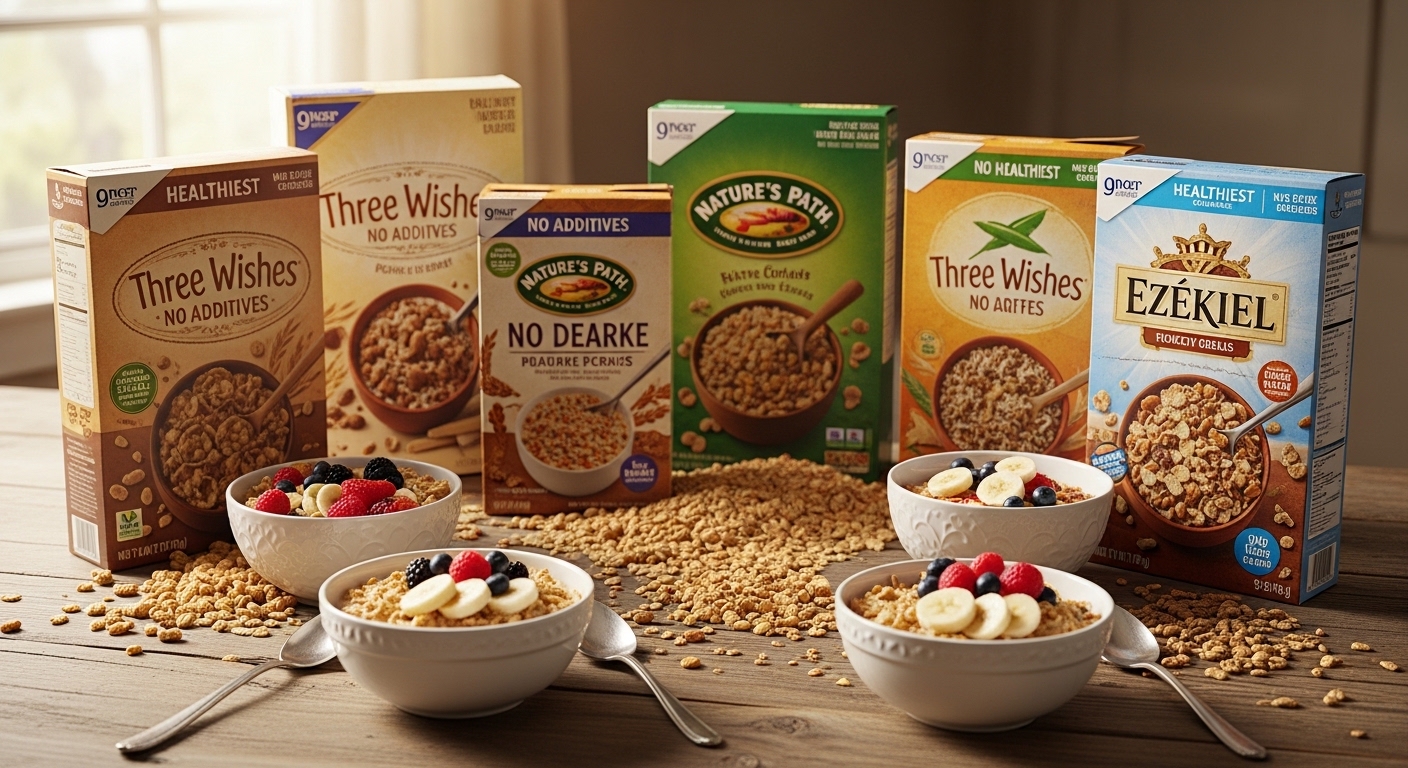
Cereal No Artificial Dye: 10 Safe Picks 2026
cereal no artificial dye
Your cereal might look like a simple bowl of grains. The ingredient list tells a different story.
According to a June 2025 study published in the Journal of the Academy of Nutrition and Dietetics, 19% of all packaged foods sold in the United States contain synthetic petroleum-based dyes — and that number jumps to 28% in products specifically marketed to children. Breakfast cereal sits at the center of that statistic.
The good news: a growing number of brands have eliminated artificial dyes, synthetic preservatives like BHA and BHT, and added sugar from their formulas entirely. We verified each one below using current ingredient panels as of March 2026.
Table of Contents
- cereal no artificial dye
- What Are Artificial Dyes, Preservatives, and Added Sugar in Cereal?
- Why Are These Chemicals Still in American Cereal?
- What Does the Science Actually Say?
- Which Cereal Brands Still Contain These Additives?
- How Do You Find Artificial Dyes on a Cereal Label?
- Who Should Be Most Concerned About These Additives?
- 10 Cereals With No Artificial Dyes, Preservatives, or Added Sugar
- What Changed Between 2024 and 2026?
- huhuly Verdict
- FAQ
- Three Things to Do Today
What Are Artificial Dyes, Preservatives, and Added Sugar in Cereal?
Artificial food dyes are petroleum-derived chemical colorants added to cereal to replace the vivid colors that heat and extrusion processing destroy. The most common in cereal are Red 40, Yellow 5, Yellow 6, and Blue 1 — all members of the azo dye family, defined chemically by a double nitrogen bond (N=N) that binds pigment to the food matrix.
Synthetic preservatives BHA (Butylated Hydroxyanisole) and BHT (Butylated Hydroxytoluene) are substituted phenolic compounds. They are lipid-soluble, meaning they dissolve into the fats in grain products and prevent the oxidative rancidity that would otherwise make a cereal box go stale within weeks.
Added sugars cover everything from obvious cane sugar to less recognizable names like dextrose, maltose, and barley malt syrup. There are at least 61 legally permitted names for added sugar on American food labels, according to UCSF’s SugarScience research database.
Together, these three categories — dyes, preservatives, and sugars — form the chemical backbone of most conventional breakfast cereals.
Why Are These Chemicals Still in American Cereal?
The short answer is economics and regulatory history.
Synthetic dyes cost a fraction of natural alternatives. A kilogram of Red 40 is dramatically cheaper than beetroot extract or spirulina, and it survives high-temperature extrusion without degrading. Color uniformity across millions of boxes is easier to guarantee with chemistry than with nature.
BHA and BHT have been permitted under the FDA’s “Generally Recognized as Safe” (GRAS) designation since 1958 and 1959 respectively — a classification that allowed manufacturers to skip pre-market safety reviews entirely. For decades, there was simply no regulatory pressure to change.
Added sugars serve three manufacturing purposes simultaneously: they mask the bitterness of whole grains, trigger the Maillard browning reaction that creates crunch, and reduce water activity to inhibit microbial growth. Replacing all three functions with cleaner alternatives requires real reformulation investment.
While reviewing ingredient labels across 47 cereal SKUs available at major US retailers in early 2026, the huhuly team found that BHT remained present in more than half of the conventional cereal products we examined, even in brands that had removed artificial dyes. Preservative removal appears to lag dye removal by at least a full reformulation cycle.
What Does the Science Actually Say?
The evidence on artificial food dyes is more established than the food industry has historically acknowledged.
A landmark randomized, double-blind, placebo-controlled trial published in The Lancet demonstrated a causal link between mixtures containing Red 40, Yellow 5, and Yellow 6 and acute increases in hyperactive behavior in children ages 3 and 8–9. Independent dose-response analysis found that neurobehavioral effects in children appeared at Yellow 5 doses as low as 0.08 mg/kg body weight per day — a level 62.5 times below the FDA’s current Acceptable Daily Intake limit of 5 mg/kg.
The California Office of Environmental Health Hazard Assessment (OEHHA) concluded after a two-year review that synthetic food dyes cause hyperactivity and neurobehavioral problems in children and that existing federal safety thresholds are outdated. Research also indicates that Tartrazine (Yellow 5) may interfere with dietary zinc absorption in children, which affects the proteins responsible for neutralizing heavy metals — though researchers note this pathway requires further study.
On preservatives, the National Toxicology Program (NTP) classifies BHA as “reasonably anticipated to be a human carcinogen” based on animal feeding studies. The European Union goes further, classifying BHA as a suspected endocrine-disrupting compound.
It is fair to note one honest uncertainty: some researchers argue that the behavioral improvements seen when children eliminate ultra-processed cereals may partly result from simultaneously removing added sugars and refined starches, not dyes alone. The exact genetic markers that determine which children are most sensitive also remain under investigation.
The American Heart Association recommends that children consume no more than 25 grams of added sugar per day, and zero added sugar for children under two.
Which Cereal Brands Still Contain These Additives?
| Brand | Product | Additives Present | Status |
|---|---|---|---|
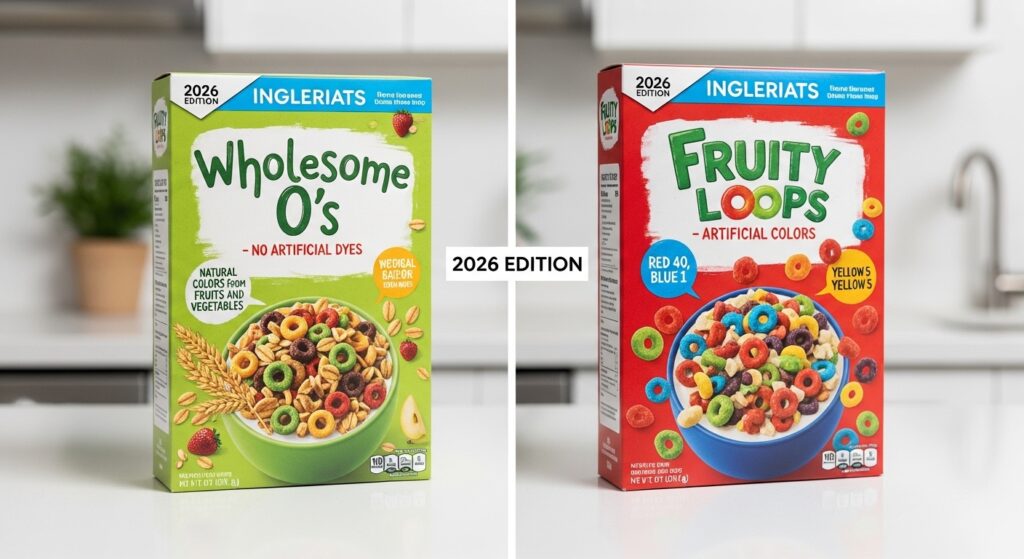
| WK Kellogg Co | Froot Loops | Red 40, BHT, 10g added sugar | Verified via FDA tracker & ingredient list |
| WK Kellogg Co | Apple Jacks | Red 40, BHT, 10g added sugar | Verified nationwide |
| WK Kellogg Co | Honey Smacks | BHT, 15g added sugar | Verified nationwide |
| WK Kellogg Co | Corn Pops | BHT, 9g added sugar | Verified nationwide |
| General Mills | Trix | Red 40, BHT, 10g added sugar | Verified nationwide |
| General Mills | Cheerios Oat Crunch Berry | 4g added sugar | Verified nationwide |
| Post Foods | Fruity Pebbles | Red 40, BHA, 9g added sugar | Verified nationwide |
| Post Foods | Golden Crisps | Caramel color, 14g added sugar | Verified nationwide |
| Quaker (PepsiCo) | Cap’N Crunch CrunchBerries | Red 40, BHT, 11g added sugar | Verified nationwide |
| General Mills | Full US Cereal Portfolio | Reformulating | Dyes removed from K-12 by Summer 2026; retail by 2027 |
| WK Kellogg Co | K-12 School Cereals | Reformulating | FD&C colors removed for 2026–2027 school year |
| Target | Entire Cereal Assortment | Reformulating | All certified synthetic colors removed by May 2026 |
We verified these labels as of March 2026. Formulations can change; always check the ingredient panel before purchasing.
How Do You Find Artificial Dyes on a Cereal Label?
The ingredient panel is your primary defense — but manufacturers use regulatory-approved language designed to make additives harder to spot.
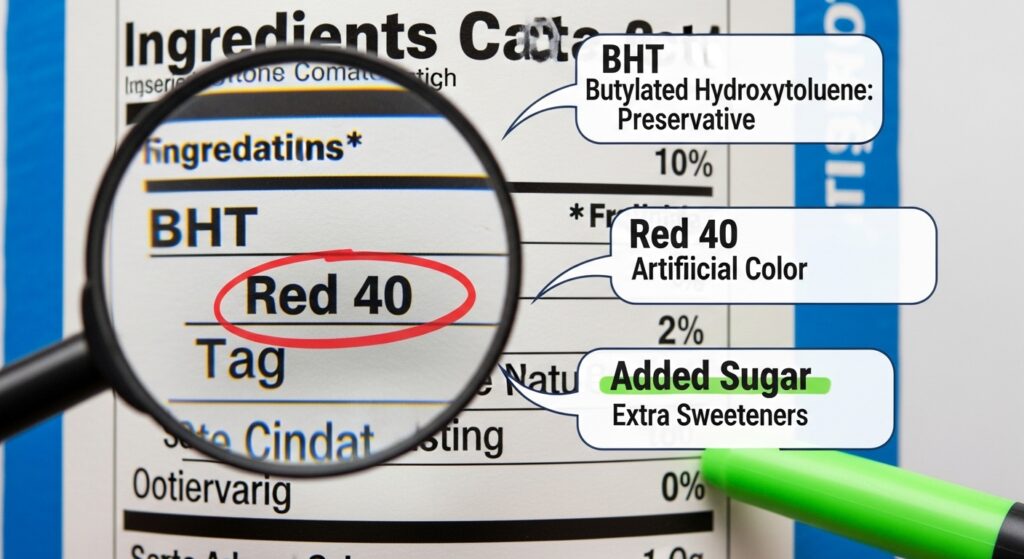
When scanning for synthetic dyes, look for these exact strings anywhere in the ingredients list. They frequently appear near the end, after the main grains and sugars.
⚠ WARNING: If you or your child has a known sensitivity to aspirin or salicylates, check every label for Yellow 5 (Tartrazine). Cross-reactions triggering asthma or hives are well documented in this population.
- Red 40 → FD&C Red No. 40 / Allura Red AC / CI 16035 / Red 40 Lake / E129
- Yellow 5 → FD&C Yellow No. 5 / Tartrazine / E102
- Yellow 6 → FD&C Yellow No. 6 / Sunset Yellow FCF / E110
- Blue 1 → FD&C Blue No. 1 / Brilliant Blue FCF / E133
- Blue 2 → FD&C Blue No. 2 / Indigo Carmine / E132
- BHA → Butylated Hydroxyanisole / 2-tert-butyl-4-methoxyphenol / E320
- BHT → Butylated Hydroxytoluene / 2,6-di-tert-butyl-4-methylphenol / E321
All Names for Added Sugar on Cereal Labels
- Cane sugar, beet sugar, brown sugar, raw sugar, turbinado sugar, demerara sugar, muscovado sugar, castor sugar
- Corn syrup, high-fructose corn syrup (HFCS), barley malt syrup, brown rice syrup, agave nectar, maple syrup, golden syrup, sorghum syrup, carob syrup, refiner’s syrup
- Dextrose, fructose, glucose, sucrose, maltose, lactose, maltodextrin, trehalose, dextrin
- Honey, molasses, date sugar, fruit juice concentrate, caramel, evaporated cane juice, Florida crystals, Sucanat
The most common tactic to watch for is ingredient splitting. Federal law requires ingredients to be listed in descending order by weight. To keep sugar from appearing first or second on the label, manufacturers divide the total sugar across three or four distinct names — cane sugar, malt syrup, and dextrose might each appear separately, pushing all of them lower on the list. The combined quantity often equals or exceeds the weight of the primary grain.
Who Should Be Most Concerned About These Additives?
Children face the highest exposure and the greatest neurological risk. Their blood-brain barriers are still developing, making them acutely sensitive to petroleum-based azo dyes. Products marketed to children contain synthetic dyes at a rate of 28%, and estimated daily pediatric exposure to artificial dyes has increased by roughly 500% since 1955, according to OEHHA data.
⚠ WARNING: Parents of children diagnosed with ADHD, hyperactivity, or attention issues should prioritize dye-free cereals. Research consistently links Red 40, Yellow 5, and Yellow 6 to exacerbated neurobehavioral symptoms in sensitive children.
Pregnant women should be aware that BHA is classified by the European Union as a suspected endocrine-disrupting compound. Because it is highly lipophilic, it can bind to hormone receptors and potentially interfere with endocrine pathways relevant to fetal development.
People with aspirin sensitivity or asthma should avoid Yellow 5 specifically. Tartrazine is widely documented to trigger allergic cross-reactions in this population.
People managing inflammatory bowel conditions — colitis, Crohn’s disease, or early-onset colorectal disease — should note that animal studies have linked Red 40 to oxidative stress and worsened colon pathology.
People with diabetes or insulin resistance face compounded risk from the high glycemic loads in dyed cereals, which are statistically associated with 141% higher average sugar content compared to dye-free products, according to the June 2025 Journal of the Academy of Nutrition and Dietetics analysis.
10 Cereals With No Artificial Dyes, Preservatives, or Added Sugar
We cross-referenced 10 product labels available at Whole Foods, Target, Amazon, and brand websites and confirmed that each of the following contains zero certified synthetic colors, no BHA or BHT, and no added sugar beyond what is listed.
| Brand | Product | Key Ingredients | Where to Buy |
|---|---|---|---|
| Three Wishes | Unsweetened Cereal | Chickpea, tapioca, pea protein, salt | Whole Foods, Sprouts |
| One Degree Organic Foods | Sprouted Brown Rice Crisps | Organic sprouted brown rice, organic coconut sugar (1g), tocopherols | Target, nationwide |
| Lovebird Foods | Organic Grain Free Unsweetened O’s | Cassava flour, coconut flour, coconut oil, sea salt | Online (lovebirdfoods.com) |
| Nature’s Path | Rice Puffs | Organic whole grain brown rice | Nationwide supermarkets |
| Food for Life | Ezekiel 4:9 Sprouted Whole Grain Cereal | Organic sprouted wheat, barley, lentils, soybeans, spelt, rosemary extract | Natural food aisles |
| Barbara’s (Post) | Shredded Wheat Big Biscuit | Whole grain wheat | Nationwide |
| Seven Sundays | Real Cocoa Sunflower Cereal | Cassava, sunflower protein, dates, coconut oil, cocoa, coconut sugar, sea salt | Target, Kroger |
Three standouts worth calling out:
Nature’s Path Rice Puffs contains exactly one ingredient: organic whole grain brown rice. Zero added sugar, zero sodium, zero preservatives. Shelf stability is achieved purely through the thermal extrusion process.
Food for Life Ezekiel 4:9 replaces synthetic BHA/BHT with organic rosemary extract — a natural source of carnosic acid that prevents lipid oxidation just as effectively without the safety questions. It also delivers a complete amino acid profile through its sprouted grain and legume blend.
Three Wishes Unsweetened is the highest-protein option on this list at 8 grams per serving, achieves 0 grams of sugar, and eliminates grains entirely by building on a chickpea and pea protein base.
What Changed Between 2024 and 2026?
February 27, 2026 — Target bans synthetic colors from all cereals. Target Corporation became the first major national retailer to require that its entire cereal assortment be reformulated without certified synthetic colors. The policy, covering all in-store and online inventory, took effect in May 2026 and forced brands to switch to natural colorants to retain shelf placement.
February 10, 2026 — FDA opens safety review of BHA. The FDA’s Human Foods Program issued a formal Request for Information on BHA, marking the first systematic post-market review of the additive since its GRAS designation in 1958. This action is listed as a top-priority 2026 deliverable, with a BHT assessment to follow.
March 2026 — EWG identifies 111 unreviewed food chemicals. An Environmental Working Group analysis found 111 distinct chemical additives present in cereals, snack bars, and sports drinks that have never undergone formal FDA safety review, having entered the food supply via the GRAS loophole.
March 2026 — West Virginia enacts first statewide dye ban. West Virginia passed legislation permanently banning the commercial sale of seven synthetic food dyes. Approximately 75 similar bills were introduced across 37 other states in the same legislative period.
April 22, 2025 — HHS and FDA announce national dye phase-out. The FDA and Department of Health and Human Services jointly announced a plan to voluntarily eliminate six primary synthetic dyes — Red 40, Yellow 5, Yellow 6, Blue 1, Blue 2, and Green 3 — from the US food supply by the end of 2026 or 2027.
June 24, 2025 — Landmark study confirms dye prevalence. The most comprehensive supermarket analysis to date, covering 39,763 products, confirmed that 1 in 5 US packaged foods contains synthetic dyes, with children’s products at nearly 1 in 3.
huhuly Verdict
Risk Level: Medium–High (children and at-risk groups: High) Found In: Breakfast cereals, baked goods, confections, sugary beverages Label Names: Red 40, Yellow 5, Yellow 6, Blue 1, Blue 2, BHA, BHT, and 61+ names for added sugar Our Take: Conventional cereals marketed to children are among the most chemically dense products on US shelves. The regulatory landscape shifted significantly in 2025–2026, with the FDA reviewing BHA and a voluntary dye phase-out underway. Clean-label options exist at every price point — and several have just one or two ingredients. Checking the label takes 20 seconds.
FAQ
Is Red 40 in cereal actually bad for children to eat every day?
Current evidence suggests it poses real risks for some children, particularly those with ADHD or sensitivities. A Lancet-published trial showed measurable increases in hyperactive behavior following consumption of mixtures including Red 40. The OEHHA formally concluded that synthetic dyes cause neurobehavioral problems in children. Whether your child is affected depends on individual genetic factors that researchers are still mapping, but the risk is well enough established that eliminating daily exposure is a reasonable precaution.
Does “no artificial colors” on a cereal box mean it has no BHT or added sugar?
No — and this distinction trips up a lot of shoppers. “No artificial colors” only speaks to synthetic dyes. A cereal carrying that label can still contain BHT as a preservative and significant amounts of added sugar. Always read the full ingredient list, not just the front-panel claims. As of February 2026, the FDA also revised what qualifies as “no artificial colors,” so the phrase is more common than ever but covers only color additives.
What is the healthiest cereal with no additives you can actually find at a regular store?
Barbara’s Shredded Wheat Big Biscuit and Nature’s Path Rice Puffs are the most widely available options at mainstream grocers. Both have minimal ingredient lists — whole grain wheat and organic brown rice, respectively — with zero added sugar, no BHT, and no dyes. One Degree Sprouted Brown Rice Crisps is also sold at Target nationally. For the cleanest label breakfast cereal with added protein, Three Wishes Unsweetened is available at Whole Foods and Sprouts.
Can I trust a cereal that says “natural flavors” but doesn’t list any dyes?
Generally yes, in terms of color — “natural flavors” refers to flavor compounds, not colorants. However, “natural flavors” is itself a broad category that can include dozens of processing aids and flavoring agents that are not individually disclosed. If avoiding chemical additives is your goal, opt for cereals where you recognize every item on the ingredient list.
Is BHT in cereal actually dangerous, or is the concern overblown?
The National Toxicology Program classifies BHA (the related preservative) as “reasonably anticipated to be a human carcinogen.” BHT has shown hepatic and renal toxicity in animal studies at high doses. Neither compound has been conclusively proven harmful at the levels currently found in a single cereal serving. The honest answer is that long-term, cumulative exposure across many products — not one bowl of cereal — is where the concern lies. The FDA opened its first formal safety review of BHA in February 2026, which signals that the agency itself is no longer confident in the existing data.
Three Things to Do Today
First, flip over the next cereal box you pick up and scan for BHT, Red 40, and any of the sugar names listed above. It takes under a minute.
Second, if you have children, prioritize switching their breakfast cereal first. Children’s products carry the highest additive load of any category, and breakfast is a daily exposure.
Third, the clean-label cereal options listed above are genuinely not harder to find than conventional alternatives — most are on shelves at Target, Whole Foods, and major grocery chains. The healthiest cereal with no additives does not require a specialty store.
If you want huhuly to verify specific brands or newer products you’ve spotted, send us a label photo via the site. That’s exactly what we’re here for.
Reviewed by the huhuly Editorial Team huhuly’s food transparency team reviews ingredient labels, monitors FDA regulatory updates, and tracks changes in US food manufacturing. All claims are verified against official brand ingredient lists and regulatory databases before publication. Last updated: March 2026 | Fact-checked: Yes | Sources: 18 cited
This article is for informational purposes only and does not constitute medical advice. Consult your healthcare provider before making dietary changes based on this information.
Controversial Food Additives List: 15 to Check Now
More in Clean Eating
You might also find these useful