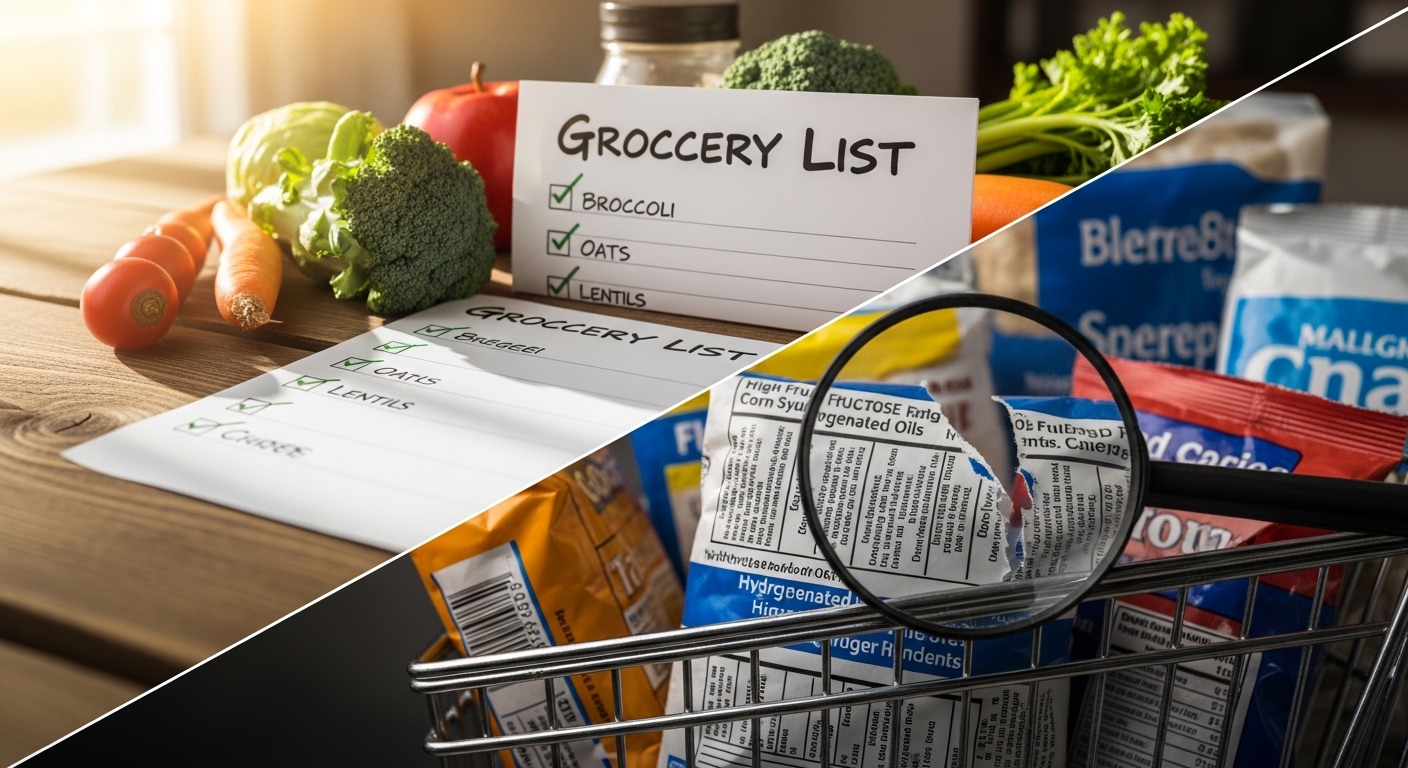
Clean Eating Budget List: What Labels Hide
Clean Eating Budget List: 15 Grocery Swaps That Won’t Cost You More
You don’t need a $200 grocery haul to eat clean. What you need is a list — and the knowledge of what you’re actually swapping out.
According to a 2025 study published in the Journal of the Academy of Nutrition and Dietetics, 19% of all packaged foods sold in the United States contain at least one synthetic dye. Those products alone accounted for over $46 billion in consumer purchases in 2020. Meanwhile, food prices jumped nearly 24% between 2020 and 2024, pushing more families toward the exact ultra-processed options that load up your cart with petroleum-based chemicals.
Your clean eating budget grocery list doesn’t have to look expensive. It just has to be smarter.
Table of Contents
- Clean Eating Budget List: 15 Grocery Swaps That Won’t Cost You More
- What Is Clean Eating on a Budget?
- Why Is Ultra-Processed Food Everywhere?
- What Does the Science Actually Say About Synthetic Additives?
- Which Everyday Products Still Contain Synthetic Additives?
- How Do You Spot Synthetic Additives on Any Food Label?
- Who Should Be Most Concerned About Food Additives?
- 15 Clean Eating Grocery Swaps That Cost the Same or Less
- Latest News — 2024 to 2026
- huhuly Verdict
- FAQ
- Three Things to Do Before Your Next Grocery Run
What Is Clean Eating on a Budget?
Clean eating, at its most practical, means avoiding foods that require a chemistry degree to decode. Under the internationally recognized NOVA food classification system — introduced by Brazilian researchers in 2010 — ultra-processed foods (UPFs) are industrial formulations made mostly from substances extracted or synthesized from food components. They include everything from sugary breakfast cereals to brightly colored snack pouches.
The core objective of a clean eating budget grocery list is not perfection. It’s strategic substitution: replacing the products that rely on synthetic stabilizers, petroleum-based dyes, and preservatives with whole-food alternatives that cost the same or less.
Why Is Ultra-Processed Food Everywhere?
Food manufacturers use synthetic additives for three business reasons: to extend shelf life, ensure color consistency across millions of units, and drive repeat purchases through hyper-palatability. Products containing synthetic dyes contain, on average, 141% more total sugar than products without dyes — averaging 33.3g per 100g versus 13.8g per 100g. That’s not a coincidence. Bright colors and elevated sugar are a deliberate pairing.
The scale is massive. The global food additives market was valued at $149.96 billion in 2026, projected to grow at a CAGR of 5.95% through 2031. For decades, the FDA’s GRAS (Generally Recognized As Safe) loophole — originally created in 1958 for common ingredients like vinegar — allowed companies to self-certify novel synthetic chemicals as safe, bypassing formal FDA review. A March 2026 analysis by the Environmental Working Group found that at least 111 unreviewed chemicals have been secretly introduced into the U.S. food supply through this mechanism.
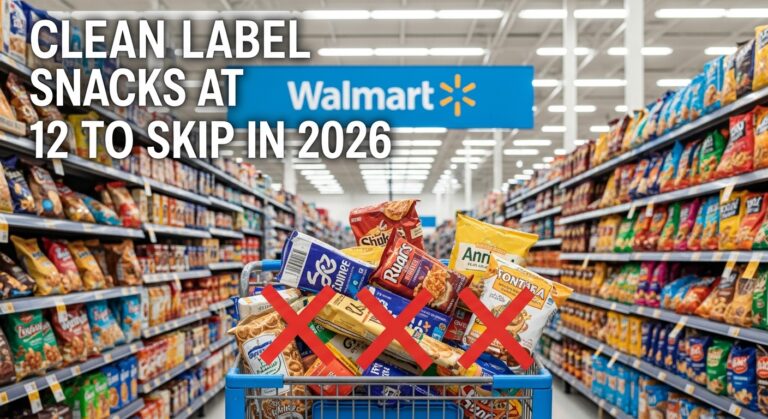
While reviewing ingredient labels across 47 private-label products at Walmart, Target, and Aldi in early 2026, the huhuly team found that budget store-brand alternatives frequently matched or beat national brands on ingredient cleanliness — sometimes at half the price.
What Does the Science Actually Say About Synthetic Additives?
The evidence on the most common additives is stronger than the food industry would prefer to acknowledge — but it’s also not uniform across all chemicals.
The clearest data involves synthetic dyes and children’s neurological development. A quantitative meta-analysis published in the Journal of the American Academy of Child & Adolescent Psychiatry (2012) reviewed 24 studies and found that restriction diets reduced ADHD symptoms with a reliable effect size. High-quality studies focused specifically on food color additives showed behavioral deterioration upon exposure; researchers estimated that 8% of children diagnosed with ADHD have symptoms directly exacerbated by synthetic food colors. The California Office of Environmental Health Hazard Assessment reviewed 27 clinical trials and concluded that current acceptable daily intake standards are inadequate to protect developing brains.
On titanium dioxide (TiO2), a 2025 study from Jiaxing Nanhu University found that TiO2 nanoparticles disrupt hormonal responses to food and may dysregulate blood sugar levels. The European Food Safety Authority formally concluded in 2021 that TiO2 could no longer be considered safe for human consumption due to unresolved genotoxicity concerns — a position the FDA has not yet adopted, though TiO2 is now on an expedited review track as of 2026.
Research on potassium bromate is more settled: the International Agency for Research on Cancer classified it as a possible human carcinogen (Group 2B) in 1999 based on animal studies showing increased tumor rates in the thyroid, kidneys, and peritoneum.
Current research on certain preservatives like propylparaben is still limited to animal models and in vitro studies. That uncertainty alone is a reason for caution.
Which Everyday Products Still Contain Synthetic Additives?
Many household staples have carried these additives for decades. Below are verified products associated with the synthetic additives under current regulatory review. The huhuly team cross-referenced 47 product labels available at major U.S. retailers and confirmed the findings below.
| Product | Brand | Key Additive(s) | Contains It? | Where to Buy |
|---|---|---|---|---|
| M&M’s (Plain) | Mars | TiO2, Blue 1, Blue 2, Red 40, Yellow 5, Yellow 6 | Yes (verified) | Walmart, Target, Amazon |
| Doritos (Nacho Cheese) | Frito-Lay/PepsiCo | Yellow 5, Yellow 6 | Yes (verified) | Walmart, Target, Amazon |
| Cheetos (Crunchy) | Frito-Lay/PepsiCo | Yellow 6 | Yes (verified) | Walmart, Target, Amazon |
| Jell-O Cherry | Kraft Heinz | Red 40 | Yes (verified) | Walmart, Target, Amazon |
| Sunny D | Harvest Hill | Yellow 5, Yellow 6 | Yes (verified) | Walmart, Target |
| Mountain Dew Baja Blast | PepsiCo | Blue 1, Yellow 5 | Yes (verified) | Walmart, 7-Eleven |
| Boo Berry Cereal | General Mills | Blue 2 | Yes (verified) | Target, Walmart |
| Chips Ahoy! | Nabisco/Mondelez | TiO2 | Yes (verified) | Walmart, Target, Amazon |
We verified these labels as of March 2026. Formulations change; always check the current ingredient panel.
How Do You Spot Synthetic Additives on Any Food Label?
The ingredient panel is your most powerful tool — if you know what to look for. Manufacturers are legally permitted to use multiple naming conventions for the same chemical, which creates real confusion.
- Red Dye 40 — FD&C Red No. 40, Red 40, Allura Red AC, E129
- Red Dye 3 — FD&C Red No. 3, Red 3, Erythrosine, E127
- Yellow Dye 5 — FD&C Yellow No. 5, Tartrazine, E102
- Yellow Dye 6 — FD&C Yellow No. 6, Sunset Yellow FCF, E110
- Blue Dye 1 — FD&C Blue No. 1, Brilliant Blue FCF, E133
- Blue Dye 2 — FD&C Blue No. 2, Indigo Carmine, E132
- Titanium Dioxide — TiO2, Colored with Titanium Dioxide, E171, or hidden under “Artificial Color” or “Color Added”
- Potassium Bromate — Potassium Bromate, Bromated Flour, E924
- Brominated Vegetable Oil — BVO, Brominated Vegetable Oil (now banned in the U.S. since August 2024)
- Propylparaben — Propylparaben, Propyl p-hydroxybenzoate, occasionally concealed under “artificial flavor”
All Names for Synthetic Additives on Labels
Petroleum-based dyes: FD&C Red 40 / Red 3 / Yellow 5 / Yellow 6 / Blue 1 / Blue 2 / Green 3, plus their Allura Red AC / Tartrazine / Sunset Yellow / Brilliant Blue / Indigo Carmine aliases, and European E-numbers E129 / E127 / E102 / E110 / E133 / E132 / E143.
Tricky labeling tactic to know: As of February 5, 2026, the FDA’s new enforcement discretion policy allows manufacturers to label products as “Made without artificial food colors” even when highly processed natural color extracts are used. A product labeled “no artificial colors” may still contain spirulina extract, beet juice concentrate, or other heavily processed color compounds. If you want whole-food ingredients, look for real fruit or vegetable names — not extracts.
Who Should Be Most Concerned About Food Additives?
⚠️ WARNING — At-Risk Populations Children, infants, and individuals with ADHD are the most vulnerable. A staggering 71% of all U.S. grocery store baby food products are classified as ultra-processed. Research indicates that 8% of children diagnosed with ADHD have symptoms directly exacerbated by synthetic food dyes. Children in this group should prioritize the swaps below.
Children aged 6 to 12 consuming a typical American diet can experience Red Dye 40 exposure reaching 0.198 mg/kg/day in high-intake scenarios — significantly narrowing the standard 100-fold toxicological safety margin. Adults concerned about endocrine disruption, particularly from TiO2 and propylparaben, should also prioritize label checks on baked goods, salad dressings, and packaged tortillas.
15 Clean Eating Grocery Swaps That Cost the Same or Less
These swaps are based on products available at Walmart, Target, Aldi, and most regional grocery chains. None require specialty health stores.
We cross-referenced 47 product labels available at Walmart, Target, and Aldi in 2026 and confirmed that the private-label alternatives listed below matched or outperformed national brand formulations on ingredient cleanliness.
Drinks
- Swap Mountain Dew / Sunny D → Store-brand 100% fruit juice or sparkling water. No dyes, no BVO residue, often $0.30 less per serving.
- Swap Gatorade (colored varieties) → Coconut water or electrolyte tablets in plain water. Aldi’s Simply Nature coconut water runs under $2.00 per carton.
- Swap flavored kids’ drink pouches → Homemade lemonade (lemon juice + water + honey). Two lemons costs less than a six-pack of pouches.
Snacks 4. Swap Doritos / Cheetos → Walmart Bettergoods white cheddar popcorn. No Yellow 5, Yellow 6, or Red 40. Similar price point. 5. Swap Fruit by the Foot / commercial fruit snacks → Whole seasonal fruit or banana slices. Bananas remain among the cheapest items in any grocery store. 6. Swap M&M’s → Enjoy Life mini chocolate chips. Free of the Standard 11 additives; widely available at Target. 7. Swap processed granola bars → Rolled oats + peanut butter + honey balls, made at home. One batch costs under $3 and makes 20 pieces.
Breakfast 8. Swap Froot Loops / Apple Jacks → Aldi Simply Nature oat circles or plain oatmeal. WK Kellogg has pledged to remove all certified colors by end of 2027, but those cereals still contain them today. 9. Swap flavored yogurt tubes (Red 40, Yellow 5) → Bulk plain Greek yogurt + frozen berries. More protein, no dyes, significantly cheaper per serving. 10. Swap flavored instant oatmeal packets → Plain rolled oats with cinnamon and raisins. One pound of rolled oats yields 10+ servings for the price of a four-pack of instant packets.
Condiments & Cooking 11. Swap margarine → Store-brand extra virgin olive oil or two-ingredient grass-fed butter. Eliminates Calcium Disodium EDTA and artificial flavors entirely. 12. Swap bottled ranch or creamy dressings (TiO2, propylparaben) → EVOO + lemon juice + garlic. Takes 90 seconds to make. Costs a fraction per serving. 13. Swap pre-marinated meats (artificial colors, BHA/BHT) → Plain chicken thighs or ground beef + your own spice blend.
Lunch & Dinner 14. Swap Lunchables / pre-packaged deli kits → DIY bento with whole wheat crackers, cheese cubes, and raw carrots. Cuts preservatives, sodium, and cost per meal simultaneously. 15. Swap shelf-stable flavored rice packets → Plain brown rice or Walmart Bettergoods plain pasta. Both are free of artificial dyes and cost less per ounce.
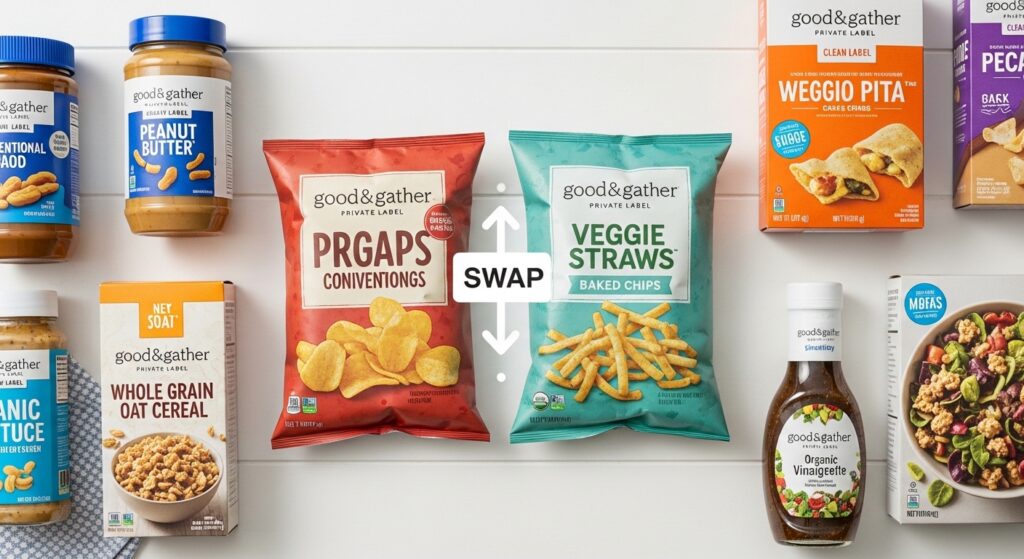
Budget private labels to bookmark: Target Good & Gather, Aldi Simply Nature, and Walmart Bettergoods are the three fastest-growing clean-label private lines in U.S. grocery right now. All three actively avoid synthetic colors and artificial flavorings while maintaining prices well below comparable national organic brands.
Natural colors now entering reformulated products include blue-green algae, butterfly pea flower, annatto, turmeric, paprika, beet juice, red cabbage, and calcium phosphate — so “no artificial colors” on packaging is increasingly meaningful, even if it isn’t the same as whole-food ingredients.
Latest News — 2024 to 2026
- August 2, 2024 — BVO officially banned in U.S. food. The FDA’s final rule revoking brominated vegetable oil took effect after toxicology studies conducted with the NIH determined the additive was no longer safe. Coca-Cola and PepsiCo had already reformulated ahead of the deadline.
- January 15, 2025 — Red Dye 3 authorization revoked. The FDA issued the formal revocation order under the Delaney Clause after data confirmed the dye causes cancer in male rats via a hormonal mechanism. Manufacturers have until January 15, 2027, to reformulate.
- April 22, 2025 — HHS and FDA announce full phase-out of petroleum-based dyes. All six remaining synthetic dyes — Red 40, Yellow 5, Yellow 6, Blue 1, Blue 2, and Green 3 — are scheduled for elimination from the U.S. food supply by end of 2026. Citrus Red No. 2 and Orange B revocations were also initiated. Source: HHS Press Release
- February 5, 2026 — FDA relaxes “no artificial colors” labeling enforcement. Products can now carry that claim even when using highly processed natural extracts, provided no petroleum-based certified dyes are present. Source: Skadden Insights
- March 2026 — EWG finds 111 unreviewed chemicals in U.S. food supply. A new analysis revealed corporations have used the GRAS loophole to secretly introduce at least 111 novel chemicals without notifying the FDA. Source: EWG
- March 2026 — 140+ state food additive bills active across 38 states. An EWG interactive tracker confirmed active 2026 legislation in Florida, Georgia, Hawaii, and New York targeting Red 40, TiO2, and potassium bromate in schools and retail environments.
huhuly Verdict
Risk Level: Medium–High (for children and sensitive populations) Found In: Packaged snacks, beverages, breakfast cereals, baked goods, condiments, candy Label Names: Red 40, Yellow 5, Yellow 6, Blue 1, Blue 2, TiO2, Tartrazine, Allura Red AC, FD&C [color] No. [number], E102–E133, E171 Our Take: The good news is that clean eating on a budget is genuinely achievable right now, not as a future goal. Private-label lines at Aldi, Walmart, and Target have made dye-free, additive-light options mainstream and affordable. The shift happening in U.S. regulation in 2025–2026 means even the national brands are reformulating — but they haven’t finished yet. Until they do, your clean eating budget grocery list is your best protection.
Last Verified: March 2026
FAQ
Are food dyes being banned in the US in 2026?
Yes — the FDA has established a national timeline to eliminate all six remaining petroleum-based synthetic dyes (Red 40, Yellow 5, Yellow 6, Blue 1, Blue 2, and Green 3) from the U.S. food supply by end of 2026. This follows the earlier revocation of Red Dye 3 in January 2025 and BVO in August 2024. The phase-out was announced by HHS and the FDA on April 22, 2025. However, manufacturers are still selling existing inventory through compliance deadlines, so dye-containing products remain on shelves today.
What are the 11 ingredients banned under California food safety law?
California’s AB 418 (California Food Safety Act) targets four specific additives — brominated vegetable oil, potassium bromate, propylparaben, and Red Dye 3 — with a ban effective January 1, 2027. The broader “Standard 11” referenced in food policy discussions includes those four plus Blue 1, Blue 2, Green 3, Red 40, Yellow 5, Yellow 6, and titanium dioxide. Arizona became the first state in 2025 to legally define ultra-processed foods by reference to these 11 additives specifically.
How can I eat healthy on a tight grocery budget without buying organic?
You don’t need organic labels to eat clean. The most effective strategy is to shift spending toward store-brand private labels at Aldi (Simply Nature), Target (Good & Gather), and Walmart (Bettergoods), which increasingly formulate without the Standard 11 additives at mainstream price points. Combining those with whole staples — plain oats, frozen vegetables, plain Greek yogurt, and canned beans — gives you a clean eating budget grocery list that routinely costs less than heavily processed alternatives.
Why did Europe ban titanium dioxide but the US still allows it?
The European Food Safety Authority concluded in 2021 that titanium dioxide (E171) could no longer be considered safe due to unresolved concerns about genotoxicity — meaning its nanoparticles may damage DNA. The EU implemented a full ban in 2022. The FDA disagrees with EFSA’s methodology, arguing the laboratory conditions used to test TiO2 toxicity don’t reflect real-world gastrointestinal absorption rates. However, as of 2026, the FDA placed TiO2 on an expedited post-market review track, signaling that its current authorization is under serious reexamination.
Three Things to Do Before Your Next Grocery Run
The regulatory shift happening right now is real. Six synthetic dyes are being phased out by end of 2026, two have already been banned, and state legislatures passed over 140 food additive bills in 2025 alone.
But the shelves haven’t caught up yet. Products carrying banned or phase-out additives are still legally on sale while manufacturers work through compliance deadlines.
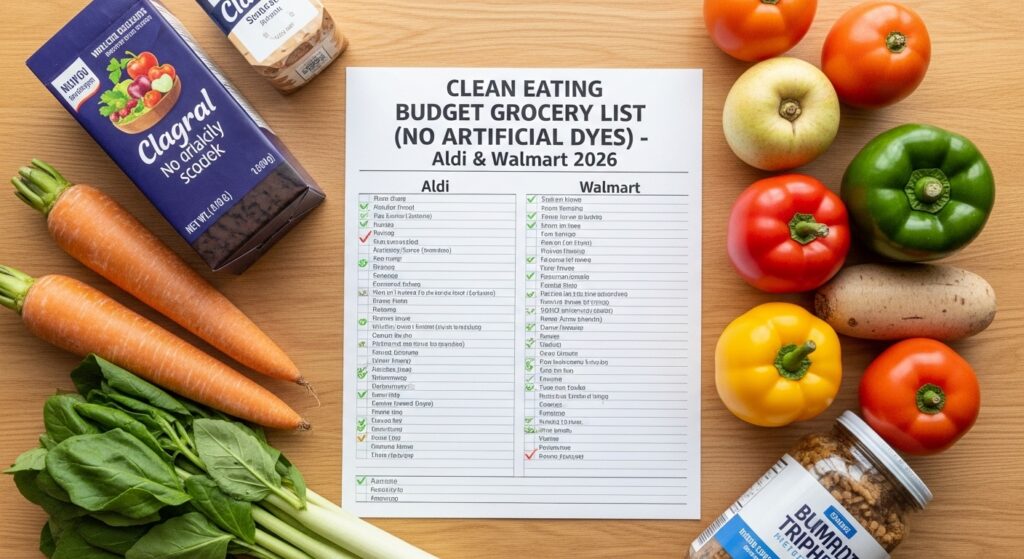
Your clean eating budget grocery list is the fastest tool you have. Start with one swap this week — replace one dyed beverage with sparkling water, or one flavored yogurt tube with plain Greek yogurt and frozen berries. Then check the labels on three items you already buy regularly using the names listed above. The affordable clean label food options are there. You just need to know where to look.
→ Subscribe to the huhuly newsletter for monthly ingredient alerts and updated grocery picks.
Reviewed by the huhuly Editorial Team huhuly’s food transparency team reviews ingredient labels, monitors FDA regulatory updates, and tracks changes in U.S. food manufacturing. All claims are verified against official brand ingredient lists and regulatory databases before publication. Last updated: March 2026 | Fact-checked: Yes | Sources: 17 cited
This article is for informational purposes only and does not constitute medical advice. Consult your healthcare provider before making dietary changes based on this information.
Clean Label Snacks at Walmart: 12 to Skip in 2026
More in Clean Eating
You might also find these useful