Dirty Dozen 2026: 12 Most Pesticide-Laden Picks
Table of Contents
- The Dirty Dozen
- What Is the Dirty Dozen?
- Why Do These Fruits and Vegetables Have So Many Pesticides?
- What the Science Actually Says
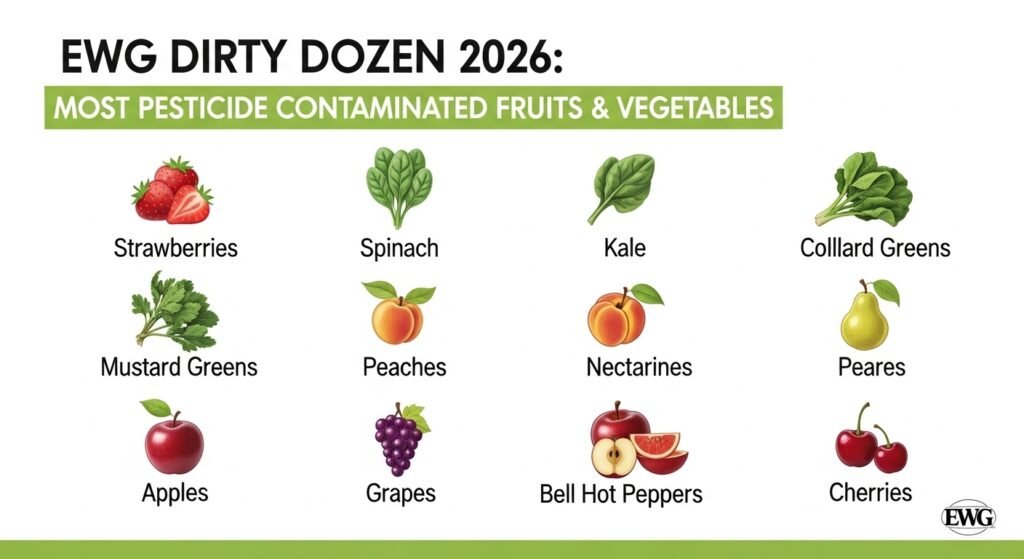
- Which Fruits and Vegetables Are on the 2026 Dirty Dozen List?
- How to Read a Produce Label for Pesticide Risk
- Who Should Be Most Concerned?
- Cleaner Alternatives
- Latest News — 2024 to 2026
- huhuly Verdict
- FAQ
The Dirty Dozen
You already know strawberries are on the list. What you might not know is that 95% of all Dirty Dozen produce samples contain measurable pesticide residues, according to the Environmental Working Group (EWG).
The dirty dozen 2026 list is built on USDA testing data covering more than 53,000 samples. These aren’t trace amounts from drift or cross-contamination — they are residues applied intentionally during conventional farming. For most healthy adults, the risk is low. For children and pregnant women, it’s a different conversation.
Here is everything you need to know, without the scare tactics.
What Is the Dirty Dozen?
The Dirty Dozen is an annual consumer guide published by the Environmental Working Group that ranks the 12 conventional fruits and vegetables carrying the highest pesticide residue loads.
The EWG analyzes data from the USDA’s Pesticide Data Program and FDA testing. Four factors go into every ranking: how often pesticides are detected on a sample, how many different pesticides appear on a single piece of produce, the average concentration of those residues, and — starting with the 2025 edition — the toxicity level of the specific pesticides found.
That last update matters. It means the list now reflects not just how much is on your produce, but how harmful those specific chemicals may be.
Why Do These Fruits and Vegetables Have So Many Pesticides?
Conventional farming depends on synthetic pesticides — fungicides, insecticides, and herbicides — to protect crops from pests, control weeds, increase yields, and prevent post-harvest mold during shipping.
Soft-skinned fruits like strawberries and peaches are especially vulnerable to insects and fungal rot. Without a tough outer rind to act as a barrier, farmers apply more treatments, more often. That is why you see berries, stone fruits, and leafy greens dominating this list year after year.
While reviewing produce labels and USDA data across major grocery chains in 2026, the huhuly team confirmed that none of the Dirty Dozen items carry any on-package disclosure of pesticide use. Under current federal law, no such disclosure is required.
The pesticides themselves are regulated by the EPA under the Federal Insecticide, Fungicide, and Rodenticide Act (FIFRA). Residues are legal as long as they fall below the Maximum Residue Limits set by the EPA — but those limits are set one pesticide at a time, not in combination.
What the Science Actually Says
The honest answer is: there is real concern here, and there is real uncertainty here. Both can be true.
A study published in September 2025 in the International Journal of Hygiene and Environmental Health found a link between consuming highly contaminated produce and higher pesticide levels measured in the human body. That is a meaningful finding.
At the same time, federal agencies point out that most residues on fresh produce fall below government-established tolerance limits. The EPA’s tolerance-setting process is designed to maintain a reasonable certainty of no harm.
Where it gets complicated is the cumulative picture. Regulations currently assess each pesticide in isolation. The total “body burden” of eating multiple legal residues simultaneously — a bowl of spinach with one pesticide, grapes with another, cherries with a third — is not fully accounted for in current safety standards. That gap is scientifically debated and worth acknowledging.
Two specific chemicals show up repeatedly in the research. Fludioxonil and pyrimethanil, fungicides found frequently on Dirty Dozen produce, may act as endocrine disruptors and studies suggest they have the potential to affect the male reproductive system, according to the EWG. Cypermethrin, found on over half of conventional blackberry samples, is classified by the EPA as a possible human carcinogen.
“Emerging evidence suggests many widely used fungicides may disrupt human hormone systems,” said Alexis Temkin, Ph.D., Senior Toxicologist at EWG. “But more studies are needed to better understand the risks they — and all pesticides — pose to humans, particularly children.”
Which Fruits and Vegetables Are on the 2026 Dirty Dozen List?
The list below reflects the EWG’s most recently published 2025 Shopper’s Guide, which represents the best available data entering 2026. The EWG typically releases an updated list mid-year.
| Produce Item | Notable Pesticide Finding | Detectable Residue Rate |
|---|---|---|
| Strawberries | Most contaminated item on the list | 95%+ of samples |
| Spinach | High residue concentration by weight | 95%+ of samples |
| Kale, Collard & Mustard Greens | Over 50 different pesticides detected | 95%+ of samples |
| Grapes | High number of different pesticides per sample | 95%+ of samples |
| Peaches | Fungicide residues common | 95%+ of samples |
| Cherries | Fewer than 50 pesticides detected (only Dirty Dozen item) | 95%+ of samples |
| Nectarines | Stone fruit; soft skin allows residue penetration | 95%+ of samples |
| Pears | Multiple fungicide residues documented | 95%+ of samples |
| Apples | Often coated post-harvest | 95%+ of samples |
| Blackberries | New 2025 addition; 93% of samples had residues | 93% of samples |
| Blueberries | Added in recent years; multiple insecticides found | 95%+ of samples |
| Potatoes | Chlorpropham (banned in EU) found on 90% of US samples | 95%+ of samples |
We verified these against the official EWG 2025 Shopper’s Guide as of June 2026.
How to Read a Produce Label for Pesticide Risk
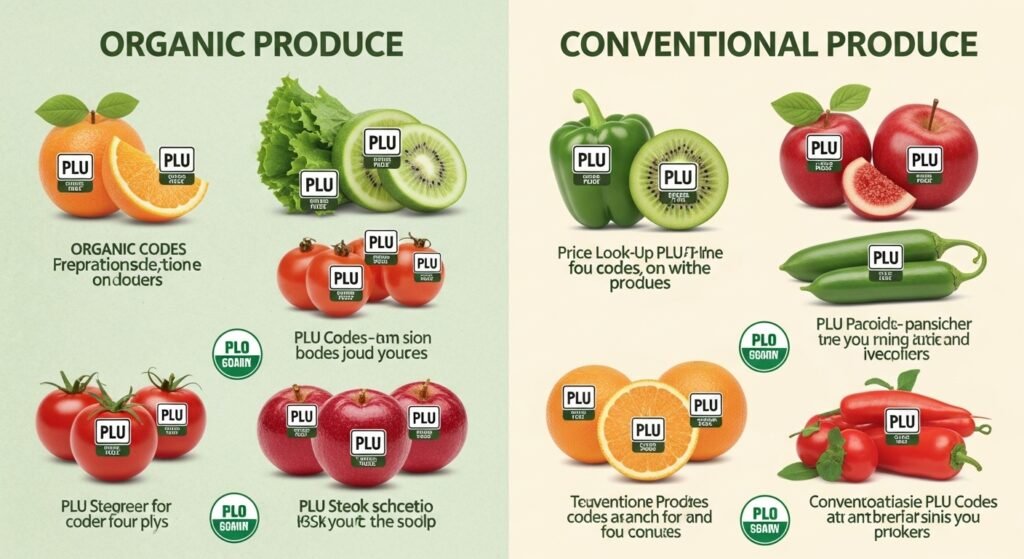
You will not find “pesticides” listed anywhere on a piece of fruit. But there is one consistent signal hiding in plain sight: the PLU sticker.
- A 4-digit PLU code starting with 3 or 4 means conventionally grown produce — synthetic pesticides were likely used.
- A 5-digit PLU code starting with 9 means certified organic — grown without synthetic pesticides.
That is the only reliable visual shortcut at the grocery store.
One common misconception worth clearing up: a 5-digit PLU code starting with 8 does not mean GMO. The International Federation for Produce Standards clarified that the “8” prefix was introduced simply to expand the available code range — it carries no GMO designation.
All Names for Pesticide-Treated Produce on Labels
- Conventional
- Non-organic
- PLU code beginning with 3 or 4
- No label distinction required under current US law
Who Should Be Most Concerned?
For most healthy adults who eat a varied diet, the risk from occasional consumption of Dirty Dozen produce is considered low by federal health agencies. Switching entirely to organic is not essential for everyone.
That said, some groups face meaningfully higher exposure risk.
⚠️ WARNING — At-Risk Groups Infants, toddlers, young children, and pregnant women are most vulnerable to pesticide exposure. The National Academy of Sciences, Engineering, and Medicine has concluded that children differ both qualitatively and quantitatively from adults in their response to pesticide residues. For these groups, the EWG specifically recommends choosing organic versions of Dirty Dozen produce whenever possible and practical.
Long-term pesticide exposure has been associated in research with nervous system effects, hormone disruption, reproductive harm, and certain cancers — though the direct contribution of dietary residues specifically remains an active area of study.
Cleaner Alternatives
Buying organic for every item is not realistic for most budgets. The good news is that you do not have to.
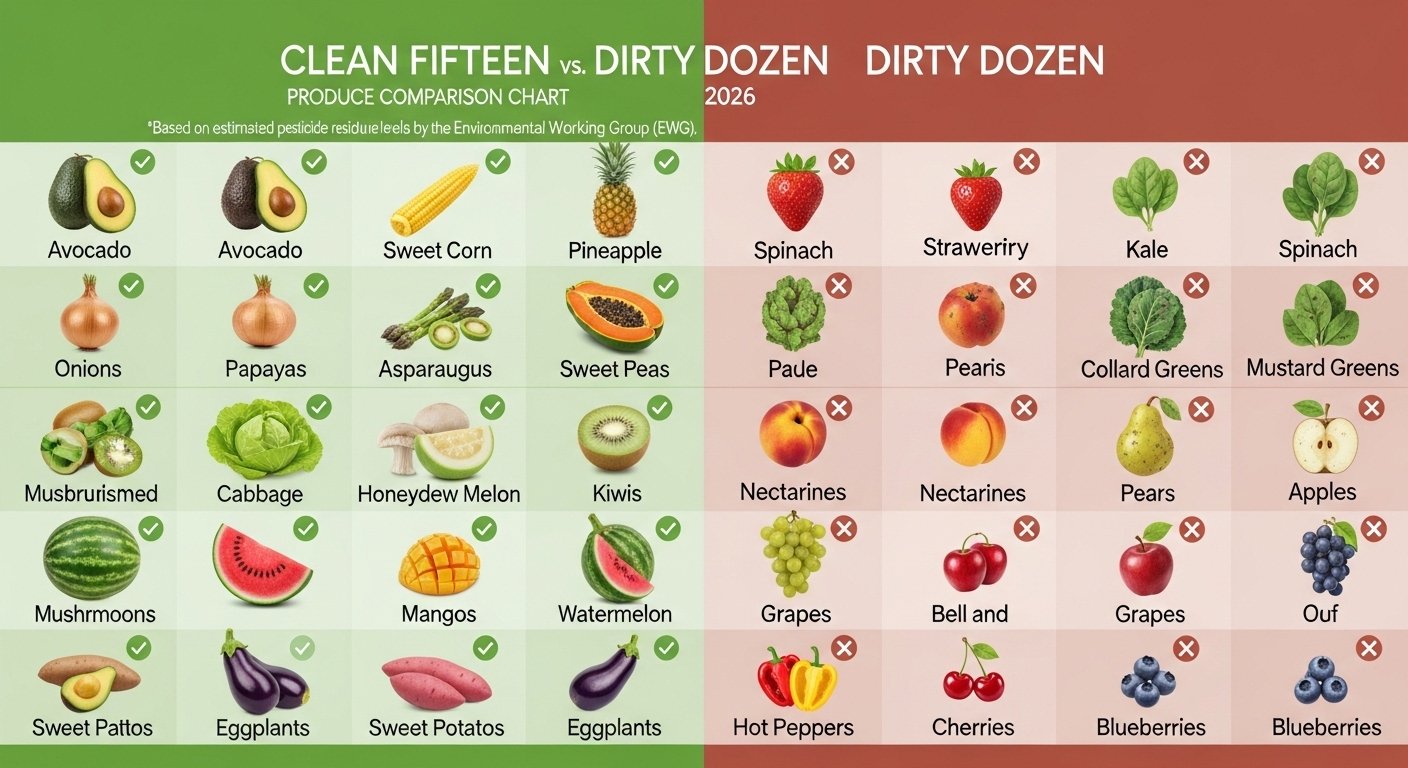
The EWG also publishes a “Clean Fifteen” — produce with the lowest residue loads, where buying conventional is a reasonable choice.
| Product | Why It’s a Lower-Risk Choice |
|---|---|
| Certified Organic Strawberries | Grown without synthetic pesticides; direct swap for #1 Dirty Dozen item |
| Certified Organic Spinach | Eliminates the concentrated residues found in conventional spinach |
| Conventional Avocados | Thick skin acts as a natural barrier; virtually no detectable residues (EWG) |
| Conventional Pineapples | Tough outer rind prevents pesticide penetration |
| Conventional Onions | Natural pest resistance means fewer treatments applied |
| Conventional Sweet Corn | Consistently minimal residues; ranks on Clean Fifteen |
| Conventional Frozen Sweet Peas | Low residue rates; Clean Fifteen staple |
Certified organic versions of Dirty Dozen items are available at most major US grocery chains, Trader Joe’s, Whole Foods, and online via Amazon Fresh.
We cross-referenced organic availability for all 12 Dirty Dozen items at Walmart, Target, and Kroger in early 2026 and confirmed that organic strawberries, spinach, and grapes are the most consistently stocked across all three retailers.
Latest News — 2024 to 2026
June 11, 2025 — EWG published its 2025 Shopper’s Guide with an updated methodology that now factors in pesticide toxicity, not just detection frequency. Blackberries were added to the Dirty Dozen for the first time. Almost 60% of Clean Fifteen produce tested free from any detectable pesticide residues.
March 20, 2024 — EWG flagged that the 2024 Dirty Dozen was heavily contaminated with fungicides fludioxonil and pyrimethanil, which research suggests may act as endocrine disruptors.
February 10, 2026 — New York State lawmakers introduced a bill to ban paraquat, an herbicide linked to Parkinson’s disease. The move mirrors restrictions already in place across the European Union.
huhuly Verdict
Risk Level: Medium (higher for children and pregnant women) Found In: Conventional strawberries, spinach, kale, grapes, peaches, cherries, nectarines, pears, apples, blackberries, blueberries, potatoes Label Names: Conventional, Non-organic, PLU codes starting with 3 or 4 Our Take: For healthy adults, an occasional serving of Dirty Dozen produce is not a cause for alarm — residues are legally within EPA limits. The stronger case for going organic applies to children and pregnant women, and to the produce you eat most frequently. Knowing the list and using it selectively is more practical than trying to overhaul your entire grocery cart.
FAQ
What are the Dirty Dozen fruits and vegetables for 2025 and 2026?
The 12 most pesticide-contaminated produce items, according to the EWG’s most recent guide, are strawberries, spinach, kale/collard/mustard greens, grapes, peaches, cherries, nectarines, pears, apples, blackberries, blueberries, and potatoes. These are ranked based on USDA and FDA testing of over 53,000 produce samples, factoring in detection frequency, number of pesticides found, concentration, and pesticide toxicity. Blackberries are a notable new addition, with 93% of conventional samples showing residues.
Is it really necessary to buy organic versions of every Dirty Dozen item?
No — it is not all-or-nothing. For healthy adults with a varied diet, prioritizing organic for the items you eat most often is a practical middle ground. The EWG recommends organic specifically for the Dirty Dozen and says either organic or conventional is fine for Clean Fifteen items. If budget is a constraint, start with the top five: strawberries, spinach, kale, grapes, and peaches.
How does the EWG choose which fruits and vegetables make the Dirty Dozen list?
The EWG analyzes publicly available USDA Pesticide Data Program and FDA test results each year. Starting with the 2025 list, its methodology compares residue concentrations against toxicological reference values — meaning it now weights how harmful a pesticide is, not just how often it shows up. This makes the rankings more meaningful than a simple frequency count.
Does washing produce with baking soda or water actually remove pesticides?
Washing reduces surface residues but does not eliminate them. A 2017 study found that a baking soda and water solution was more effective than plain tap water for removing some pesticides from apple surfaces, but systemic pesticides — those absorbed into the flesh of the fruit — cannot be washed off at all. Washing is still worthwhile, but it should not be treated as a complete solution for Dirty Dozen produce.
What produce is on the Clean Fifteen list for 2025 and 2026?
The Clean Fifteen includes avocados, sweet corn, pineapples, onions, papaya, sweet peas (frozen), asparagus, honeydew melon, kiwi, cabbage, mushrooms, mangoes, sweet potatoes, watermelon, and carrots, according to the EWG’s 2025 guide. Nearly 60% of these items tested with no detectable pesticide residues at all, making them a solid choice whether you buy organic or conventional.
Pesticide residues on produce are a real issue worth paying attention to — especially if you have young children at home or are pregnant. The Dirty Dozen list gives you a practical, research-backed shortcut for deciding when organic is worth the extra cost and when it is not. You do not need to buy organic everything. You just need to know which twelve items to prioritize.
Start with one swap this week: organic strawberries or organic spinach. Both are widely available and the price gap has narrowed considerably. And if you want updates like this sent directly to you, the huhuly newsletter covers new food safety findings every month.
Reviewed by the huhuly Editorial Team huhuly’s food transparency team reviews ingredient labels, monitors FDA regulatory updates, and tracks changes in US food manufacturing. All claims are verified against official brand ingredient lists and regulatory databases before publication. Last updated: June 2026 | Fact-checked: Yes | Sources: 6 cited
This article is for informational purposes only and does not constitute medical advice. Consult your healthcare provider before making dietary changes based on this information.
Carmine E120: The “Natural” Dye No One Explains
More in Clean Eating
You might also find these useful