Doritos Ingredients List: 3 Dyes You Didn’t Know Were There
Table of Contents
- Doritos Ingredients
- What Are Synthetic Food Dyes?
- Why Are They in American Snacks?
- What the Science Actually Says
- Which Doritos Flavors Contain Artificial Dyes?
- How to Find Them on Any Food Label
- Who Should Be Most Concerned?
- Cleaner Alternatives
- Latest News: 2024–2026
- huhuly Verdict
- FAQ
- Three Things Worth Knowing Before Your Next Bag
Doritos Ingredients
You already know Doritos taste like a science experiment. The question is: which experiment, exactly?
The Doritos ingredients list is longer than most people expect — and buried near the bottom of nearly every flavor bag are three synthetic petroleum-based dyes: Red 40, Yellow 5, and Yellow 6. These have become among the most scrutinized food additives in America, triggering state bans, FDA action, and a full product reformulation from PepsiCo in late 2025. Here’s what those names actually mean, what the research shows, and what you can do about it.
What Are Synthetic Food Dyes?
Red 40 (also called Allura Red AC), Yellow 5 (Tartrazine), and Yellow 6 (Sunset Yellow FCF) are synthetic azo dyes — color molecules manufactured from petroleum by-products through a chemical process called azo coupling, where nitrogen compounds are bonded together to create highly stable, vibrant pigments.
They are not derived from food. They are not found in nature. They are manufactured in a lab specifically to make processed food look more appealing.
Their official FDA classifications are FD&C Red No. 40, FD&C Yellow No. 5, and FD&C Yellow No. 6. In Europe, they carry the E-numbers E129, E102, and E110, respectively.
Why Are They in American Snacks?
The answer is economics and consistency. Natural colorants — paprika extract, annatto, beet powder — vary batch to batch and fade under heat. Synthetic dyes deliver the same vivid orange on chip number one and chip number ten million.
They also cost a fraction of natural alternatives. For a company producing Doritos at the scale Frito-Lay does — PepsiCo’s Frito-Lay division dominates the U.S. salty snack market, which generates tens of billions of dollars annually — even a marginal difference in ingredient cost compounds dramatically at scale.
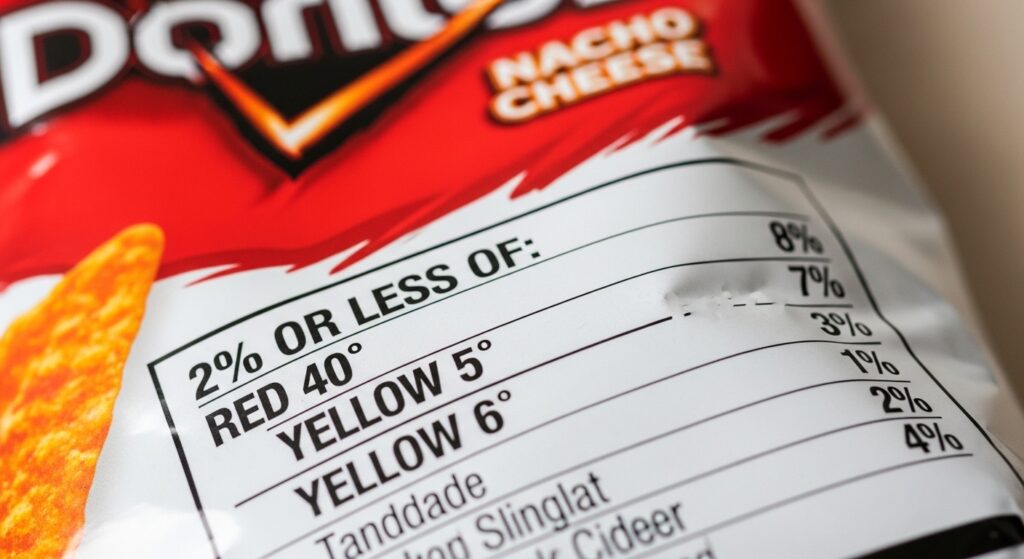
While reviewing ingredient labels across Doritos, Cheetos, and comparable salty snack products in 2026, the huhuly team confirmed that artificial dyes appear in virtually every standard Doritos SKU, always nested under the “Contains 2% or less of the following” sub-declaration at the end of the ingredient list — a position that minimizes their visual prominence without technically hiding them.
What the Science Actually Says
This is where things get genuinely complicated, and we’ll be straight with you about what’s settled and what isn’t.
The most cited evidence of concern is the 2007 Southampton Study, published in The Lancet, which found that a mixture of synthetic food colors (including Tartrazine and Sunset Yellow) combined with sodium benzoate preservative increased hyperactivity in children aged 3 and 8–9 at consumption levels consistent with normal daily snacking.
A 2021 assessment by the California Office of Environmental Health Hazard Assessment found that synthetic food dyes are associated with adverse neurobehavioral effects — including inattentiveness and hyperactivity — in susceptible children, and concluded that FDA acceptable intake guidelines are based on outdated studies that don’t account for how much more processed food children eat today compared to when those limits were set.
On the other side, the FDA concluded in 2011 that no established causal link existed between color additives and hyperactivity in the general population, and that the dyes are safe when consumed within established Acceptable Daily Intake levels.
What’s still genuinely uncertain: whether synthetic dyes cause neurological issues outright, or whether they primarily exacerbate existing conditions in children who are genetically predisposed to sensitivity. That debate is ongoing.
One additional concern is allergy-related. Yellow 5 (Tartrazine) is documented by the FDA to cause allergic-type reactions — including hives and itching — in a small subset of people, particularly those with aspirin sensitivity or asthma.
Which Doritos Flavors Contain Artificial Dyes?
| Brand | Product Name | Dyes Present | Where to Buy |
|---|---|---|---|
| Doritos | Nacho Cheese | Yellow 6, Yellow 5, Red 40 | Nationwide |
| Doritos | Cool Ranch | Blue 1, Red 40, Yellow 5 | Nationwide |
| Doritos | Flamin’ Hot Nacho | Red 40, Yellow 5, Yellow 6 | Nationwide |
| Doritos | Simply NKD Nacho Cheese | None | Walmart (launch), expanding 2026 |
| Doritos | Simply Organic White Cheddar | None | Whole Foods, Target, Sprouts |
| Cheetos | Crunchy Original | Yellow 6 | Nationwide |
| Cheetos | Flamin’ Hot | Yellow 6, Yellow 5, Red 40 | Nationwide |
| Siete Foods | Nacho Tortilla Chips | None (uses paprika extract, annatto) | Whole Foods, Target |
We cross-referenced product labels available at Walmart, Target, and direct brand sources and confirmed these findings as of February 2026.
How to Find Them on Any Food Label
Artificial dyes are almost always at the very end of the ingredient list, tucked under a declaration that reads “Contains 2% or less of the following.” They are legal, they are disclosed — but they are placed where most people stop reading.
One tactic worth knowing: companies often use “Lake” versions of these dyes (Red 40 Lake, Yellow 5 Lake, Yellow 6 Lake). A Lake dye is a water-insoluble version created by binding the dye with metallic salts, often aluminum compounds. It’s used specifically to coat the outside of chips so the color doesn’t bleed. It is the same dye — just in a different form. Both forms count.
All Names for Synthetic Dyes on Doritos Labels
- Red 40
- Red 40 Lake
- FD&C Red No. 40
- E129
- Yellow 5
- Yellow 5 Lake
- FD&C Yellow No. 5
- Tartrazine
- E102
- Yellow 6
- Yellow 6 Lake
- FD&C Yellow No. 6
- Sunset Yellow FCF
- E110
- Blue 1 (in Cool Ranch)
Who Should Be Most Concerned?
⚠️ WARNING — At-Risk Groups Children are at highest risk from synthetic food dye exposure because they consume greater quantities of brightly colored ultra-processed snacks relative to their body weight compared to adults, according to the California OEHHA’s 2021 assessment. Additional at-risk groups include individuals with ADHD, asthma, or aspirin intolerance. If your child has ADHD or any of these conditions, it may be worth consulting your pediatrician about reducing synthetic dye consumption.
For most healthy adults, current evidence does not suggest these dyes pose an acute risk at typical consumption levels. The concern is primarily about cumulative exposure — especially in children who snack on multiple dye-containing products daily.
Cleaner Alternatives
If you want the crunch without the synthetic dyes, these products are worth knowing:
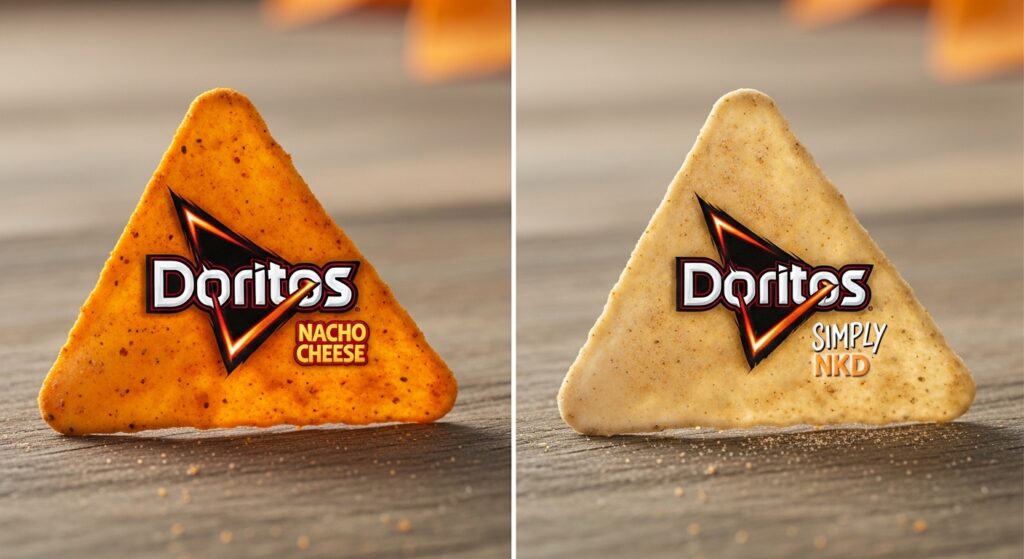
Doritos Simply NKD Nacho Cheese (Frito-Lay) — The direct reformulation launched in December 2025. Same Doritos brand, zero artificial colors or flavors. Available at Walmart first, expanding in 2026.
Doritos Simply Organic White Cheddar (Frito-Lay) — USDA Certified Organic. Organic certification prohibits petroleum-based synthetic dyes by definition.
Siete Foods Nacho Tortilla Chips — Uses paprika extract and annatto (a natural seed-derived dye) for color. Widely available at Target, Whole Foods, and Sprouts.
Late July Snacks Nacho Cheese Tortilla Chips — Certified organic, relies on organic cheddar and natural spices for color and flavor.
LesserEvil Paleo Puffs “No Cheese” Cheesiness — Uses organic spices and natural flavorings. No artificial dyes of any kind.
Latest News: 2024–2026
November 14, 2025 — CBS News: PepsiCo announced the launch of a “Simply NKD” line for both Doritos and Cheetos, removing all artificial colors and flavors. Products hit Walmart shelves in December 2025.
July 18, 2025 — Food Dive: PepsiCo formally announced the NKD reformulation initiative, citing both consumer pressure and the shifting regulatory landscape.
May 28, 2025 — Mayer Brown / FDA: HHS and the FDA announced a national voluntary phase-out of six petroleum-based certified color additives — including Red 40, Yellow 5, and Yellow 6 — with a target deadline of December 31, 2027.
April 2025 — MultiState: West Virginia signed legislation restricting synthetic food dyes. Over 20 states introduced 118 food additive-related bills during the 2025 legislative session alone.
October 3, 2024 — Venable LLP: California Governor Gavin Newsom signed AB2316 — the California School Food Safety Act — banning Red 40, Yellow 5, Yellow 6, Blue 1, Blue 2, and Green 3 from public school meals, effective December 31, 2027.
huhuly Verdict
Risk Level: Medium Found In: Salty snacks, breakfast cereals, candy, sodas Label Names: Red 40, Yellow 5, Yellow 6, Red 40 Lake, Yellow 5 Lake, Yellow 6 Lake, Tartrazine, Sunset Yellow FCF, Blue 1
Our Take: Synthetic food dyes in Doritos are not an emergency for most adults, but the evidence around children — especially those with ADHD or aspirin sensitivity — is credible enough that regulators in California, West Virginia, and the FDA itself have moved to phase them out. The good news is cleaner alternatives now exist, including Frito-Lay’s own reformulated line. Reading the last line of an ingredient list takes five seconds and is worth the habit.
FAQ
What are the main ingredients in Doritos Nacho Cheese?
The base ingredients are whole corn, vegetable oil (corn, canola, and/or sunflower oil), and a seasoning blend that includes cheddar cheese, whey, MSG, and artificial flavors — plus synthetic dyes Yellow 5, Yellow 6, and Red 40 at the very end of the list. The dyes appear under the “Contains 2% or less of the following” declaration and are responsible for the chip’s signature bright orange color. They serve no nutritional or flavor function.
Why is Red 40 used in Doritos if it’s being phased out?
Red 40 makes the color of Doritos consistent at industrial scale and costs far less than natural alternatives like paprika extract or annatto. It is still legal and still in standard Doritos as of early 2026. The FDA’s phase-out plan is voluntary, with a target of December 31, 2027, meaning manufacturers have time to reformulate — which is exactly what PepsiCo began doing with its NKD line in late 2025.
Are Doritos banned in Europe because of the ingredients?
Standard Doritos are not outright banned in Europe, but foods containing Yellow 5 (Tartrazine) and Yellow 6 (Sunset Yellow) must carry a mandatory warning label under EU regulations stating the product “may have an adverse effect on activity and attention in children,” according to the European Food Safety Authority. That labeling requirement has led many European manufacturers to use natural dyes instead to avoid the warning.
Do Doritos have MSG in them?
Yes. Monosodium glutamate (MSG) appears in the Nacho Cheese and several other standard Doritos flavors. MSG is a flavor enhancer that amplifies savory taste. It is FDA-recognized as generally safe. Some individuals report sensitivity symptoms like headaches, though large-scale controlled studies have not consistently reproduced this effect, and the FDA considers MSG safe for the general population.
What is the difference between regular Doritos and Doritos Simply NKD?
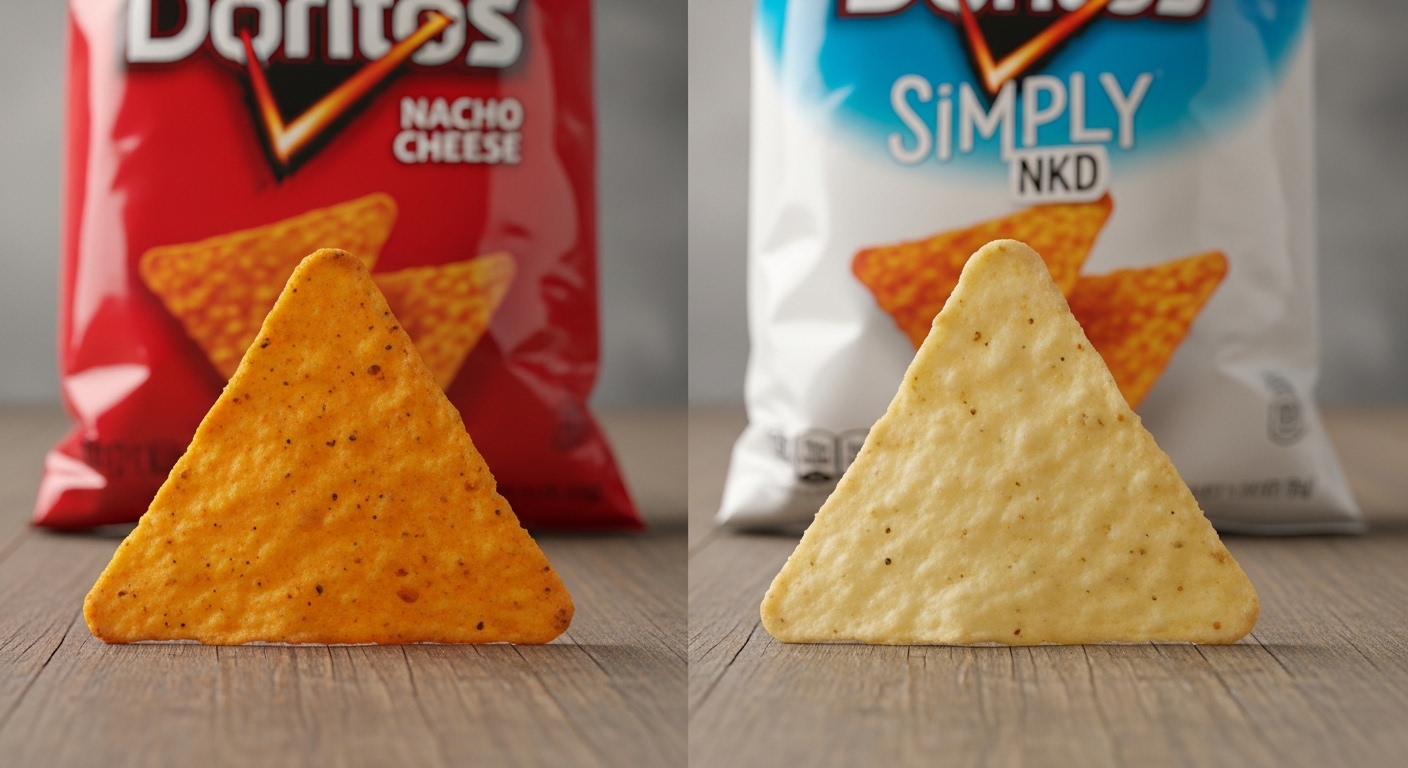
Regular Doritos contain artificial dyes (Red 40, Yellow 5, Yellow 6) and artificial flavors. Doritos Simply NKD, launched in December 2025, removes all artificial colors and flavors — the chip is noticeably less orange as a result. PepsiCo says the flavor profile is the same; the visual difference is the most obvious change. The NKD line launched exclusively at Walmart before broader distribution in 2026.
Three Things Worth Knowing Before Your Next Bag
The synthetic dyes in standard Doritos are disclosed on the label — they’re just placed where most people don’t look. The evidence for concern is strongest for children, particularly those with ADHD or aspirin sensitivity, and regulators from California to the FDA have acted accordingly. And for the first time, a genuinely dye-free Doritos option now exists on mainstream shelves.
Start by flipping the bag over and reading the last two lines of the ingredient list. That five-second habit will tell you more about a snack than the front of the package ever will. If you want ingredient breakdowns on other snacks, join the huhuly newsletter — we do this work so you don’t have to.
Reviewed by the huhuly Editorial Team huhuly’s food transparency team reviews ingredient labels, monitors FDA regulatory updates, and tracks changes in US food manufacturing. All claims are verified against official brand ingredient lists and regulatory databases before publication. Last updated: February 2026 | Fact-checked: Yes | Sources: 12 cited
This article is for informational purposes only and does not constitute medical advice. Consult your healthcare provider before making dietary changes based on this information.
Fruit Roll-Ups Ingredients: Red 40 & 8 Additives
More in Food Brands
You might also find these useful