Enriched Flour vs Whole Grain: 5 Nutrients Never Replaced
What Is the Difference Between Enriched Flour vs Whole Grain Flour?
Your bread says “wheat.” Your crackers say “multigrain.” Your cereal says “made with whole grains.” But flip the box and read the first ingredient. Odds are, it says enriched wheat flour — not whole grain.
That one word difference — enriched versus whole — matters more than most food marketing will ever tell you. According to NHANES data, roughly 84% of all grain foods consumed daily by Americans come from refined or enriched flour bases. The enriched flour vs whole grain distinction isn’t a niche nutrition debate. It’s baked into the foods feeding most of the country.
The huhuly team reviewed ingredient labels across dozens of bread, cereal, cracker, and pasta products in early 2026. In every category, enriched flour appeared as the first ingredient — ahead of water, sugar, and everything else — even on products marketed as “healthy” or “multigrain.”
Here’s what that actually means for your plate.
Table of Contents
- What Is the Difference Between Enriched Flour vs Whole Grain Flour?
- What Is Enriched Flour?
- Why Is Enriched Flour in Almost Every American Food?
- What Does the Science Actually Say?
- Which Brands and Products Contain Enriched Flour?
- How Do You Find Enriched Flour on a Food Label?
- Who Should Be Most Concerned About Enriched Flour?
- What Are the Cleanest Alternatives to Enriched Flour?
- What’s Happening With Enriched Flour Regulations in 2024–2026?
- huhuly Verdict
- FAQ
- Three Things to Take Away — and One to Do Today
What Is Enriched Flour?
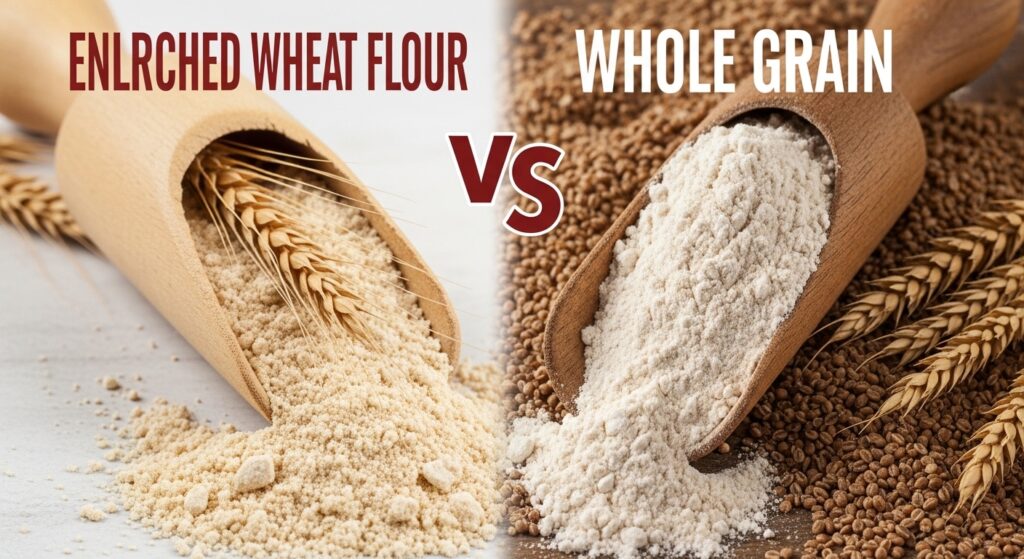
Enriched flour is refined white flour — stripped of its bran and germ during industrial milling, then artificially refortified with five synthetic nutrients: thiamin, riboflavin, niacin, folic acid, and iron. The FDA legally defines the exact amounts each pound must contain under 21 CFR Section 137.165. Critically, the hundreds of other compounds lost during milling — dietary fiber, Vitamin E, zinc, copper, carotenoids — are never added back.
Whole grain flour keeps the entire wheat kernel intact: the bran, the endosperm, and the germ. That intact structure is where most of the nutrition lives.
The milling process was industrialized in the late 19th century using abrasive steel rollers. The outer bran — rich in fiber, B vitamins, and minerals — and the germ — concentrated with polyunsaturated fats and Vitamin E — are physically stripped away. What remains is the starchy endosperm, which is ground into fine white flour.
According to research presented at NUTRITION 2024 by the American Society for Nutrition, roller-milling reduces major minerals like calcium, magnesium, and potassium by up to 72% compared to stone-milled whole wheat. Trace minerals including copper, zinc, and molybdenum drop by up to 64%. Baking then destroys more than 80% of whatever Vitamin E survives.
The synthetic nutrients added back are highly specific compounds. Thiamin is introduced as thiamine mononitrate. Niacin is added as niacinamide. Iron can be integrated as ferrous sulfate, ferrous fumarate, or electrolytic iron. Five nutrients in — hundreds of nutrients out.
Why Is Enriched Flour in Almost Every American Food?
Enriched flour is everywhere because it solves real commercial problems that whole grain flour cannot. The wheat germ contains natural oils that oxidize quickly, making whole grain flour go rancid within weeks. Strip the germ, and you get a shelf-stable product that ships globally without degradation.
In baking, fibrous bran particles physically cut through gluten proteins, producing heavier, denser products. Refined flour creates an uninterrupted gluten network that traps carbon dioxide efficiently — giving commercial bread, crackers, and pastries their light, uniform texture. It also has a neutral flavor that whole wheat cannot match, avoiding the bitter, earthy notes from bran tannins.
The enrichment mandate itself was a public health intervention. In 1941, the U.S. government required fortification of refined grains to combat widespread deficiency diseases. Pellagra and beriberi were virtually eradicated. In 1998, the FDA added mandatory folic acid specifically to reduce neural tube birth defects in newborns.
That context matters — enriched flour exists partly because it works as a nutrient delivery vehicle, even if it’s not the best possible food.
While reviewing ingredient lists across over 40 US bread and cereal products available at major retailers in early 2026, the huhuly team confirmed that zero major commercial sandwich bread brands list whole wheat flour as the first ingredient without also including an enriched flour variant in the same product line.
What Does the Science Actually Say?
The science on enriched flour is clearer on some points than others.
A 2021 study in The BMJ, drawing on the international PURE dataset spanning 21 countries, found that high consumption of refined grains was directly associated with higher total mortality, elevated systolic blood pressure, and major cardiovascular disease events. No equivalent harm was linked to whole grain intake.
A 2023 analysis across three large U.S. cohort studies published in Diabetes Care found that high intake of ultra-processed foods — overwhelmingly formulated from refined wheat flour — correlated with increased type 2 diabetes onset. The researchers identified the absence of dietary fiber and the loss of natural food structure as primary mechanisms.
On the other side, a 2020 review in Advances in Nutrition found that enriched staple grains have driven measurable public health progress. Mandatory folic acid fortification reduced the percentage of Americans failing to meet adequate folate intake from 88% to 11%. Iron deficiency dropped from 22% to 7%. For populations where whole grain access is inconsistent, enriched flour still prevents documented harm.
According to the Harvard T.H. Chan School of Public Health’s Nutrition Source, the intact fibrous structure of whole grains slows starch digestion and improves glycemic response — a benefit refined flour cannot replicate.
The core unresolved question is whether metabolic harm attributed to refined flour comes from the flour itself, or from the combination of flour with added sugars, industrial seed oils, and emulsifiers in ultra-processed products. Researchers are also actively investigating whether Unmetabolized Folic Acid (UMFA) — which accumulates in the blood from chronic enriched flour consumption — may predispose children to broader food allergies. Current research on that question is still limited.
Which Brands and Products Contain Enriched Flour?
Almost every mainstream bread, cracker, cereal, and pasta brand uses enriched flour as its structural base.
| Brand | Product | Where to Buy | Contains Enriched Flour? |
|---|---|---|---|
| Wonder | Classic White Bread | Nationwide grocery | Yes — first ingredient |
| Nabisco | Ritz Crackers | Nationwide grocery | Yes — first ingredient |
| Nabisco | CHIPS AHOY! Mini Chocolate Chip Cookies | Kroger, Smith’s | Yes — first ingredient |
| Nabisco | “Whole Grain” Premium Saltine Crackers | Nationwide grocery | Yes — despite the whole grain label claim |
| Keebler | Sandies Pecan Shortbread Cookies | Kroger, Baker’s, Smith’s | Yes — first ingredient |
| Post Consumer Brands | Honey Bunches of Oats Protein Cereal | Nationwide | Yes — enriched grain base |
| Post Consumer Brands | Cinnamon PEBBLES Cereal | Nationwide | Yes — enriched grain base |
| King Arthur Baking Co. | All-Purpose Unbleached Flour | Amazon, nationwide | Yes — pure enriched flour product |
| Kroger Smart Way | Iced Oatmeal Cookies | Kroger, Baker’s | Yes — first ingredient |
| USDA Foods (CSFP) | Pasta, Macaroni Enriched | Government distribution | Yes — by federal definition |
We cross-referenced 10 product labels available at Kroger, Smith’s, and Amazon and confirmed enriched wheat flour appears as the primary ingredient in all cases as of March 2026.
NOTE: In August 2024, a class-action lawsuit (Ransom v. Mondelez Global LLC) targeted Nabisco’s “Whole Grain Premium Saltines” for allegedly deceptive labeling. The primary ingredient is enriched flour. The actual whole grain content was characterized by the plaintiff as “de minimis.”
How Do You Find Enriched Flour on a Food Label?
⚠ WARNING: The word “wheat” on a food label does not mean whole grain. Under FDA regulations (21 CFR 137.105), “wheat flour” is legally synonymous with refined white flour. Products branded as “wheat bread,” “made with wheat,” or “100% wheat” can be built entirely from enriched refined flour.
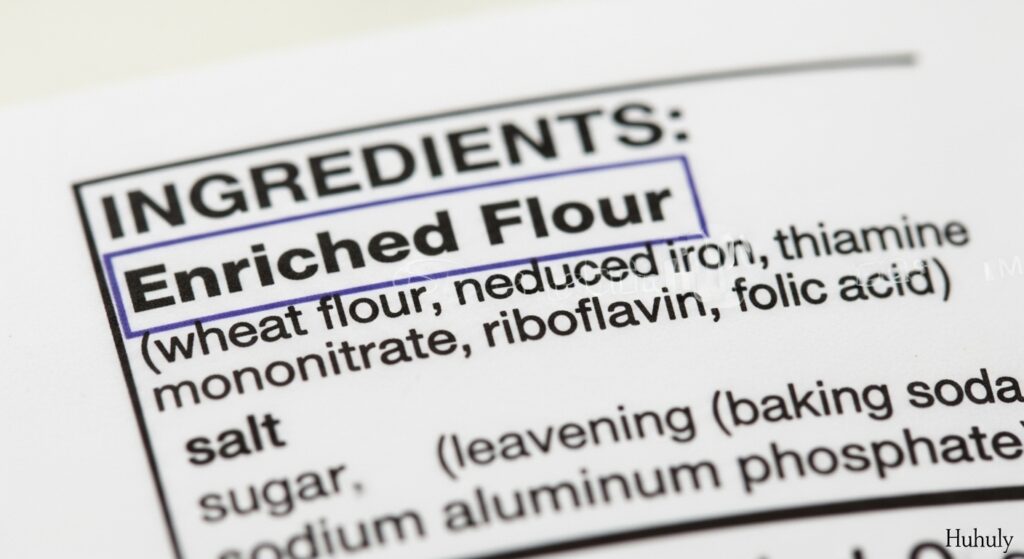
When you see “Enriched Wheat Flour” or “Enriched Flour” on a US label, federal law requires an immediate parenthetical: (wheat flour, niacin, reduced iron, thiamin mononitrate, riboflavin, folic acid). That parenthetical is the fingerprint of refined flour.
All Names for Enriched Flour on Labels
- Enriched Wheat Flour
- Enriched Flour
- Wheat Flour (does not mean whole grain under US law)
- White Flour / Enriched White Flour
- All-Purpose Flour / Unbleached All-Purpose Flour
In international markets, the enrichment additives carry E-numbers: E101 or E101a for riboflavin, E300 for ascorbic acid used as a dough conditioner, E282 for calcium propionate (a standard preservative in commercial enriched breads), and E481 for sodium stearoyl-2-lactylate (an emulsifier).
Enriched flour always appears first or second in the ingredient list. Because it provides the structural bulk of baked goods, it’s almost universally the primary ingredient by weight. In wet-dough products like sliced bread, it follows water in position two.
Three labeling tactics to watch:
Manufacturers add caramel color or molasses to turn enriched white bread brown — creating a visual impression of whole grain where none exists. “Multigrain” products frequently contain 70–80% enriched white flour with a minor addition of oats or millet for marketing. The phrase “Made with Whole Grains” on packaging does not mean whole grain is the primary ingredient — only the ingredient list position confirms that.
Who Should Be Most Concerned About Enriched Flour?
⚠ WARNING — AT-RISK GROUPS: People with type 2 diabetes, insulin resistance, or metabolic syndrome should pay careful attention to enriched flour intake. Because refining removes dietary fiber, enriched flour converts to glucose rapidly, spiking blood sugar and stressing already-compromised metabolic systems. Speak with a healthcare provider before making significant changes to your grain consumption.
People managing cardiovascular disease or hypertension face additional concerns. The BMJ PURE study — spanning 21 countries — linked high refined grain consumption directly to elevated systolic blood pressure and significantly increased cardiovascular events.
Children are especially exposed. Ultra-processed, sweetened cereals built on enriched flour dominate marketing to young audiences. The 2025–2030 Dietary Guidelines explicitly instruct parents to reduce these foods. Pediatric nutritionists caution, however, that abrupt removal risks iron and B-vitamin gaps if whole grain replacements aren’t introduced at the same time.
Pregnant women face a genuine paradox. Synthetic folic acid in enriched flour actively protects against neural tube defects like spina bifida. Women reducing enriched flour intake during pregnancy should confirm supplemental folic acid levels with their provider — the protection is real and shouldn’t be abandoned without a plan.
According to NHANES data, Hispanic adults average 7.01 ounce equivalents of refined grains per day, with whole grains representing only 11.1% of their total grain intake — among the highest refined flour exposure of any demographic group in the US.
All people with celiac disease or non-celiac gluten sensitivity cannot safely consume any wheat flour, enriched or whole grain.
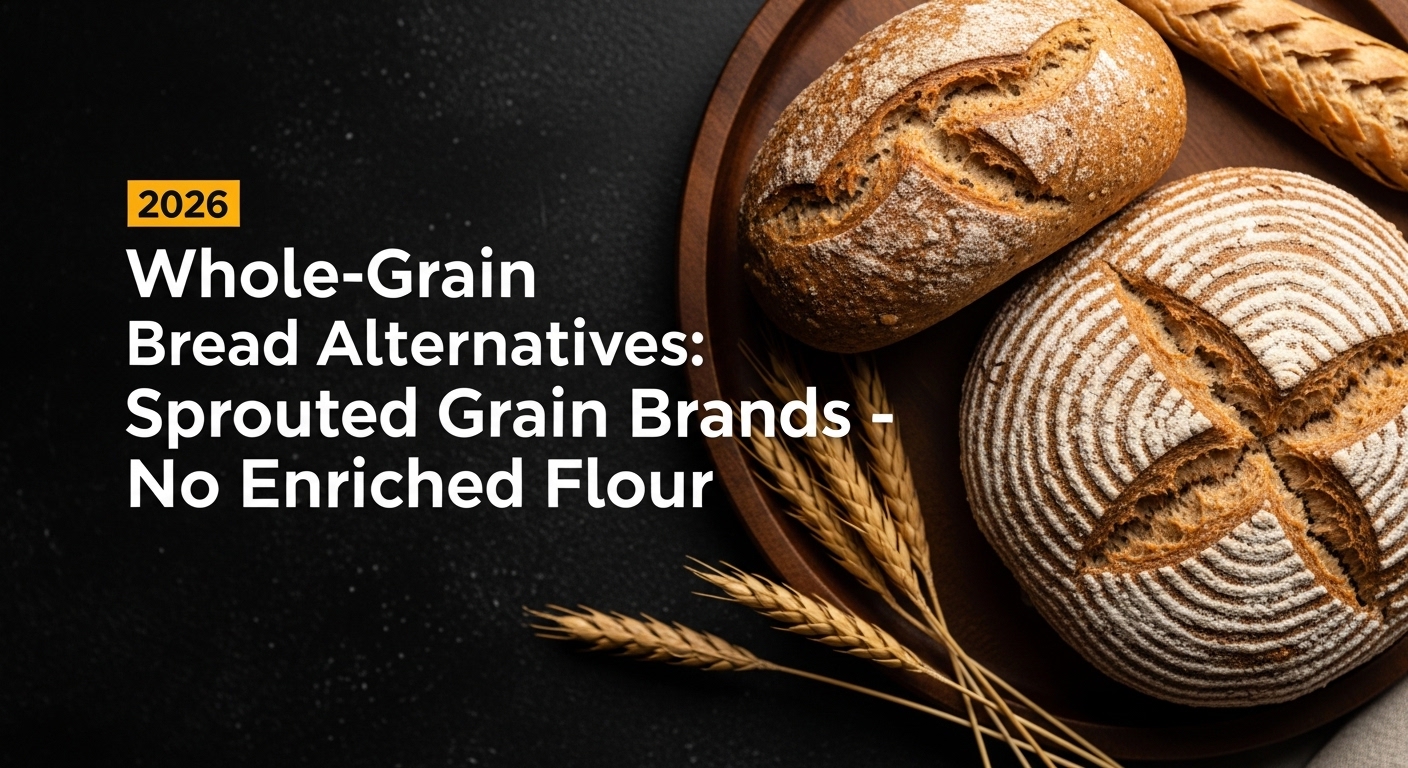
What Are the Cleanest Alternatives to Enriched Flour?
| Brand | Product | What Makes It Better | Where to Buy |
|---|---|---|---|
| Food for Life | Ezekiel 4:9 Sprouted Grain Bread | Completely flourless; sprouting neutralizes phytic acid and raises natural nutrient bioavailability | Nationwide grocery |
| Dave’s Killer Bread | White Done Right | Organic whole grain base with 3g protein and 2g natural fiber per slice; soft texture | Nationwide grocery |
| Silver Hills Sprouted Bakery | Little Big Bread | Sprouted whole wheat; retains natural B-vitamin and fiber matrix without synthetic enrichment | Nationwide grocery |
| Base Culture | Sourdough Bread | Grain-free, gluten-free, paleo-certified; cashew butter, arrowroot, golden flaxseed | Amazon, Thrive Market |
| King Arthur Baking Co. | 100% Whole Wheat Flour | Single ingredient; entire kernel of hard red winter wheat; no enrichment needed | Amazon, nationwide retail |
| Mestemacher | Whole Rye Bread | Zero refined wheat flour; high-fiber, low-glycemic European-style whole grain | Select grocery / online |
| Cairnspring Mills | Stone-Milled Whole Grain Flour | First flour company globally to earn Climate Label certification (March 2026); stone-milled to preserve full nutritional layers | Online / specialty retail |
What’s Happening With Enriched Flour Regulations in 2024–2026?
The regulatory climate shifted faster in this period than at any point since the original 1941 enrichment mandate.
February 27, 2026 — The Western Producer: Former FDA Commissioner Dr. David Kessler formally filed citizen petition FDA-2025-P-3071 requesting the FDA revoke GRAS status for processed refined carbohydrates, including enriched flour. The petition argues that refining produces compounds that overwhelm human metabolic pathways, accelerating liver fat accumulation and cardiometabolic disease.
February 15, 2026 — CBS News / 60 Minutes: HHS Secretary Robert F. Kennedy Jr. confirmed on national television that the federal government will act on the Kessler petition, calling the GRAS loophole questions the FDA should have addressed “a long, long time ago.”
January 7, 2026 — HHS / USDA: The 2025–2030 Dietary Guidelines for Americans were released, explicitly instructing Americans to “significantly reduce the consumption of highly processed, refined carbohydrates” including white bread, crackers, and flour tortillas.
2024 — FDA Final Rule: Enriched white bread and heavily sweetened fortified cereals were stripped of eligibility for the “healthy” label claim. Mandatory industry compliance is required by February 25, 2028.
August 2024 — JD Supra: The Ransom v. Mondelez Global LLC class action targeted Nabisco’s “Whole Grain Premium Saltines” for allegedly deceptive labeling, with enriched flour confirmed as the dominant ingredient.
State level: By early 2026, 38 states had introduced over 140 pieces of food additive legislation targeting refined and ultra-processed food ingredients. West Virginia became the first state to enact comprehensive food additive restrictions. New York’s pending “Food Safety and Chemical Disclosure Act” would explicitly reject FDA GRAS status as a valid legal defense for ingredient safety. Texas’s SB 25 — which would have required warning labels on foods containing bleached flour — was blocked by a federal court in February 2026 on First Amendment grounds.
huhuly Verdict
Risk Level: Medium (higher for metabolic and cardiovascular populations) Found In: Bread, crackers, pasta, breakfast cereal, cookies, pastries, pizza dough, flour tortillas Label Names: Enriched Wheat Flour, Enriched Flour, Wheat Flour, All-Purpose Flour, White Flour Our Take: Enriched flour is not a threat in occasional use, but it forms the foundation of the ultra-processed food system that federal guidelines now explicitly tell Americans to reduce. The folic acid it delivers is still critical for certain populations — particularly pregnant women. The cleaner path is making whole grain your default grain and treating enriched flour as the occasional exception rather than the daily staple.
FAQ
Is enriched flour bad for you if you eat it every day?
Enriched flour is not acutely harmful, but daily consumption — especially as your primary grain source — is linked to elevated blood sugar, cardiovascular risk, and reduced dietary fiber intake. Research from the BMJ’s international PURE study associates high refined grain consumption with higher mortality and blood pressure across 21 countries. The 2025–2030 Dietary Guidelines specifically recommend reducing daily intake of foods built on refined flour bases, while acknowledging that enriched grains still deliver important shortfall nutrients.
What is the difference between wheat flour and enriched wheat flour?
They are legally the same base product under FDA rules. “Wheat flour” (21 CFR 137.105) refers to refined white flour by federal definition — not whole grain. When the product is further fortified with five specific synthetic nutrients — niacin, reduced iron, thiamin mononitrate, riboflavin, and folic acid — it earns the “enriched” designation. Neither term confirms whole grain content. Only “whole wheat flour” listed first in the ingredient deck confirms a whole grain product.
Why is folic acid added to enriched flour?
The FDA mandated folic acid fortification of all enriched grain products in 1998 specifically to protect against neural tube birth defects — including spina bifida and anencephaly — during early fetal development. These defects form in the first weeks of pregnancy, often before a woman knows she is pregnant. Research indicates mandatory fortification reduced the rate of neural tube defects substantially in the US population, making this one of the most documented public health wins of the enrichment program.
Does enriched flour have gluten in it?
Yes. Enriched flour is made from wheat and contains gluten — the protein network formed by glutenin and gliadin that gives dough its elasticity. Individuals with celiac disease experience a serious autoimmune response to gluten that causes intestinal damage regardless of whether the flour is enriched or whole grain. Non-celiac gluten sensitivity produces similar symptoms without the autoimmune mechanism. The enrichment process adds synthetic vitamins and iron; it does not alter the gluten content.
How can you tell if a bread is actually whole grain or just enriched flour?
Read the first ingredient. If it says “whole wheat flour” or another intact whole grain first, the product is primarily whole grain. If it says “enriched wheat flour,” “enriched flour,” or “wheat flour” first, you are buying refined starch — regardless of how the packaging looks or what the front label claims. Brown color, the word “multigrain,” and phrases like “made with whole grains” are not reliable confirmations. Position one in the ingredient list is the only definitive test.
Three Things to Take Away — and One to Do Today
Enriched flour replaced vital nutrition with a partial synthetic substitute. The five added nutrients are real and have prevented genuine harm — but the fiber, minerals, Vitamin E, and phytonutrients stripped during milling are not restored. That gap compounds over decades of daily intake.
The regulatory environment is shifting in ways it hasn’t since 1941. From the 2025–2030 Dietary Guidelines to the pending GRAS challenge filed by former FDA Commissioner Kessler, federal nutrition policy is formally moving away from refined grains for the first time in generations.
You don’t need to eliminate enriched flour — but it should stop being treated as a neutral default. Whole grain as your baseline, enriched flour as the occasional ingredient.
Do this today: Flip the next loaf of bread you buy and read the first ingredient. If it doesn’t say “whole wheat flour,” you’re holding an enriched product. You get to decide from there — but now you’re reading the label.
Want this level of ingredient research for every food category? Join the huhuly list.
Reviewed by the huhuly Editorial Team huhuly’s food transparency team reviews ingredient labels, monitors FDA regulatory updates, and tracks changes in US food manufacturing. All claims are verified against official brand ingredient lists and regulatory databases before publication. Last updated: March 2026 | Fact-checked: Yes | Sources: 30+ cited
This article is for informational purposes only and does not constitute medical advice. Consult your healthcare provider before making dietary changes based on this information.
Types of Food Preservatives: 5 Linked to Cancer
More in Food Guides
You might also find these useful