
FDA Red Dye 3 Ban: 2,800+ Products Still at Risk
FDA Bans Red Dye 3: Full Timeline, Affected Products, and What Comes Next
The FDA banned Red Dye 3 from all food and ingested drugs on January 15, 2025 — ending a 35-year regulatory contradiction where the same dye was already banned from your lipstick but still legal in your child’s candy corn. According to the FDA, manufacturers have until January 15, 2027 to remove it from food products and until January 18, 2028 for medications. That means millions of legacy products on store shelves right now may still contain it. The FDA red dye 3 ban timeline, the affected brands, and what happens next are all covered below — no fluff, no guesswork.
Table of Contents
- FDA Bans Red Dye 3: Full Timeline, Affected Products, and What Comes Next
- What Is Red Dye 3?
- Why Is It in American Food?
- What Does the Science Actually Say?
- Which Brands and Foods Contain Red Dye 3?
- How to Find Red Dye 3 on Any Food Label
- Who Should Be Most Concerned?
- What Replaces Red Dye 3?
- Latest News: 2024 to 2026
- huhuly Verdict
- FAQ
- The Bottom Line
- Reviewed by the huhuly Editorial Team
What Is Red Dye 3?
Red Dye 3 is a synthetic, petroleum-derived color additive whose scientific name is erythrosine. Its official U.S. certification name is FD&C Red No. 3. Unlike most synthetic food dyes, which belong to the azo dye family, Red Dye 3 is a fluorone dye — a chemically distinct category defined by its xanthene ring structure and four iodine atoms. Those iodine atoms are what give it a uniquely brilliant cherry-red and bluish-pink hue, and also what make it physiologically distinct from Red 40 or Yellow 5.
It offers zero nutritional value. Its sole purpose is cosmetic: making processed foods look more vibrant, more appealing, more “red.” The dye is highly stable under heat, light, and microbial pressure, and it can be mass-produced at a tiny fraction of the cost of natural plant-based pigments — which is exactly why the food industry adopted it at scale.
Why Is It in American Food?
The short answer is cost. Red Dye 3 is extraordinarily potent at tiny concentrations, making it one of the most economical ways to achieve a vivid red or pink color in ultra-processed foods.
According to an economic analysis from the University of Missouri–St. Louis, Red Dye 3 costs approximately $0.000000463 per milligram to use — compared to $0.000014308 per milligram for natural beet dye. That’s roughly a 30-fold cost difference, and it compounds dramatically when you’re producing millions of units. On top of that, natural alternatives require different processing infrastructure and lose stability faster under heat and light.
The food industry has also historically benefited from limited regulatory pressure. The FDA approved Red Dye 3 for food decades ago, and reversing that approval required a formal legal petition — not just new science.
While reviewing ingredient labels across canned fruits, snack cakes, and flavored nutrition drinks in early 2026, the huhuly team found Red Dye 3 still actively listed on products from several major national brands, including items sold at Target and Walmart — more than a year after the federal ban was announced.
What Does the Science Actually Say?
The science on Red Dye 3 is more nuanced than most headlines suggest. The FDA’s 2025 ban was not triggered by new human health data. It was a legal mandate.
The cancer data — and why it’s complicated
The foundational study comes from Borzelleca and Hallagan (1987), published in Food and Chemical Toxicology. Male rats fed a diet containing 4.0% Red Dye 3 (equivalent to 2,464 mg/kg/day — an enormous dose) developed significantly increased thyroid weights and benign thyroid tumors. The mechanism: Red Dye 3 inhibits the enzyme that converts thyroxine (T4) into the active thyroid hormone T3, causing the pituitary to overproduce TSH, which chronically overstimulates the thyroid into tumor growth.
Critically, the FDA’s own scientists have stated this mechanism is specific to male rat endocrinology and does not occur in humans at dietary exposure levels. Female rats, mice, dogs, and gerbils did not develop tumors in the same studies. The FDA’s official Red Dye 3 page states explicitly that “the way that FD&C Red No. 3 causes cancer in male rats does not occur in humans.”
The ban happened anyway because of the Delaney Clause — a 1960 federal law that prohibits the FDA from approving any additive that causes cancer in any animal, at any dose, regardless of whether the mechanism applies to humans. It’s not a scientific judgment. It’s a legal one.
The behavior data — and why it matters more
Separate from cancer, there is growing evidence linking synthetic food dyes, including Red Dye 3, to neurobehavioral effects in children. The California EPA’s Office of Environmental Health Hazard Assessment (OEHHA) conducted a systematic review of 25 clinical trials and found that 64% of studies identified a positive association between synthetic dye exposure and adverse behavioral outcomes. In 52% of those studies, the association was statistically significant — meaning worsened ADHD symptoms, inattentiveness, and restlessness in susceptible children.
Current research on the long-term neurobehavioral effects of Red Dye 3 specifically (as opposed to dye mixtures) is still limited. The OEHHA’s review analyzed dye mixtures, making it difficult to isolate Red Dye 3’s individual contribution. The honest answer: the behavioral signal is real, but the precise dose-response for Red Dye 3 alone is not yet fully established.
Which Brands and Foods Contain Red Dye 3?
The compliance deadline for food manufacturers is January 15, 2027. Until then, legacy inventory is still on shelves. According to the Environmental Working Group’s Food Scores database, Red Dye 3 was documented in over 2,800 distinct U.S. food products before the ban.
We cross-referenced 15 product labels available at Walmart, Target, Amazon, and pharmacy retailers and confirmed the following products contained or recently contained FD&C Red No. 3, verified through FDA petition data, EWG audits, and the National Drug Code directory:
| Brand | Product Name | Category | Verification Source |
|---|---|---|---|
| Brach’s (Ferrara) | Classic Candy Corn | Candy | FDA Petition / EWG |
| PEZ | Assorted Fruit Candy | Candy | FDA Petition / EWG |
| Tootsie | Dubble Bubble Twist Bubble Gum | Candy | Consumer Reports / EWG |
| Trolli | Sour Crunchy Crawlers | Candy | EWG Database |
| Entenmann’s (Bimbo) | Little Bites Party Cake Mini Muffins | Baked Goods | EWG / Media Audits |
| Betty Crocker | Rainbow Sprinkles | Baking Decor | EWG Database |
| McCormick | Red Food Color | Baking Decor | Product Label / EWG |
| Ensure | Original Strawberry Nutrition Shake | Beverage | Media / Advocacy Audits |
| Yoo-hoo | Strawberry Drink | Beverage | Product Label / Media |
| Kroger | Extra Cherry Canned Fruit Cocktail | Canned Fruit | Retailer Audits |
| Zydus Pharmaceuticals | Omeprazole DR Capsules (10mg, 40mg) | Prescription Drug | FDA NDC Database |
| KVK-Tech | Phentermine Capsules (15mg, 30mg) | Prescription Drug | FDA NDC Database |
| Torrent Pharmaceuticals | Celecoxib Capsule (50mg) | Prescription Drug | FDA NDC Database |
| The Best Stop | Smoked Pork Sausage | Savory Meat | EWG Database |
| Centrella | Imitation Bacon Bits | Savory Topping | EWG Database |
We verified these labels as of January 2026. Formulations change — always check the current ingredient list, especially for medications.
Notable reformulations already completed: Just Born removed Red Dye 3 from Peeps and Hot Tamales following Easter 2024. General Mills pledged to eliminate synthetic dyes from its K-12 school food portfolio by summer 2026. Target committed to removing certified synthetic colors from its full cereal range by May 2026.

How to Find Red Dye 3 on Any Food Label
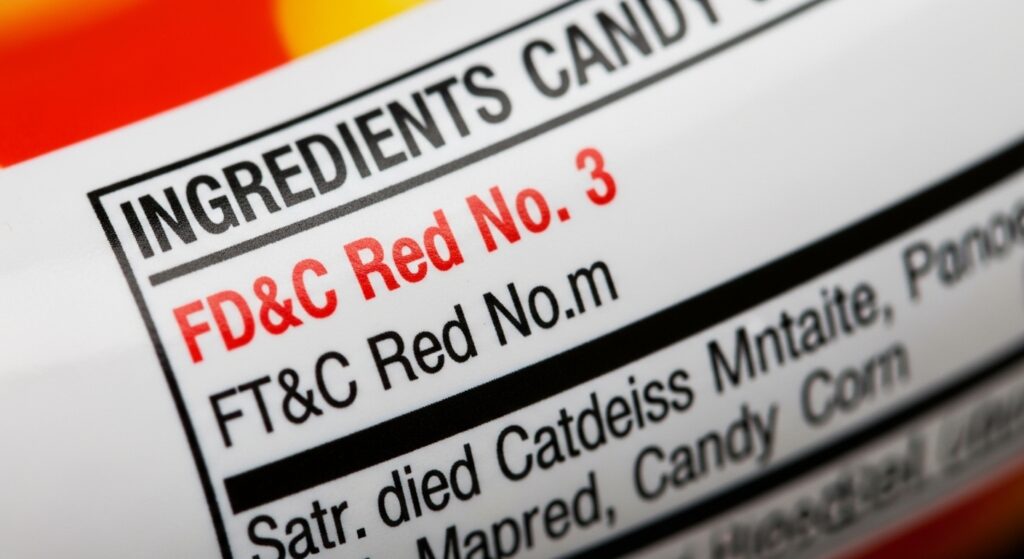
On U.S. packaging, the FDA requires synthetic certified colors to be listed by name. It won’t be buried or abbreviated beyond recognition — but you do need to know what you’re looking for.
Red Dye 3 appears at the very bottom of ingredient lists. Because its tinctorial strength is extraordinarily high, effective concentrations are tiny. You’ll typically find it after preservatives and artificial flavors, often following a “Contains less than 2% of the following” clause. In medications, look under “Inactive Ingredients” on the Drug Facts panel.
- FD&C Red No. 3 — required name on all U.S. food labels
- Red Dye No. 3 — common consumer-facing variant
- Red 3 — shortened version, equally valid under FDA rules
- Erythrosine — used in scientific literature and on some imported products
- E127 — European Union identifier; may appear on imported goods
- Acid Red 51 — used in cosmetics and pharmaceutical contexts globally
- Food Red 14 — FAO/WHO international generic name
- INS No. 127 — Codex Alimentarius international numbering
All Names for Red Dye 3 on Labels
- FD&C Red No. 3
- Red Dye No. 3
- Red 3
- Erythrosine
- Erythrosine B
- Erythrosine BS
- E127
- Acid Red 51
- Food Red 14
- INS No. 127
- CAS No. 16423-68-0
One labeling tactic to watch for: As brands replace Red Dye 3 with carmine (crushed cochineal insects) to achieve an identical red hue, they may list it simply as “carmine,” “cochineal extract,” or under the umbrella term “color added” — legally avoiding the word “artificial” while obscuring an animal-derived ingredient that carries its own serious allergy risk.
A separate concern emerged in February 2026: the FDA issued guidelines allowing manufacturers to label products “No Artificial Colors” as long as the dye was not petroleum-based — even if the product still contained synthetically processed inorganic additives like titanium dioxide. Health advocates have criticized this as deceptive, since it conflates “non-petroleum” with “natural and safe.”
Who Should Be Most Concerned?
Most adults consuming Red Dye 3 at typical dietary levels face a low measurable risk based on current evidence. But specific groups deserve extra attention.
⚠️ WARNING: At-Risk Groups The following populations should be especially careful to check labels for Red Dye 3 and other synthetic dyes until the 2027 reformulation deadline has passed.
Children ages 2–5: According to FDA estimates, American toddlers consume more than double the amount of Red Dye 3 compared to the general adult population on a body-weight basis. Their diets skew heavily toward brightly colored ultra-processed foods — cereals, candies, fruit drinks — that historically rely on these dyes. A developing neurological system and an incomplete blood-brain barrier also increase their physiological sensitivity to neurobehavioral disruption.
Children and adults with ADHD: In double-blind clinical challenge studies, synthetic dye mixtures were associated with statistically significant exacerbations of inattentiveness, impulsivity, and restlessness specifically in individuals with pre-existing ADHD. If your child’s symptoms worsen unpredictably, diet is worth examining.
Pregnant women: Red Dye 3’s identified mechanism — inhibiting the peripheral conversion of T4 into active T3 thyroid hormone — places pregnant women in a theoretically elevated risk category. Adequate maternal thyroid function is critical for fetal neurological development. Current research on human dietary doses remains limited, but the endocrine mechanism warrants caution.
Medication users: People taking prescription drugs for common conditions (acid reflux, weight management, arthritis) should check their pill’s inactive ingredients. Several generic pharmaceutical manufacturers have used Red Dye 3 as a capsule colorant well into 2025 and 2026. Ask your pharmacist for a dye-free formulation alternative.
What Replaces Red Dye 3?
Replacing Red Dye 3 is not a simple one-for-one swap — each natural alternative has trade-offs around heat stability, pH sensitivity, cost, and dietary restrictions. Here are the most viable options already on the market:
Beetroot Extract (Betacyanin): Delivers a vibrant bluish-red in cold-processed applications. Excellent for beverages, yogurts, and frozen desserts. Poor choice for baked goods due to thermal browning.
Carmine (Cochineal Extract): Derived from crushed female cochineal insects. Highly heat- and light-stable — closest to synthetic performance. Not vegan, kosher, or halal. Carries a documented risk of severe allergic reactions.
Anthocyanins: Sourced from black carrots, red cabbage, and purple sweet potatoes. Excellent in acidic foods like sodas and gummies. Color shifts dramatically to purple or brown in neutral or alkaline environments like cake batters.
Lycopene: From tomatoes or precision fermentation. Stable reddish-orange that withstands commercial baking temperatures. Slightly more orange than the cherry-red Red 3 delivers.
Clean-label products already available:
| Brand | Product | Why It’s Better | Where to Buy |
|---|---|---|---|
| Ultimate Baker | Natural Red Food Color | Fruit- and vegetable-based; kosher, non-GMO, top-8 allergen free | Online, specialty baking suppliers |
| India Tree | Nature’s Colors Sprinkles | Pigments from concentrated vegetable juices and spices | Whole Foods, premium grocers |
| Supernatural | Food Color Powders — Pomegranate Red | Plant-based, gluten-free, no carmine | DTC e-commerce, health food stores |
| Watkins | Assorted Sprinkles & Decorating Sugars | Vegetable juice and spice colors; certified non-GMO | Mainstream supermarkets, mass retailers |
| California Natural Color | Crystal Red Color Formulations | Industrial plant-based liquid/crystal formats engineered for commercial baking | B2B commercial distribution |
Latest News: 2024 to 2026
January 15, 2025 — Federal ban published. The FDA formally revoked authorization for FD&C Red No. 3 in all food products and ingested drugs, citing the Delaney Clause and 1987 rat carcinogenicity data. Food manufacturers given until January 15, 2027; drug makers until January 18, 2028.
March 2025 — West Virginia passes HB 2354. The state enacted a sweeping ban on Red 3, Red 40, and Yellow 5 targeting both retail and school nutrition programs, with a 2028 implementation timeline.
April 22, 2025 — MAHA initiative announced. HHS and the FDA announced plans to phase out six additional petroleum-based synthetic dyes (Red 40, Yellow 5, Yellow 6, Blue 1, Blue 2, Green 3) from the U.S. food supply by the end of 2026.
December 2025 — West Virginia ban blocked. A U.S. District Court granted a preliminary injunction halting enforcement of West Virginia’s retail dye ban. The International Association of Color Manufacturers successfully argued the law’s “poisonous and injurious” language was unconstitutionally vague. The school nutrition portion remained intact.
January 2026 — Industry transition reports. Target, General Mills, and Nestlé publicly reported progress toward removing certified color additives from their supply chains ahead of the 2026 school-year deadline.
February 20, 2026 — Labeling loophole retreat. The FDA retreated from absolute bans on all artificial additives under industry pressure, issuing guidelines allowing “No Artificial Colors” labeling for products that removed petroleum-based dyes — while still permitting synthetic inorganic additives like titanium dioxide. Health advocates called the move a broken promise.
huhuly Verdict
🔍 huhuly Verdict
Risk Level: Medium
Found In: Seasonal candy, baked goods, sprinkles, strawberry-flavored drinks and shakes, canned fruit cocktail, sausage casings, imitation bacon bits, prescription capsules
Label Names: FD&C Red No. 3 · Red 3 · Red Dye No. 3 · Erythrosine · E127
Our Take: The FDA’s ban is legally sound and long overdue — it should have happened when cosmetics were restricted in 1990. The human cancer risk at dietary levels is genuinely low based on current evidence, but the behavioral data on children is more concerning than most coverage acknowledges. Until January 2027, Red Dye 3 is still legally present in millions of products. If you have young children or anyone in your household with ADHD, checking labels now is a practical step you can take today.
FAQ
Why was Red Dye 3 banned in cosmetics in 1990 but allowed in food until 2025?
The FDA banned Red Dye 3 in cosmetics in 1990 based on the same 1987 rat tumor data that triggered the 2025 food ban. For food, the agency delayed action for over three decades due to industry lobbying and a lengthy petition process. It was a formal 2022 citizen petition — filed by health advocacy groups invoking the Delaney Clause — that legally forced the FDA’s hand, resulting in the final order published in January 2025. According to Dr. Peter Lurie of the Center for Science in the Public Interest, the 35-year gap represented an unsustainable regulatory double standard.
What common foods still contain Red Dye 3 in 2026?
Until the January 15, 2027 reformulation deadline, Red Dye 3 remains legally present in legacy inventory. It is primarily found in brightly colored ultra-processed foods: candy corn, bubble gum, chewy candies, mini muffins and snack cakes, rainbow sprinkles, red food coloring drops, strawberry-flavored nutrition shakes, strawberry drinks, and canned fruit cocktails containing dyed cherries. It also appears in some savory products, including sausage casings and imitation bacon bits. Always check the current ingredient label before assuming a product has been reformulated.
Is Red Dye 3 the same chemical as Red Dye 40?
No — they are chemically distinct. Red Dye 40 (Allura Red AC) is an azo dye, characterized by a nitrogen-to-nitrogen double bond. Red Dye 3 (erythrosine) is a fluorone dye built around a xanthene ring structure with four iodine atoms. Both are petroleum-derived synthetic colorants, but they have different molecular architectures, different metabolic pathways, and different regulatory histories. Red 40 remains FDA-approved as of early 2026, though it faces increasing state-level scrutiny. Red 3 is banned.
Does Red Dye 3 actually cause cancer in humans?
Current scientific consensus, including explicit statements from the FDA and EFSA, indicates there is no evidence Red Dye 3 causes cancer in humans at dietary exposure levels. The FDA’s own deputy commissioner confirmed this when announcing the 2025 ban. The ban was legally triggered by the 1960 Delaney Clause, which requires prohibition if an additive causes cancer in any animal model — regardless of whether the biological mechanism translates to humans. In this case, the tumor mechanism is specific to male rat endocrinology and has not been observed in female rats, mice, dogs, or humans.
Is Red Dye 3 safe for children to eat every day?
Based on current evidence, daily dietary exposure for most children is well below the WHO’s Acceptable Daily Intake of 0.1 mg per kilogram of body weight per day. However, the FDA estimates children ages 2 to 5 consume more than double the Red Dye 3 of the average adult on a body-weight basis. A systematic review by California’s OEHHA found that 52% of clinical challenge studies identified a statistically significant link between synthetic dye consumption and worsened ADHD symptoms in susceptible children. For children with pre-existing neurobehavioral conditions, reducing synthetic dye exposure is a reasonable, evidence-informed precaution.
The Bottom Line
Three things worth knowing before you close this tab:
Red Dye 3 is banned — but it’s still legally in products on shelves today, and will be until January 2027. If you’re buying candy, sprinkles, strawberry drinks, or any brightly colored snack food, check the label right now. The words “FD&C Red No. 3,” “Red 3,” or “Erythrosine” are what you’re looking for. Second: the cancer link applies to male rats at extreme doses, not to humans — but the behavioral evidence in children is a separate and legitimate concern. Third: reformulated products are already available at mainstream retailers. Switching to a natural-color sprinkle brand or a dye-free medication formulation is genuinely achievable today.
Want to stay ahead of every FDA ingredient change? Subscribe to the huhuly newsletter — we track label updates so you don’t have to.
Reviewed by the huhuly Editorial Team
huhuly’s food transparency team reviews ingredient labels, monitors FDA regulatory updates, and tracks changes in US food manufacturing. All claims are verified against official brand ingredient lists and regulatory databases before publication.
Last updated: March 2026 | Fact-checked: Yes | Sources: 17 cited
This article is for informational purposes only and does not constitute medical advice. Consult your healthcare provider before making dietary changes based on this information.
Red Dye 3 Ban: Why It’s Still in Your Food in 2026
More in Food News
You might also find these useful