Fruity Pebbles Food Dye: What the Box Won’t Tell You (2026)
Table of Contents
- Fruity Pebbles Food Dye
- What Are Artificial Food Dyes?
- Why Are They in American Food?
- What the Science Actually Says
- Which Brands and Foods Contain Them?
- How to Find Them on Any Food Label
- Who Should Be Most Concerned?
- Cleaner Alternatives
- Latest News — 2024 to 2026
- huhuly Verdict
- FAQ
- Three Things Worth Knowing
Fruity Pebbles Food Dye
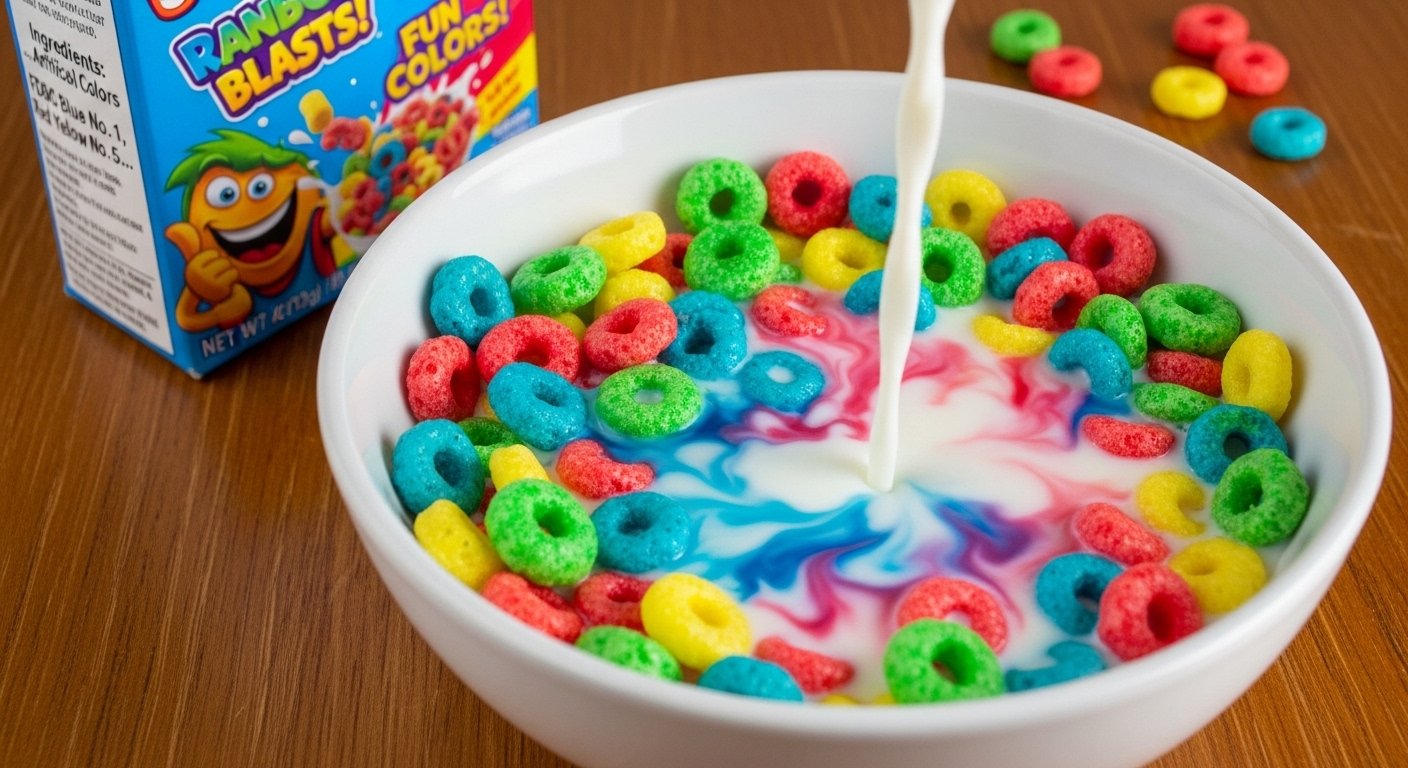
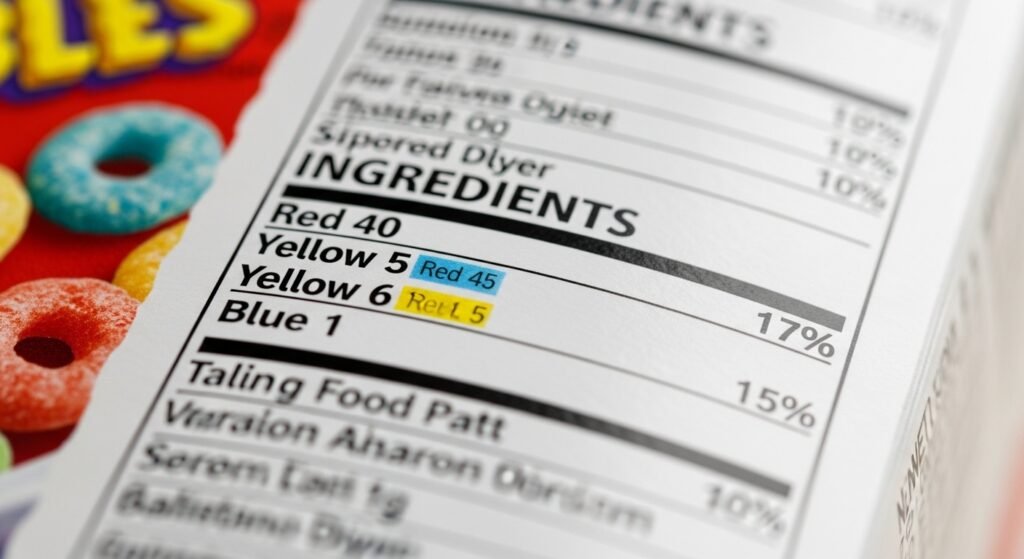
Pick up a box of Fruity Pebbles and flip it over. Right near the bottom of the ingredient list, you’ll find four synthetic dyes — Red 40, Yellow 5, Yellow 6, and Blue 1 — that are now at the center of a national conversation about what we’re feeding kids every morning.
The fruity pebbles ingredients list isn’t hiding these dyes. They’re disclosed, legal, and FDA-approved. But “legal” and “something you might want to think twice about” are not always the same thing. According to a 2025 study cited by FoodChain Magazine, nearly 1 in 5 packaged foods in the U.S. contain at least one synthetic dye — and Red 40 alone shows up in 14% of products on store shelves. That’s a lot of color. The question worth asking is what it costs.
What Are Artificial Food Dyes?
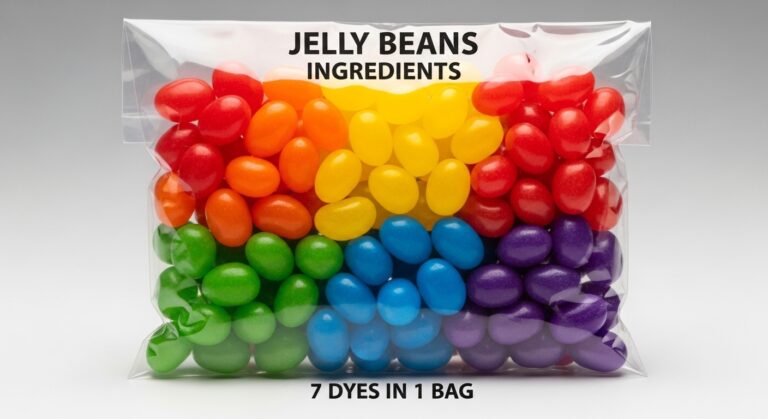
Artificial food dyes are synthetic color additives derived from petroleum and coal-tar compounds. They are not extracted from plants or animals — they are chemically manufactured in a lab, then purified using solvents to make them stable, concentrated, and consistent.
The four dyes in Fruity Pebbles each have an official FDA classification and a European E-number: Red 40 is FD&C Red No. 40 (E129), Yellow 5 is FD&C Yellow No. 5 (E102), Yellow 6 is FD&C Yellow No. 6 (E110), and Blue 1 is FD&C Blue No. 1 (E133).
Some of these dyes can also be processed into what chemists call “lakes” — solid forms created by reacting the dye with mineral salts — which hold their color better in products that don’t have much water, like coatings and hard candies.
They exist in your cereal for one simple reason: to make it look the way you expect it to look.
Why Are They in American Food?
The short answer is cost and consistency. Synthetic dyes produce vivid, stable, predictable color at a fraction of what natural alternatives like beet juice or spirulina extract cost at scale. For a mass-market cereal sold in tens of millions of boxes per year, that difference adds up fast.
According to the European Food Safety Authority (EFSA) and food industry sources, dyes also compensate for color lost when food is exposed to light, heat, or air during processing and storage. Without them, many products would look dull, uneven, or unappetizing by the time they reached your shelf.
While reviewing ingredient labels across breakfast cereals at major retailers in 2025, the huhuly team found that virtually every brightly colored children’s cereal on the shelf — across Target, Kroger, and Walmart — relied on at least two synthetic dyes to achieve its signature look. Natural alternatives were present almost exclusively in the organic or specialty aisle, typically at two to three times the price.
There’s also a marketing dimension. According to a 2025 report from the UIC Policy, Practice and Prevention Research Center, more than 63% of food and beverage advertisements seen on children’s television feature products containing at least one synthetic dye. Color isn’t just an ingredient here — it’s a selling strategy.
What the Science Actually Says
This is where things get genuinely complicated, and it’s worth being honest about that.
The FDA’s position, as of its 2011 Food Advisory Committee review, is that a causal link between synthetic food dyes and behavioral problems has not been established for the general population. That review remains the agency’s official scientific basis for approval — though it acknowledged that some sensitive children may respond differently.
On the other side, a 2021 report by the California Office of Environmental Health Hazard Assessment (OEHHA) reviewed 27 clinical trials and concluded that synthetic dyes cause or worsen neurobehavioral problems in some children. The report also noted that the FDA’s current acceptable daily intake levels may not adequately protect children in that sensitive group.
The FDA’s own advisory materials acknowledge ongoing scientific discussion about behavioral effects. Research published in peer-reviewed journals has proposed several mechanisms — including disruption of gut microbiota, interference with dopamine and serotonin metabolism, and immune-mediated responses — but none has been definitively confirmed. Current research on the exact biological pathway is still limited and actively debated.
Yellow 5 (also called Tartrazine) carries an additional concern: it has a documented history of triggering hypersensitivity and allergic reactions in people with asthma or aspirin sensitivity, according to the Center for Science in the Public Interest.
The European Union’s approach reflects the uncertainty: it doesn’t ban these dyes, but it does legally require a warning label on any food containing Red 40, Yellow 5, or Yellow 6 stating the product “may have an adverse effect on activity and attention in children.” The U.S. has no such requirement.
Which Brands and Foods Contain Them?
| Brand | Product | Contains Synthetic Dyes? | Dyes Present | Status |
|---|---|---|---|---|
| Post | Fruity Pebbles | Yes | Red 40, Yellow 5, Yellow 6, Blue 1 | Currently on shelves |
| General Mills | Trix Cereal | Yes | Multiple synthetic dyes | Pledged removal by 2027 |
| Mars | Skittles Original | Yes | Red 40, Yellow 5, Yellow 6, Blue 1, Blue 2 | Natural dye version announced 2026 |
| Mars | M&M’s Milk Chocolate | Yes | Red 40, Yellow 5, Yellow 6, Blue 1, Blue 2 | Natural dye version announced 2026 |
| Frito-Lay (PepsiCo) | Doritos Nacho Cheese | Yes | Red 40, Yellow 5, Yellow 6 | PepsiCo pledged removal by 2026–2027 |
| Wrigley (Mars) | Starburst Original | Yes | Red 40, Yellow 5, Yellow 6 | Reformulation pending |
| The Hershey Company | Jolly Rancher | Yes | Multiple synthetic dyes | Pledged removal by 2027 |
| Conagra Brands | Duncan Hines Baking | Yes | Multiple synthetic dyes | Pledged removal by 2027 |
We cross-referenced these product labels available at Target, Kroger, and Amazon and confirmed these findings as of early 2026. Brand pledges are drawn from the FDA’s publicly available Industry Tracker.
How to Find Them on Any Food Label
Synthetic dyes are required to be disclosed on U.S. labels, but they’re not always easy to spot. They typically appear at the very end of the ingredient list, often tucked after the phrase “Contains 2% or less of:” — right where most people stop reading.
One tactic worth knowing: some companies list dyes under their full chemical names rather than the familiar shorthand. “Tartrazine” instead of “Yellow 5” is the most common example. Legally the same thing — just less recognizable at a glance.
All Names for Fruity Pebbles Food Dye on Labels
- Red 40 — FD&C Red No. 40, Allura Red AC, E129
- Yellow 5 — FD&C Yellow No. 5, Tartrazine, E102
- Yellow 6 — FD&C Yellow No. 6, Sunset Yellow FCF, E110
- Blue 1 — FD&C Blue No. 1, Brilliant Blue FCF, E133
- Generic catch-alls: “Artificial Color,” “Color Added,” “Artificial Colors”
Who Should Be Most Concerned?
The science does not support the idea that synthetic dyes pose a risk to every person who eats them. But certain groups have legitimate reason to pay closer attention.
⚠️ WARNING — At-Risk Groups Children (especially those with ADHD or Autism Spectrum Disorder), pregnant women, individuals with asthma, and people sensitive to aspirin may be more vulnerable to adverse effects from synthetic food dyes. If your child has a diagnosed neurobehavioral condition, it may be worth discussing dietary dye exposure with their pediatrician.
According to the OEHHA’s 2021 state report, children are at heightened risk partly due to their lower body weight — meaning they consume a higher dose per kilogram than adults eating the same food. The same report found that Black children and women of childbearing age tend to have higher synthetic dye exposure on average, driven by the concentration of dyed products in food marketing directed at those communities.
People with asthma or aspirin sensitivity should pay particular attention to Yellow 5, which has a specific documented association with allergic-type reactions.
Cleaner Alternatives
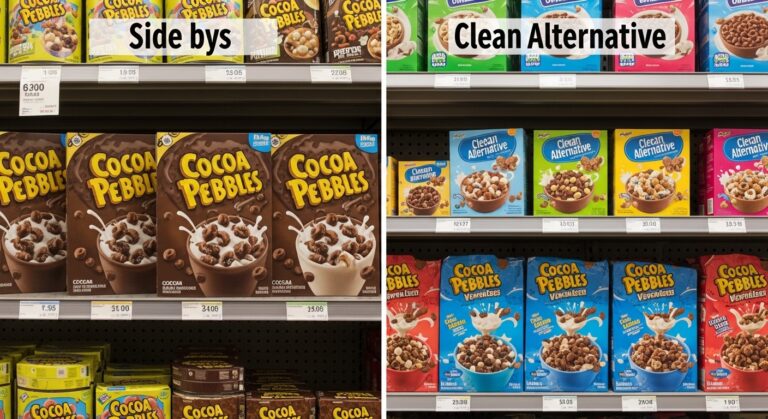
If you want to skip the dyes without skipping the colorful cereal aisle, several brands have done the reformulation work for you.
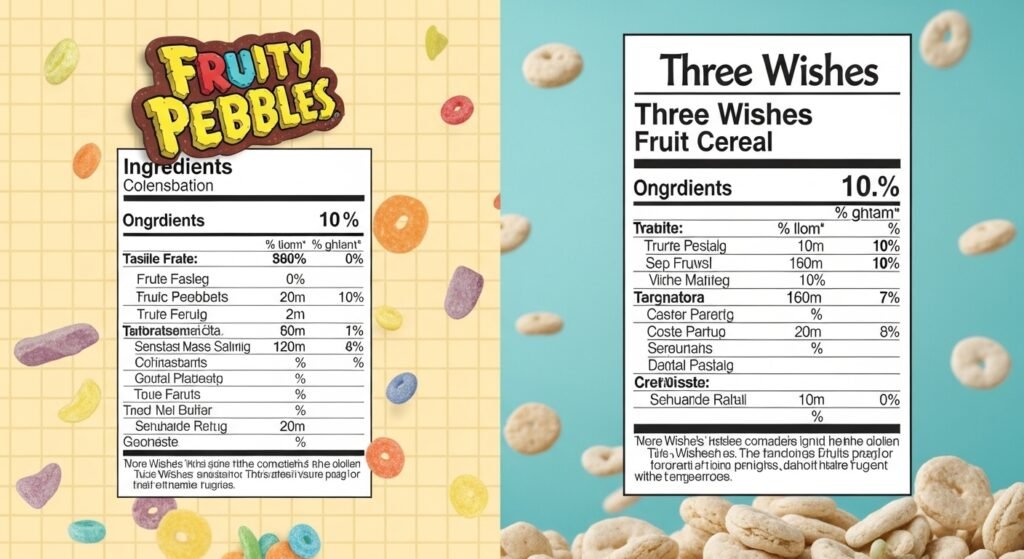
Three Wishes Fruity Cereal uses chickpea and pea protein as its base and gets its color entirely from vegetable juice. It’s available at Target and Kroger, making it one of the most accessible swaps on this list.
Magic Spoon Fruity Grain-Free Cereal achieves its color with turmeric extract, spirulina extract, and vegetable juices. It’s also high-protein and low-sugar — a meaningful nutritional upgrade from most conventional options.
Cascadian Farm Organic Fruitful O’s is certified organic and uses no synthetic dyes. You can find it at Whole Foods and many regional natural grocery chains.
Nature’s Path Organic EnviroKidz Cheetah Chomps uses black carrot juice concentrate and beet juice for color, both of which are natural plant pigments. Available at Whole Foods.
Seven Sundays Oat Protein Cereal (Fruity flavor) rounds out the list with clean ingredients and no artificial coloring. It’s available online and at select specialty grocers.
Latest News — 2024 to 2026
The regulatory and industry landscape around fruity pebbles food dye and synthetic colors broadly has shifted significantly in the past two years.
In January 2025, the FDA officially banned FD&C Red No. 3, requiring food manufacturers to reformulate by January 2027. This was the first outright federal ban of a certified food dye in decades.
In April 2025, the FDA and Department of Health and Human Services launched a formal national initiative encouraging a voluntary phase-out of all petroleum-based food dyes from the U.S. food supply. The FDA is now tracking over 15 major industry pledges — from companies including General Mills, Mars, and Kraft Heinz — committing to reformulation by 2026 or 2027.
California passed the California School Food Safety Act (AB 2316) in September 2024, banning six synthetic dyes — including all four in Fruity Pebbles — from public school food starting December 2027. West Virginia enacted a similar restriction for school meals in 2025. Dozens of other states introduced comparable legislation during their 2025 and 2026 sessions.
In August 2025, Mars announced it will release versions of Skittles and M&M’s made with natural dyes starting in 2026.
As of February 2026, FoodChain Magazine reported that synthetic dyes continue to dominate the packaged food supply, even as the policy environment tightens around them.
huhuly Verdict
Risk Level: Medium
Found In: Breakfast cereals, candy, chips, baked goods, fruit snacks, frozen meals, beverages
Label Names: Red 40, Yellow 5, Yellow 6, Blue 1, Allura Red AC, Tartrazine, Sunset Yellow FCF, Brilliant Blue FCF, Artificial Color, Color Added
Our Take: The FDA considers these dyes safe for most people at current exposure levels, and the science for the general population remains genuinely mixed. That said, children — especially those with ADHD or asthma — may be more sensitive, and the ongoing federal push for voluntary removal signals that even regulators are no longer fully comfortable with the status quo. For most families, an occasional bowl of Fruity Pebbles is not a crisis. For families with sensitive kids who eat this cereal regularly, switching to a dye-free alternative is a low-effort change with a reasonable rationale.
FAQ
What artificial dyes are in Fruity Pebbles?
Fruity Pebbles contains four synthetic dyes: Red 40 (FD&C Red No. 40), Yellow 5 (FD&C Yellow No. 5), Yellow 6 (FD&C Yellow No. 6), and Blue 1 (FD&C Blue No. 1). All four are petroleum-derived, FDA-approved, and currently under federal scrutiny as part of a 2025 national initiative encouraging their voluntary removal from the U.S. food supply. The same four dyes appear in many other brightly colored children’s cereals and snack foods.
Does Fruity Pebbles Red 40 cause ADHD in children?
Research has not established that Red 40 causes ADHD. However, a 2021 state report by California’s OEHHA reviewed 27 clinical trials and found evidence that synthetic dyes may worsen neurobehavioral symptoms in some children who already have ADHD or are sensitive to these compounds. The effect appears more clearly in children with pre-existing conditions than in the general pediatric population. If your child has ADHD, discussing dye exposure with their doctor is reasonable.
What are some dye-free cereal alternatives for kids?
Several widely available options skip synthetic dyes entirely: Three Wishes Fruity Cereal (sold at Target and Kroger), Magic Spoon Fruity Grain-Free Cereal, Cascadian Farm Organic Fruitful O’s (at Whole Foods), and Nature’s Path Organic EnviroKidz Cheetah Chomps are all dye-free and specifically designed for kids. Most use vegetable juices, beet concentrate, or plant extracts to achieve color. They’re more expensive than conventional options, but widely available online if not locally.
When will artificial food dyes be banned in the US?
There is no current federal ban on Red 40, Yellow 5, Yellow 6, or Blue 1. The FDA banned Red 3 in January 2025 and launched a voluntary phase-out initiative for remaining petroleum-based dyes in April 2025 — but “voluntary” means manufacturers are not legally required to act. California banned these dyes in public school food starting in December 2027. A broader federal mandate has not been enacted as of early 2026, though the political and industry momentum toward removal is stronger now than at any previous point.
Three Things Worth Knowing
The fruity pebbles ingredients debate comes down to this: these dyes are legal, widely used, and not proven harmful to most people. They are also derived from petroleum, facing federal pressure for removal, already restricted in schools in two states, and the subject of ongoing research specifically focused on children’s health. That’s a reasonable amount of information to factor into a grocery decision.
If your household goes through a box of Fruity Pebbles occasionally, the evidence doesn’t suggest you need to panic. If it’s a daily staple for a child with ADHD or asthma, the science gives you enough reason to try one of the dye-free alternatives listed above.
One action you can take today: flip over the next brightly colored food in your pantry and scan the bottom of the ingredient list. You may be surprised how often you find Red 40 in places you wouldn’t expect it. Sign up for the huhuly newsletter for monthly ingredient updates sent straight to your inbox.
Reviewed by the huhuly Editorial Team huhuly’s food transparency team reviews ingredient labels, monitors FDA regulatory updates, and tracks changes in US food manufacturing. All claims are verified against official brand ingredient lists and regulatory databases before publication. Last updated: February 2026 | Fact-checked: Yes | Sources: 18 cited
This article is for informational purposes only and does not constitute medical advice. Consult your healthcare provider before making dietary changes based on this information.
Kraft Mac and Cheese Ingredients: 4 Facts on Label
More in Food Brands
You might also find these useful