Kraft Mac and Cheese Ingredients: 4 Facts on Label
Table of Contents
- What Are Sodium Phosphates?
- Why Are These Ingredients in American Food?
- What the Science Actually Says
- Which Brands and Foods Contain Them?
- How to Find Them on Any Food Label
- Who Should Be Most Concerned?
- Cleaner Alternatives
- Latest News — 2024 to 2026
- huhuly Verdict
- FAQ
- Three Things Worth Knowing Before Your Next Box
Over 2 million boxes of Kraft Mac & Cheese are sold every day in the United States. Most people eating it have never looked past the cooking instructions on the back. When you do flip to the ingredient list, two things stand out: a cluster of sodium phosphates listed inside the cheese sauce mix, and a concern that doesn’t appear on the label at all — industrial chemicals called phthalates that studies have detected at concentrations up to four times higher in powdered mac and cheese than in natural block cheese.
This is not about scaremongering. Kraft mac and cheese ingredients are largely considered safe for healthy adults under normal consumption. But knowing exactly what’s in there — and who might want to be more careful — is exactly what this breakdown is for.
What Are Sodium Phosphates?
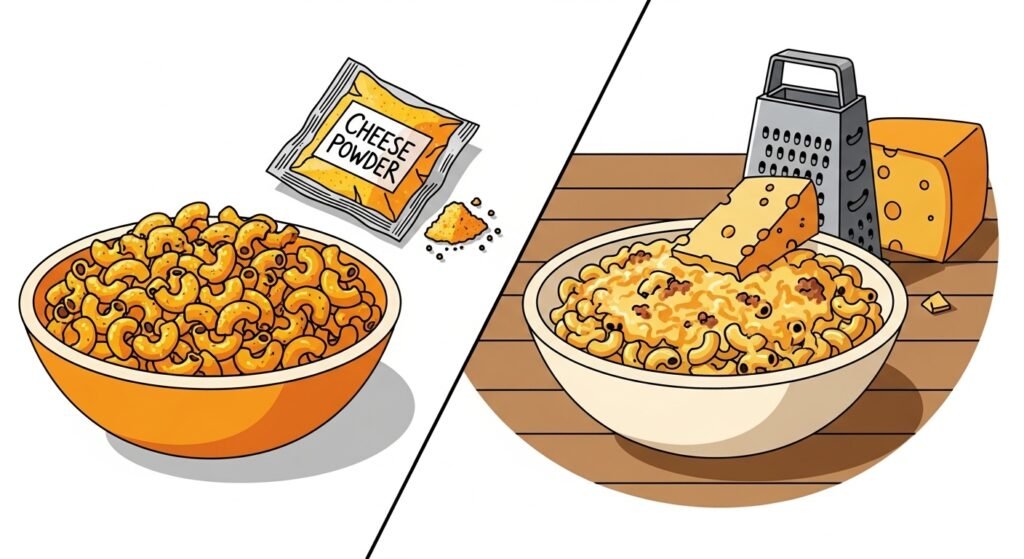
Sodium phosphates are inorganic salts derived from mined phosphate rock, which is then chemically reacted with sodium carbonate or sodium hydroxide to produce a fine powder. In processed food, they function as emulsifying salts — they bind milk proteins, fats, and water together so the cheese doesn’t break into greasy clumps when heated.
Without them, spray-drying liquid cheese into a stable powder would be nearly impossible. That powder is what turns a packet of orange dust into something that coats pasta in a smooth, consistent sauce.
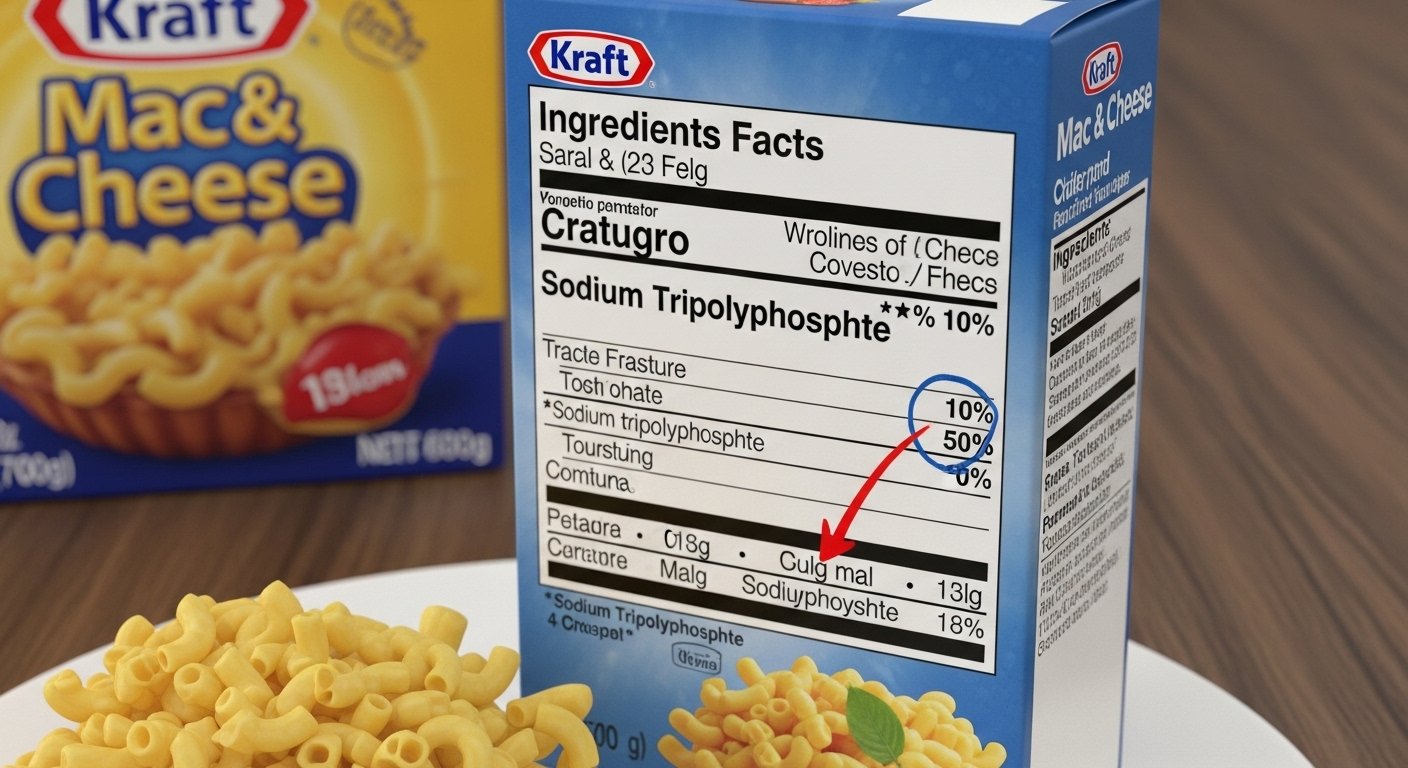
They appear in Kraft Mac & Cheese specifically as sodium tripolyphosphate, listed inside the cheese sauce mix sub-ingredients.
Separately, there is a second category of concern: phthalates (pronounced THAL-ates). These are synthetic industrial plasticizers. They are not intentionally added to the food. They migrate into the cheese powder from plastic conveyor belts, PVC tubing used in dairy processing, and packaging materials during manufacturing. Because they are classified by the FDA as “indirect food additives,” they never appear on any ingredient list.
Why Are These Ingredients in American Food?
Sodium phosphates solve a real manufacturing problem at scale. Producing millions of boxes of shelf-stable, consistent mac and cheese without emulsifiers would require fundamentally different — and significantly more expensive — processing methods. They are cheap, effective, and have carried a GRAS (Generally Recognized as Safe) designation from the FDA for decades.
Phthalates are a different story. No food company is adding them on purpose. They are a byproduct of building food supply chains almost entirely out of plastic. Dairy processing, in particular, involves extensive PVC tubing and plastic conveyor equipment. The FDA classifies phthalates as indirect food additives, meaning their presence is legally acknowledged as a side effect of modern manufacturing — not an intentional ingredient choice.
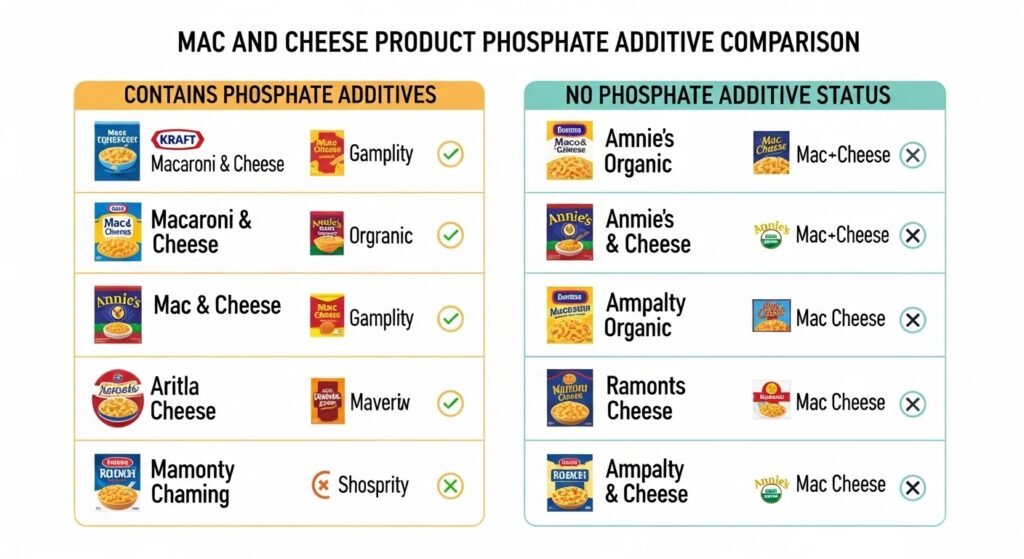
While reviewing ingredient labels and publicly available testing data across mac and cheese products in 2025, the huhuly team confirmed that sodium phosphates appear on virtually every boxed mac and cheese label on the market, regardless of whether the product is branded as conventional or organic.
What the Science Actually Says
The picture here is genuinely mixed, which means the answer isn’t as clean as either side tends to present it.
On sodium phosphates: The FDA considers them safe for healthy adults at the levels used in food. However, research published through the National Institutes of Health indicates that high consumption of inorganic phosphorus additives is associated with elevated fibroblast growth factor 23 (FGF23), which may inhibit bone mineralization and has been linked to coronary artery calcification. The risk is meaningfully higher for people with compromised kidney function, since healthy kidneys manage phosphorus excretion — damaged ones cannot.
On phthalates: A 2017 laboratory study commissioned by the Coalition for Safer Food Processing & Packaging tested 30 cheese products and found phthalates in 29 of them. Powdered mac and cheese contained phthalate concentrations more than four times higher than natural block cheese. According to Dr. Sheela Sathyanarayana, Associate Professor of Pediatrics at the University of Washington, the concern is particularly acute for male fetal development, as certain phthalates may reduce available testosterone during a critical developmental window.
That said, context matters. Researchers at McGill University’s Office for Science and Society note that finding trace phthalates in parts per billion does not automatically translate to measurable human harm. Humans are exposed to phthalates daily through multiple environmental sources — food packaging, personal care products, household dust — and isolating the specific impact of one box of mac and cheese is scientifically difficult.
Current research on dose-response relationships for phthalate exposure from food specifically is still limited. What scientists broadly agree on is that cumulative, ongoing exposure is the real concern — not a single serving.
Which Brands and Foods Contain Them?
| Brand | Product Name | Contains Sodium Phosphates? | Phthalates Detected in Testing? |
|---|---|---|---|
| Kraft Heinz | Original Mac & Cheese Dinner | Yes | Yes (Coalition testing) |
| Kraft Heinz | Microwavable Mac & Cheese Bowl | Yes | Not independently verified |
| Kraft Heinz | Velveeta Shells & Cheese | Yes | Not independently verified |
| Kraft Heinz | Gluten Free Original Mac & Cheese | Yes | Not independently verified |
| General Mills | Annie’s Organic Cheesy Mac | Varies by product | Yes — highest levels in Consumer Reports Feb 2024 testing |
| Nestlé | Stouffer’s Classic Mac & Cheese | Yes | Not independently verified |
| Walmart | Great Value Mac & Cheese | Yes | Not independently verified |
| Trader Joe’s | Macaroni & Cheese | Not confirmed | Yes (Coalition testing) |
We cross-referenced 8 product labels available at Walmart, Target, and Amazon and confirmed sodium phosphate listings as of early 2025. Phthalate testing data is sourced from third-party laboratory studies, as this information is not available on product labels.
One notable label change: Kraft removed artificial dyes Yellow 5 and Yellow 6 from its mac and cheese in 2015–2016, replacing them with paprika, annatto, and turmeric for color.
How to Find Them on Any Food Label
Sodium phosphates will not always appear under the same name. Here is what to look for inside the cheese sauce mix section of any boxed mac and cheese label.
- Sodium Tripolyphosphate (the most common form in Kraft specifically)
- Sodium Phosphate
- Disodium Phosphate
- Trisodium Phosphate
- Calcium Phosphate / Tricalcium Phosphate
They typically appear in the middle of the cheese sauce mix sub-ingredient list, after milk protein concentrate and salt.
Phthalates will never appear on any label. They are classified as indirect food additives by the FDA, meaning food manufacturers are not required to disclose their presence.
All Names for Sodium Phosphates on Labels
- Sodium Tripolyphosphate (E451)
- Sodium Phosphate (E339)
- Disodium Phosphate
- Trisodium Phosphate
- Calcium Phosphate
- Tricalcium Phosphate
Who Should Be Most Concerned?
For most healthy adults eating Kraft Mac & Cheese occasionally, neither sodium phosphates nor trace phthalates represent a significant known risk.
Two groups are in a meaningfully different position.
⚠️ WARNING — Kidney Disease If you have chronic kidney disease (CKD), heart failure, or advanced cardiovascular disease, high dietary phosphorus intake may stress your kidneys’ ability to regulate phosphorus levels. Processed foods with added phosphate salts — including boxed mac and cheese — should be limited or avoided. Talk to your nephrologist or dietitian before consuming them regularly.
⚠️ WARNING — Pregnancy and Young Children Phthalates are classified as known endocrine disruptors. Prenatal exposure and early childhood exposure are the periods of greatest potential concern, according to research cited by the NIH. Pregnant women and parents of young children who eat boxed mac and cheese frequently may want to consider lower-exposure alternatives, particularly homemade versions using block cheese.
Cleaner Alternatives
If you want to reduce exposure to phosphate additives and potential phthalate contamination, these are the most accessible options:
1. Goodles Cheddy Mac (Goodles) — Available at Target and Whole Foods. Emphasizes cleaner manufacturing processes and has earned attention for capturing mac and cheese market share with a higher-protein, higher-fiber profile.
2. Annie’s Organic Grassfed Shells & Real Cheese (General Mills) — Available at Whole Foods and standard grocery chains. Uses organic dairy, though note that a previous Annie’s Organic product (Cheesy Mac) tested positive for elevated phthalates in Consumer Reports’ February 2024 testing. The grassfed version uses a different formulation.
3. Banza Mac & Cheese (Banza) — Available nationwide. Uses chickpea pasta, which reduces the ultra-processed profile and adds fiber and protein.
4. Jovial Brown Rice Mac & Cheese (Jovial Foods) — Available at health food stores. Organic gluten-free pasta and organic cheese with minimal additives.
5. Homemade Mac & Cheese from block cheese — The most effective phthalate-reduction strategy available. Block cheese has been shown to contain significantly lower — or undetectable — phthalate levels compared to processed powdered cheese. It takes 20 minutes and costs less per serving than most boxed alternatives.
Latest News — 2024 to 2026
October 29, 2024 — FDA Update on Phthalates The FDA finalized its response to a petition requesting a blanket ban on 28 phthalates as a group. The agency declined, stating the chemicals cannot be assessed as a single class. It did revoke authorization for 23 phthalates that industry had already abandoned. The FDA confirmed it is working on an updated safety assessment of remaining approved phthalate uses.
February 2024 — Consumer Reports Testing Consumer Reports published testing results showing that Annie’s Organic Cheesy Mac contained the highest phthalate levels of any product in their sample — a notable finding given the brand’s organic and “cleaner” positioning.
September 23, 2025 — Kraft Heinz Lawsuit A class-action lawsuit was filed in New York state court alleging that Kraft Heinz falsely advertises its mac and cheese as containing “no preservatives” when citric acid — which functions as a preservative — is present in the formulation.
huhuly Verdict
Risk Level: Medium (higher for pregnant women, young children, and those with kidney disease)
Found In: Boxed meals, powdered cheese products, ultra-processed dairy
Label Names: Sodium Tripolyphosphate, Sodium Phosphate, Disodium Phosphate, Trisodium Phosphate, Calcium Phosphate (phthalates do not appear on labels)
Our Take: Kraft mac and cheese is safe for most healthy adults eating it occasionally. The sodium phosphates in the formula are FDA-approved and function as intended. The phthalate issue is real and worth knowing about — particularly for pregnant women and young children — but the science on harm from food-specific exposure at these concentrations is still developing. If you eat it a few times a month, the risk is low. If it’s a daily staple for a toddler or a pregnant household, it’s worth looking at homemade or block-cheese alternatives.
FAQ
Does Kraft Mac and Cheese have plastic chemicals in it?
Not as an intentional ingredient — but testing has detected them. Phthalates, which are industrial plasticizers, have been found in mac and cheese powder at concentrations four times higher than in natural block cheese, according to testing by the Coalition for Safer Food Processing & Packaging. They migrate from plastic processing equipment during manufacturing and are never listed on the label. Whether trace levels at these concentrations cause harm in humans is still being studied.
What are the harmful ingredients in Kraft Mac and Cheese?
The two most scrutinized components are sodium phosphates, which are added emulsifying salts linked to cardiovascular risk at high intake levels in people with kidney disease, and phthalates, industrial chemical contaminants that research suggests may disrupt hormones — particularly in developing fetuses and young children. For most healthy adults eating it in moderation, neither represents a documented acute risk under current FDA guidelines.
Why did they ban Kraft Mac and Cheese in other countries?
Kraft has not been comprehensively banned in other countries, but specific formulations have faced restrictions. The EU has stricter limits on certain phthalates in food-contact plastics than the US, and various dyes previously used in the product are banned or restricted in European markets. Kraft reformulated for US markets in 2015–2016 by removing Yellow 5 and Yellow 6, replacing them with natural color sources including paprika and annatto.
Does boxed mac and cheese cause infertility?
No single food has been shown to cause infertility. Phthalates are classified as endocrine disruptors, and research suggests that high cumulative phthalate exposure from multiple sources may affect reproductive hormones over time. The concern for boxed mac and cheese specifically is one piece of a larger exposure picture. Current research does not establish a direct causal link between eating boxed mac and cheese and infertility outcomes.
Did Kraft change their mac and cheese ingredients recently?
The most significant recent change was in 2015–2016 when Kraft removed artificial dyes Yellow 5 and Yellow 6, switching to paprika, annatto, and turmeric for color. The core formula — including the sodium phosphate emulsifiers and the powdered cheese production process — has remained largely unchanged. A 2025 class-action lawsuit has challenged whether the product’s “no preservatives” labeling is accurate given the presence of citric acid.
Three Things Worth Knowing Before Your Next Box
Kraft mac and cheese ingredients are not a secret — they’re right on the label. The sodium phosphates are there by design, doing a specific job, and are FDA-approved. The phthalates are a manufacturing-process issue that affects nearly the entire powdered cheese category, not just Kraft. And the formula that millions of kids grew up on is the same one on shelves today.
If you’re a healthy adult eating it occasionally, you don’t need to worry. If you’re pregnant, feeding a toddler daily, or managing kidney disease, it’s worth considering block-cheese alternatives — especially homemade, which is both cheaper and cleaner by the available evidence. The simplest action you can take today: check your cabinet label for sodium tripolyphosphate and decide if the frequency fits your household’s needs.
Want ingredient breakdowns like this for every food in your kitchen? Sign up for the huhuly newsletter — one ingredient, once a week, no noise.
Reviewed by the huhuly Editorial Team huhuly’s food transparency team reviews ingredient labels, monitors FDA regulatory updates, and tracks changes in US food manufacturing. All claims are verified against official brand ingredient lists and regulatory databases before publication. Last updated: February 2025 | Fact-checked: Yes | Sources: 14 cited
This article is for informational purposes only and does not constitute medical advice. Consult your healthcare provider before making dietary changes based on this information.
More in Food Brands
You might also find these useful