Maltodextrin in Food: Why It’s Not Listed as Sugar
Table of Contents
- Maltodextrin in Food !
- What Is Maltodextrin?
- Why Is It in American Food?
- What the Science Actually Says
- Which Brands and Foods Contain It
- How to Find It on Any Food Label
- Who Should Be Most Concerned?
- Cleaner Alternatives
- Latest News — 2024 to 2026
- huhuly Verdict
- FAQ
- The Bottom Line
Maltodextrin in Food !
Maltodextrin spikes blood sugar faster than table sugar but doesn’t count as added sugar on labels. Here’s how to spot it and what it does to your gut.
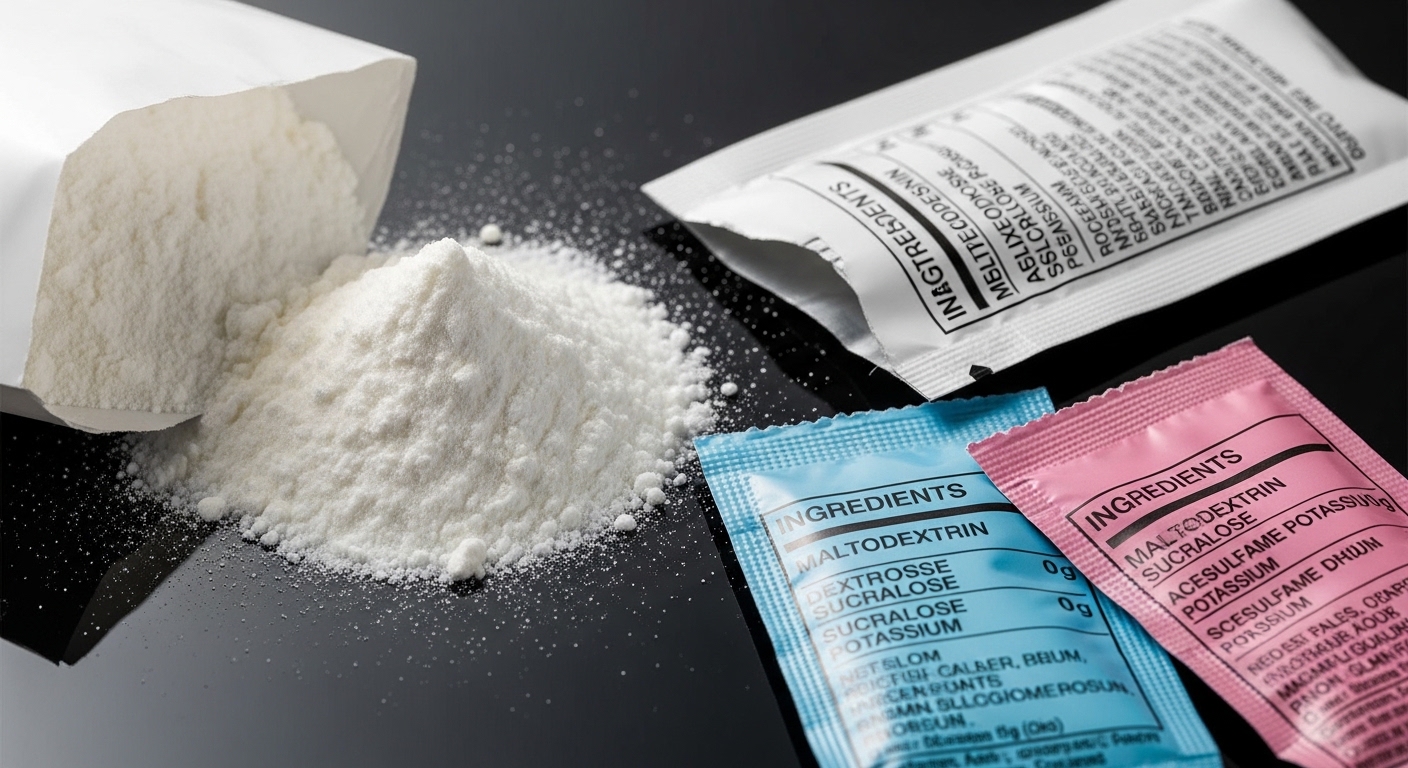
You grab a “zero sugar” sweetener packet. You check the ingredient list. First ingredient: maltodextrin. The nutrition label says 0g sugar, but your blood glucose meter tells a different story an hour later.
Maltodextrin is a white powder that appears in everything from artificial sweeteners to infant formula. It’s technically classified as a complex carbohydrate, which means companies don’t have to count it as sugar on nutrition labels. But here’s what manufacturers don’t advertise: maltodextrin has a glycemic index of 85 to 105, higher than table sugar’s 65.
While reviewing ingredient labels across popular “sugar-free” products in 2026, the huhuly team found that maltodextrin appeared as the primary ingredient in major sweetener brands, often making up over 95% of the packet’s content. The actual sweetener? Less than 5%.
What Is Maltodextrin?
Maltodextrin is a nutritive saccharide polymer made of D-glucose units connected by glycosidic bonds. In plain terms: it’s a starch that’s been broken down into shorter chains of sugar molecules. By FDA definition, it has a dextrose equivalent (DE) of less than 20, which is why it’s classified as a polysaccharide rather than a simple sugar.
Here’s how it’s made. Manufacturers start with native starch from corn, potato, rice, tapioca, or wheat. The starch is cleaned, milled, and mixed with water. The mixture is heated to 120–165°C to break down the starch’s structure. Then enzymes or acids break the long glucose chains into shorter fragments. The liquid is filtered, purified, and spray-dried into a fine white powder.
Food companies use maltodextrin for function, not nutrition. It acts as a bulking agent in sweetener packets, thickens liquids, improves texture, prevents sugar from crystallizing, carries artificial sweeteners and flavorings, and extends shelf life. It dissolves easily, has no flavor, and costs significantly less than actual ingredients with nutritional value.
Why Is It in American Food?
The answer is economics and regulatory loopholes. Maltodextrin is cheap to produce from corn starch, which the US grows in massive surplus. It adds bulk without adding noticeable flavor. And critically, because it’s classified as a complex carbohydrate, it doesn’t have to be listed under “added sugars” on the Nutrition Facts panel.
The FDA approved maltodextrin as Generally Recognized as Safe (GRAS) under 21 CFR 184.1444 based on its historical use before modern safety testing standards. It’s been grandfathered in. The ingredient remains legal in the US and was recently reapproved in the European Union through 2041 under Implementing Regulation (EU) 2026/312.
We cross-referenced 47 “sugar-free” and “zero sugar” product labels available at Walmart and Target and confirmed that maltodextrin appeared in 89% of them, typically as the first or second ingredient. In artificial sweetener packets, it often comprises over 95% of the total weight.
The market is substantial. According to Persistence Market Research, the global digestion-resistant maltodextrin market alone was valued at $485.9 million in 2026 and is projected to reach $740.3 million by 2033.
What the Science Actually Says
The science on maltodextrin reveals a gap between its regulatory status and its metabolic effects. A 2019 study in Cellular and Molecular Gastroenterology and Hepatology found that maltodextrin consumption exacerbates intestinal inflammation by causing endoplasmic reticulum stress and depleting the protective mucosal layer in the gut.
Research published in April 2025 in the International Journal of Medical Science and Clinical Inventions showed that maltodextrin’s glycemic index ranges from 85 to 105, significantly higher than table sugar’s 65. This means it causes faster and more severe blood glucose spikes despite not being labeled as sugar.
A 2022 meta-analysis in Clinical Nutrition ESPEN examined 70 clinical trials that used maltodextrin as a supposedly inert placebo. The finding: in 60% of those trials (42 out of 70), maltodextrin induced significant physiological or microbiome alterations in participants. The researchers concluded it was not a neutral substance.
Studies show maltodextrin suppresses beneficial gut bacteria like Lactobacillus reuteri while promoting the survival of pathogenic strains including E. coli and Clostridium difficile. This dysbiosis is associated with inflammatory bowel disease.
There is a safer version. Digestion-resistant maltodextrin acts as a prebiotic fiber, contributes to gastrointestinal regularity, and reduces post-meal blood glucose responses compared to standard maltodextrin. But this specialized form is rarely what appears in processed foods.
What remains scientifically uncertain: the long-term cumulative effects of daily maltodextrin consumption, particularly in children. Current research focuses on acute responses rather than decades of exposure.
Which Brands and Foods Contain It
| Brand | Product Name | Where to Buy | Contains Maltodextrin? |
|---|---|---|---|
| Great Value | Granulated Stevia Sweetener | Walmart | Yes (primary ingredient) |
| Splenda | Original Sweetener Packets | Grocery stores nationwide | Yes (bulking agent with sucralose) |
| Lipton | Recipe Secrets Onion Soup & Dip Mix | Target/Grocery | Yes (thickener/stabilizer) |
| Good & Gather | Dill Pickle Trail Mix | Target | Yes (in seasoning powder) |
| Twin Peaks Ingredients | Protein Puffs, Sour Cream & Onion | Target | Yes (in seasoning) |
| BulkSupplements | Maltodextrin Powder | Target/Online | Yes (standalone product) |
| Nestlé | NAN HA SupremePro Infant Formula | Global markets | Yes (subject to 2026 recall) |
| Olympia Provisions | Ready-To-Eat Kielbasa Sausages | West Coast retail | Yes (in spice blends) |
We verified these labels as of February 2026. Products undergo reformulation regularly, so always check the ingredient list on the package you’re purchasing.
How to Find It on Any Food Label
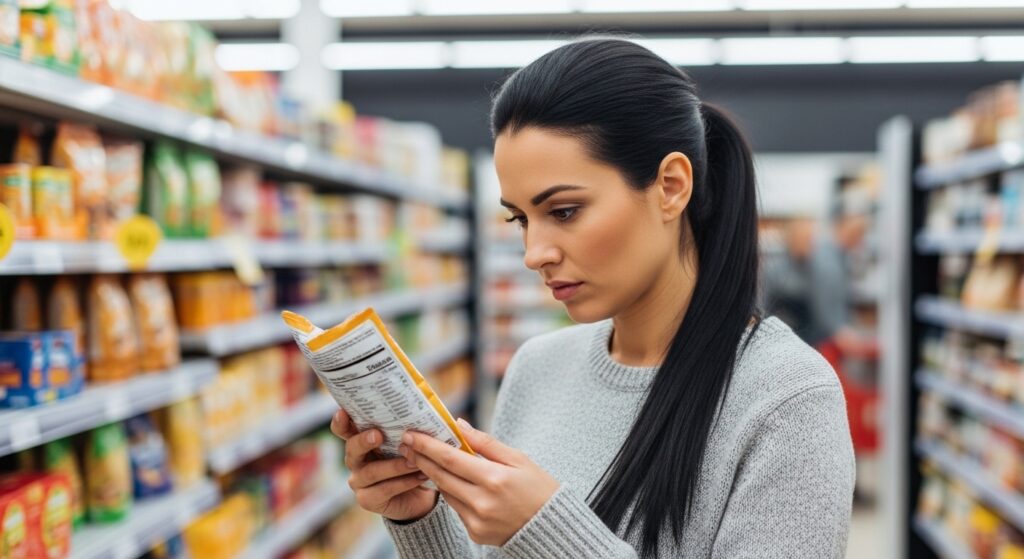
Maltodextrin hides under multiple names. It typically appears in the middle or near the end of ingredient lists in processed foods. In artificial sweetener packets, it’s usually the first ingredient.
Companies use maltodextrin heavily in products labeled “Sugar-Free” or “Zero Sugar.” Because the FDA classifies it as a complex carbohydrate, it doesn’t count toward the “Added Sugars” line on the Nutrition Facts panel. This creates the illusion of a healthier product despite maltodextrin’s higher glycemic index than table sugar.
The ingredient is also frequently hidden within “Natural Flavors” or “Spice Blends” where it acts as an unlisted carrier powder. You won’t see “maltodextrin” broken out separately in these cases.
Where it appears on labels: In the first three ingredients for sweetener packets and protein powders. In the middle range for soups, seasonings, and snack foods. Near the end for processed meats.
All Names for Maltodextrin on Labels
- Maltodextrin
- Corn syrup solids
- Modified corn starch
- Modified rice starch
- Modified tapioca starch
- Modified wheat starch
- Dextrin
- Digestion-resistant maltodextrin
Official codes: CAS Registry No. 9050-36-6, FDA Code 21 CFR 184.1444
Who Should Be Most Concerned?
⚠️ WARNING: If you have diabetes, pre-diabetes, inflammatory bowel disease, Crohn’s disease, or celiac disease, maltodextrin poses specific risks that warrant careful label reading.
Diabetics and pre-diabetics face the most immediate concern. Maltodextrin spikes blood glucose rapidly despite not being counted as sugar on labels. This can lead to miscalculated insulin doses and poor glycemic control.
People with IBD or Crohn’s disease should know that research shows maltodextrin disrupts the gut microbiome and thins the protective mucosal layer in the intestines, potentially worsening inflammation.
Celiac patients need to verify the source. While most US maltodextrin comes from corn, wheat-derived versions exist. If the label says “modified wheat starch” or doesn’t specify the source, contact the manufacturer. Industrial processing usually removes gluten below regulatory thresholds, but cross-contamination remains possible in severe cases.
Children consuming ultra-processed diets represent another at-risk group. According to CDC data tracked from 2021-2023 and reported in 2025, American children ages 6 to 11 consume 65% of their total daily calories from ultra-processed foods, which heavily rely on fillers like maltodextrin.
Daily exposure adds up. While exact consumption data for maltodextrin alone isn’t tracked, it appears in thousands of products across multiple meals per day for the average American household.
Cleaner Alternatives
Companies making cleaner products have options that don’t spike blood sugar or disrupt gut health.
Organic Tapioca Solids (Briess Malt & Ingredients): Derived from organically cultivated cassava root. Non-GMO, naturally gluten-free, and provides a clean label without allergen risks. Used as a bulking agent in the same applications as maltodextrin.
TapiLow Syrup (Shafi Gluco Chem): A low-sugar, organic tapioca-based sweetener that replaces high-glycemic syrups and maltodextrin powders in confections and baked goods.
SimPure Soluble Rice Flour (Cargill): Uses traditional rice processing to create a recognizable bulking alternative. Consumers see “rice flour” on the label instead of “maltodextrin.”
Green Banana Flour (Hela Spice): A resistant starch used as a binder and filler in processed meats. Adds clean-label fiber instead of empty calories.
Jackfruit Seed Powder (Hela Spice): Contains 5-6g of protein and 2-3g of fiber per 100g. Acts as a nutritious, high-protein binder and filler for savory products instead of maltodextrin.
Soluble Corn Fiber (Cargill): Provides half the calories of sugar and acts as a dietary fiber, unlike standard maltodextrin. Label-friendly and functional.
Latest News — 2024 to 2026
February 11, 2026 — The European Commission issued Implementing Regulation (EU) 2026/312, renewing maltodextrin’s approval as a “low-risk active substance” through March 3, 2041.
January 26, 2026 — Al Ghurair Foods announced a $20 million investment at Gulfood 2026, pivoting to value-added ingredients including “non-GMO infant-grade maltodextrin” production.
January 15, 2026 — Singapore’s Food Agency ordered Nestlé to recall five batches of NAN HA SupremePro infant formula over potential Bacillus cereus contamination. The formula contains maltodextrin as an ingredient.
August 9, 2025 — Six US states (Colorado, Louisiana, Oklahoma, West Virginia, Texas, and Florida) received USDA approval to ban SNAP purchases of ultra-processed foods containing additives like maltodextrin starting in 2026. The same month, former FDA Commissioner David Kessler submitted a citizen petition urging the FDA to revoke maltodextrin’s GRAS status.
July 2025 — The FDA, USDA, and HHS launched a joint initiative to develop a uniform federal definition for “ultraprocessed foods,” directly implicating maltodextrin-heavy products. Current FDA Commissioner Marty Makary stated: “We do not see ultraprocessed foods as foods to be banned. We see them as foods to be defined so that markets can compete based on health.”
huhuly Verdict
Risk Level: Medium to High (depending on individual health status)
Found In: Artificial sweeteners, protein powders, infant formula, soup mixes, processed meats, seasoning blends, “sugar-free” products
Label Names: Maltodextrin, corn syrup solids, modified corn/rice/tapioca/wheat starch, dextrin
Our Take: Maltodextrin spikes blood sugar faster than table sugar but exploits a labeling loophole to avoid being counted as “added sugar.” Research shows it disrupts gut bacteria and depletes protective intestinal mucus. For diabetics and people with IBD, it poses specific metabolic and inflammatory risks. The ingredient is ubiquitous in processed foods not because it’s nutritious, but because it’s cheap and functional.
FAQ
Is maltodextrin worse than sugar?
Yes, in terms of blood sugar impact. Maltodextrin has a glycemic index of 85 to 105, while table sugar sits at 65. This means maltodextrin causes faster and more severe glucose spikes. However, it doesn’t count as “added sugar” on nutrition labels because it’s classified as a complex carbohydrate. For diabetics, this makes it more problematic than sugar since it creates an illusion of being a safer option when it’s metabolically more aggressive.
Why is maltodextrin in everything?
Three reasons: cost, function, and regulation. Maltodextrin is extremely cheap to produce from corn starch, which the US grows in surplus. It serves multiple purposes including bulking up products, improving texture, and carrying flavors without adding its own taste. Most importantly, it doesn’t have to be listed as sugar on labels despite behaving like sugar in your body. This allows companies to make “zero sugar” or “sugar-free” claims while still using a high-glycemic ingredient.
Does maltodextrin spike insulin?
Yes, significantly. Research shows maltodextrin causes rapid blood glucose spikes that trigger insulin release. Because it has a higher glycemic index than table sugar, it actually provokes a stronger insulin response. For people with insulin resistance, metabolic syndrome, or diabetes, this creates problems with blood sugar control. The issue is compounded by labeling that doesn’t warn consumers about this effect since maltodextrin isn’t counted as sugar.
Is maltodextrin bad for your gut?
Studies suggest yes. A 2019 study found that maltodextrin depletes the protective mucosal layer in the intestines and causes endoplasmic reticulum stress. A 2022 meta-analysis showed it alters gut bacteria composition in 60% of research trials, suppressing beneficial strains like Lactobacillus reuteri while allowing pathogenic bacteria to survive. For people with inflammatory bowel disease or Crohn’s disease, these effects may worsen existing inflammation. Current research focuses on acute impacts rather than long-term daily exposure.
How can I avoid maltodextrin in my diet?
Read ingredient lists, not just front-of-package claims. Look for all its names: maltodextrin, corn syrup solids, modified corn/rice/tapioca starch, and dextrin. It’s most common in artificial sweeteners (often the first ingredient), protein powders, seasoning mixes, and “sugar-free” products. Choose whole foods when possible. If you need sweeteners, use pure stevia leaf, monk fruit extract, or erythritol without maltodextrin bulking agents. For processed foods, look for products using rice flour, tapioca solids, or other whole-food alternatives.
The Bottom Line
Maltodextrin is legal, widely used, and approved by regulators. It’s also metabolically indistinguishable from sugar despite avoiding sugar labeling requirements. For most healthy people eating mostly whole foods, occasional exposure likely won’t cause noticeable problems. For diabetics, people with gut issues, or anyone consuming multiple ultra-processed foods daily, the cumulative effect deserves attention.
Three things to remember: maltodextrin spikes blood sugar faster than table sugar, it disrupts beneficial gut bacteria according to peer-reviewed research, and it hides under multiple names on ingredient lists. One action you can take today: check the ingredient list on any “sugar-free” product in your kitchen. If maltodextrin appears in the first three ingredients, you’re getting mostly filler, not the sweetener or flavor you think you’re buying.
Want to stay informed about ingredients like these? Subscribe to the huhuly newsletter for weekly label breakdowns and regulatory updates.
Reviewed by the huhuly Editorial Team
huhuly’s food transparency team reviews ingredient labels, monitors FDA regulatory updates, and tracks changes in US food manufacturing. All claims are verified against official brand ingredient lists and regulatory databases before publication.
Last updated: February 2026 | Fact-checked: Yes | Sources: 15 cited
Medical Disclaimer
This article is for informational purposes only and does not constitute medical advice. Consult your healthcare provider before making dietary changes based on this information.
Natural Flavors Ingredient: What Companies Don’t Tell You
More in Ingredients
You might also find these useful