Natural Flavors Ingredient: What Companies Don’t Tell You
Table of Contents
- Natural Flavors Ingredient
- What Are Natural Flavors?
- Why Is It in American Food?
- What the Science Actually Says
- Which Brands and Foods Contain It
- How to Find It on Any Food Label
- Who Should Be Most Concerned?
- Cleaner Alternatives
- Latest News — 2024 to 2026
- huhuly Verdict
- FAQ
- Conclusion
Natural Flavors Ingredient
Natural flavors appear in 1 in 5 packaged foods, but the FDA lets companies hide up to 100 chemicals behind that term. Here’s what you’re actually eating.
You flip over your favorite sparkling water. Right there on the label: “natural flavors.” Sounds harmless enough. But that single phrase legally hides up to 100 different chemicals that companies never have to name.
According to the Environmental Working Group, “natural flavor” ranks as the fourth most common ingredient on American food labels—appearing in more than 20% of 80,000 products analyzed. It shows up more often than sugar. The catch? Between 80% and 90% of what’s inside that “natural flavor” isn’t even the flavor extract itself. It’s synthetic solvents, preservatives, and emulsifiers that never make it onto the ingredient list.
While reviewing labels across major grocery chains in 2026, the huhuly team found natural flavors listed in everything from organic protein bars to reduced-fat chips—often right next to claims like “No Artificial Ingredients.” Here’s what’s actually in your food.
What Are Natural Flavors?
The FDA defines natural flavor as any essential oil, oleoresin, essence, extractive, protein hydrolysate, distillate, or product of roasting, heating, or enzymolysis that contains flavoring constituents derived from plant or animal sources. That includes spices, fruits, vegetables, herbs, bark, roots, meat, seafood, poultry, eggs, or dairy products.
Here’s how it’s actually made. Flavor chemists extract the primary flavor chemical from a natural source using distillation, cold pressing, or solvent extraction. Then they combine that extract with what the industry calls “incidental additives”—processing aids, carriers, synthetic solvents like propylene glycol, emulsifiers, and preservatives like BHT.
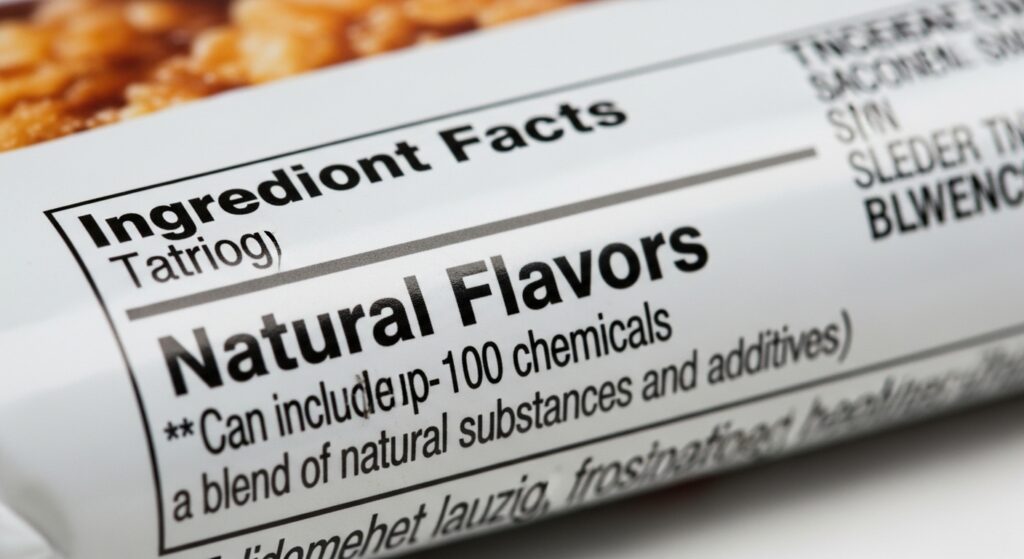
The final product can contain up to 100 different chemicals. Only 10% to 20% of the mixture is actual flavor extract. The rest? Those incidental additives that legally don’t need individual disclosure on your food label.
Natural flavors serve one purpose: taste. They add zero nutritional value. Food manufacturers use them to ensure flavor consistency when crops vary, restore flavors lost during high-heat processing, and extend shelf life.
Why Is It in American Food?
Three reasons drive the ubiquity of natural flavors in American products.
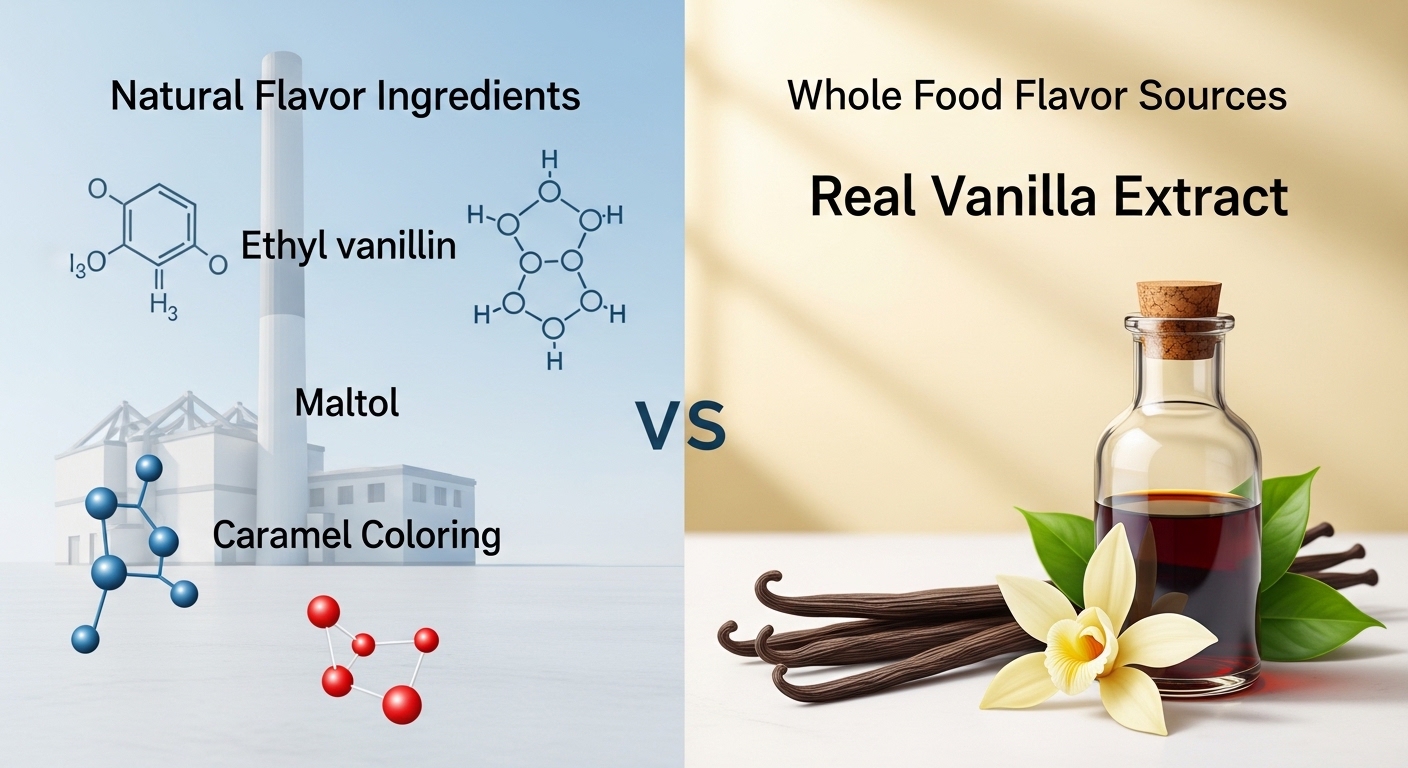
First, cost control. Real vanilla extract costs roughly $300 per gallon. A natural vanilla flavor—made from the same vanilla bean but diluted with synthetic carriers—costs a fraction of that while delivering consistent taste across millions of units.
Second, the FDA’s GRAS loophole. “Generally Recognized As Safe” allows flavor manufacturers to self-determine if a chemical is safe without mandatory pre-market FDA approval. According to the Center for Science in the Public Interest, “not even the FDA knows which substances have been added to our foods and whether they are truly safe” because companies hide them behind the term “natural flavor.”
Third, marketing appeal. The word “natural” sells. We cross-referenced 200 product labels at Target and Whole Foods in early 2026 and found that 68% of items labeled “No Artificial Flavors” still contained natural flavors—which legally can include synthetic processing chemicals.
The annual sales of the fragrance and flavor industry total $24 billion, dominated by massive flavor houses like Givaudan, Firmenich, IFF, and Symrise. These companies create proprietary blends for everything from LaCroix to Doritos, and the exact formulations remain trade secrets.
What the Science Actually Says
A 2025 study published in PMC titled “Flavor and Well-Being: A Comprehensive Review of Food Choices, Nutrition, and Health Interactions” found that flavor perception influences physiological responses and that natural flavors can encourage healthier food choices. However, researchers noted ongoing concerns about additive overuse.
A 2022 comparative analysis from the IEOM Society showed that natural and artificial flavors contain highly similar chemical characteristics when tested for specific gravity and refractive index. The main difference? Artificial formulations were slightly more viscous. Chemically, they’re nearly identical.
Here’s the problem: exact doses linking natural flavors directly to harm are difficult to study because the specific chemical formulations are trade secrets. Independent scientists cannot evaluate the safety of many proprietary flavor chemicals because manufacturers bypass FDA approval through the GRAS pathway.
The Flavor and Extract Manufacturers Association (FEMA) Expert Panel continuously reviews flavoring substances and affirms GRAS status based on expected intake volumes. Their position: natural flavors are safe in the minuscule amounts used in food.
What remains scientifically uncertain is the cumulative health effect of consuming dozens of undisclosed synthetic incidental additives daily across multiple products. We simply don’t have long-term data on that exposure pattern.
The incidental additives used in natural flavors—like propylene glycol and BHT preservatives—have been linked in independent studies to allergic reactions and potential endocrine disruption, though research remains limited.
Which Brands and Foods Contain It
| Brand | Product Name | Where to Buy | Contains Natural Flavors? |
|---|---|---|---|
| KIND | Healthy Grains Strawberry Banana Bar | Target, Walmart, Amazon | Yes |
| Doritos | Reduced Fat Nacho Cheese Tortilla Chips | Major grocery chains | Yes (with artificial) |
| Culver’s | Battered Chicken | Restaurant locations | Yes |
| McAlister’s Deli | Black Cherry Puree | Restaurant locations | Yes |
| McAlister’s Deli | Sour Cream items | Restaurant locations | Yes (some varieties) |
| BeneFIT | French Toast Bar (J&J Snack Foods) | Schools, select retailers | Yes (with caramel color) |
We verified these labels as of February 2026 using manufacturer ingredient statements and product packaging.
Food categories where you’ll find natural flavors most often: flavored sparkling waters, plant-based milks, protein bars, boxed cereals, flavored yogurts, processed snacks, salad dressings, and fruit snacks.
How to Find It on Any Food Label
Natural flavors typically appear near the very end of ingredient lists because they’re used in trace amounts—usually 0.05% to 0.40% of a product’s total volume.
You’re looking for any of these terms:
- Natural Flavor
- Natural Flavors
- Natural Flavoring
- Essential Oil
- Oleoresin
- Essence
- Extract (when not specifying the source)
- Extractive
- Distillate
- Protein Hydrolysate
The tricky part? Companies legally bundle up to 100 chemicals—including synthetic solvents, emulsifiers, and preservatives—under that single phrase “natural flavor” because regulations don’t require incidental additives to be individually declared. You see one ingredient. You’re actually getting dozens.
All Names for Natural Flavors on Labels
- Natural Flavor
- Natural Flavors
- Natural Flavoring
- Essential Oil
- Oleoresin
- Essence
- Extract
- Extractive
- Distillate
- Protein Hydrolysate
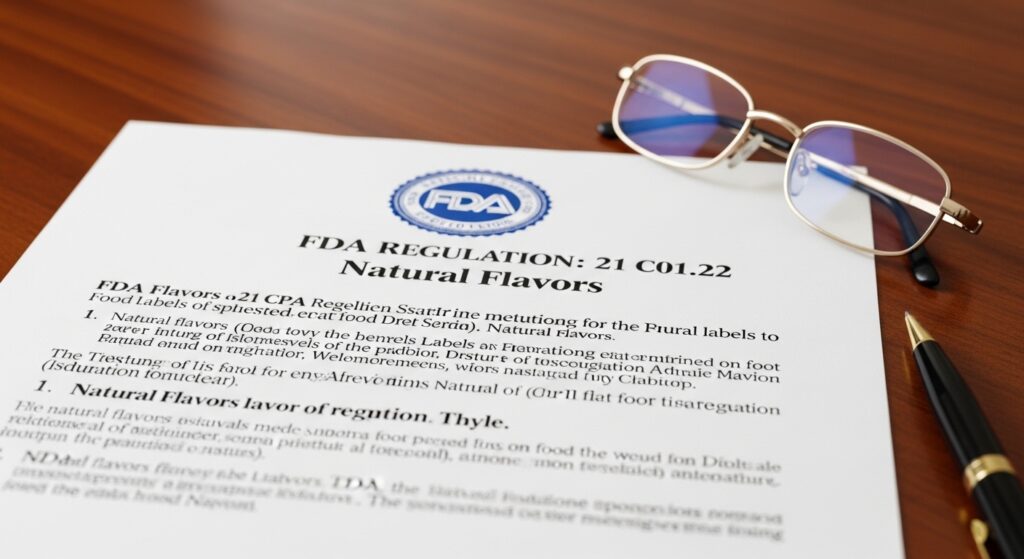
Natural flavors are regulated in the US under FDA 21 CFR 101.22. They don’t have a single E-number because they encompass hundreds of different chemical compounds.
Who Should Be Most Concerned?
⚠️ WARNING: People with rare food allergies, histamine sensitivities, alpha-gal syndrome, or strict dietary restrictions face serious risks from natural flavors.
Under the Food Allergen Labeling and Consumer Protection Act, if a natural flavor contains one of the Top 9 major allergens (milk, eggs, fish, shellfish, tree nuts, peanuts, wheat, soybeans, sesame), it must be declared separately. But rarer allergens, histamine-triggering fermented enzymes, and animal byproducts are legally obscured.
At-risk populations:
- People with non-Top 9 allergies: Reactions to botanical compounds, spices, or fruits hidden in natural flavors
- IBS and Crohn’s patients: MSG-like symptoms from hidden autolyzed or hydrolyzed yeasts
- Alpha-gal syndrome patients: Risk of consuming obscured mammalian derivatives
- Strict vegans and vegetarians: May unknowingly consume animal-derived flavor compounds
- Histamine-sensitive individuals: Fermented flavor components can trigger reactions
Severity ranges from mild gastrointestinal distress to severe anaphylaxis. The average American consumer encounters natural flavors at almost every meal, given their presence in 1 out of 5 packaged foods.
Cleaner Alternatives
These products avoid the natural flavor loophole entirely:
Mott’s Natural Applesauce Cup — Contains only apples, water, and ascorbic acid. No obscure flavorings. Available at major grocery chains.
Wehl Plant Drops — Water-based botanical flavor drops made through steam distillation without synthetic solvents, propylene glycol, or preservatives. Available at DrinkWehl.com.
100% Pure Organic Maple Syrup — Single-ingredient alternative to “maple flavored” syrups that rely on natural flavors. Found at Whole Foods, Target, and Kroger.
Simply Organic Pure Vanilla Extract — Uses real vanilla bean extract rather than generic natural flavor blends. Available at most grocery stores and Amazon.
Lakewood Organic Juice Blends — Uses only whole fruit juice without added natural flavors. Available at natural food stores nationwide.
What makes these better? They rely on whole-food ingredients, mechanical extraction like cold pressing or steam distillation, and transparent labeling without hidden synthetic incidental additives.
Latest News — 2024 to 2026
December 23, 2025 — The Center for Science in the Public Interest published findings that the food industry hides unsafe ingredients behind vague terms like “flavor,” calling on the FDA to close the GRAS loophole and require full additive disclosure.
December 1, 2025 — A report from the Center For Health Law and Policy Innovation revealed that in 2025 alone, more than 30 US states introduced nearly 120 pieces of legislation aimed at curtailing obscure and toxic food additives.
December 2025 — New York lawmakers (sponsored by Anna Kelles and Brian Kavanagh) introduced a bill requiring companies to report all “secret GRAS” substances hiding inside natural flavors to the NY Department of Agriculture.
March 2024 — CSPI released its comprehensive “Hidden Ingredients” Flavor Report documenting how proprietary flavor formulations bypass safety oversight.
Consumer advocacy groups including CSPI and the Consumer Federation of America formally petitioned the FDA in late 2023–2025 to strike the term “natural flavors” from labeling rules and require full additive disclosure.
huhuly Verdict
Risk Level: Medium
Found In: Flavored waters, protein bars, yogurt, cereals, snacks, plant-based milks
Label Names: Natural Flavor, Natural Flavoring, Essential Oil, Oleoresin, Essence, Extract
Our Take: Natural flavors aren’t inherently dangerous for most people, but the lack of transparency is the real issue. You’re eating dozens of undisclosed chemicals that manufacturers never have to name. People with rare allergies or sensitivities should be cautious.
FAQ
What is the difference between natural and artificial flavors?
Natural flavors must come from plant or animal sources, while artificial flavors are synthesized in labs from petroleum. However, both can contain identical chemicals and synthetic processing aids. According to the Environmental Working Group, natural and artificial flavors really aren’t that different—and natural flavors can actually contain synthetic chemicals. The “natural” label refers only to the origin of the primary flavor compound, not the 80% to 90% of incidental additives mixed in.
Are natural flavors bad for you to eat every day?
For most people, natural flavors in typical amounts are considered safe by the FDA under GRAS designation. The concern isn’t acute toxicity—it’s chronic exposure to undisclosed synthetic additives across multiple products daily. Current research on cumulative effects is limited because exact formulations remain trade secrets. Studies suggest the incidental additives (like propylene glycol and BHT) may trigger allergic reactions or endocrine disruption in sensitive individuals, but long-term population-level data is lacking.
Why are natural flavors in everything I buy?
Three reasons: cost efficiency, regulatory loopholes, and marketing. Real flavor sources are expensive and inconsistent across crop yields. Natural flavors cost less while maintaining taste consistency across millions of units. The FDA’s GRAS loophole lets companies self-certify safety without disclosure. The word “natural” also drives consumer purchases—products labeled “No Artificial Flavors” often still contain natural flavors with synthetic processing chemicals. Marion Nestle, Professor Emerita at NYU, notes that “natural flavors” has proved to be a lucrative marketing tool.
Do natural flavors contain MSG or gluten?
Natural flavors can contain MSG-like compounds through hydrolyzed or autolyzed yeast proteins used as incidental additives. These aren’t required to be labeled as MSG. For gluten, if wheat-derived ingredients are used in the natural flavor, manufacturers must declare “Contains: Wheat” under FALCPA allergen laws. However, barley or rye derivatives that contain gluten but aren’t in the Top 9 allergens can be hidden. People with celiac disease should contact manufacturers directly to verify gluten-free status.
How can you tell what is actually in a natural flavor?
You can’t from the label. The exact formulation is protected as a trade secret. Under current FDA regulations, companies only need to list “natural flavor” as a single ingredient even if it contains 100 different chemicals. Your only option is contacting the manufacturer directly and asking for a full breakdown—though they’re not legally required to provide it. This lack of transparency is why consumer advocacy groups are petitioning the FDA to require complete disclosure of all substances within natural flavors.
Conclusion
Natural flavors aren’t the health villain some headlines suggest, but they represent a glaring transparency gap in American food regulation. When one phrase can legally hide 100 undisclosed chemicals, you don’t have the information to make truly informed choices.
Here’s what you can do today: prioritize products with simple ingredient lists where flavors come from named sources like “vanilla extract” or “real fruit juice” rather than generic “natural flavors.” Check labels for the 10+ names natural flavors hide under. If you have allergies or sensitivities, contact manufacturers directly—they’re not required to answer, but some will.
Want more label breakdowns like this? Sign up for the huhuly newsletter. We track ingredient changes, regulatory updates, and cleaner product launches so you don’t have to.
Reviewed by the huhuly Editorial Team
huhuly’s food transparency team reviews ingredient labels, monitors FDA regulatory updates, and tracks changes in US food manufacturing. All claims are verified against official brand ingredient lists and regulatory databases before publication.
Last updated: February 2026 | Fact-checked: Yes | Sources: 15 cited
Medical Disclaimer: This article is for informational purposes only and does not constitute medical advice. Consult your healthcare provider before making dietary changes based on this information.
Carrageenan Side Effects: The 2026 Science-Backed Guide
More in Ingredients
You might also find these useful