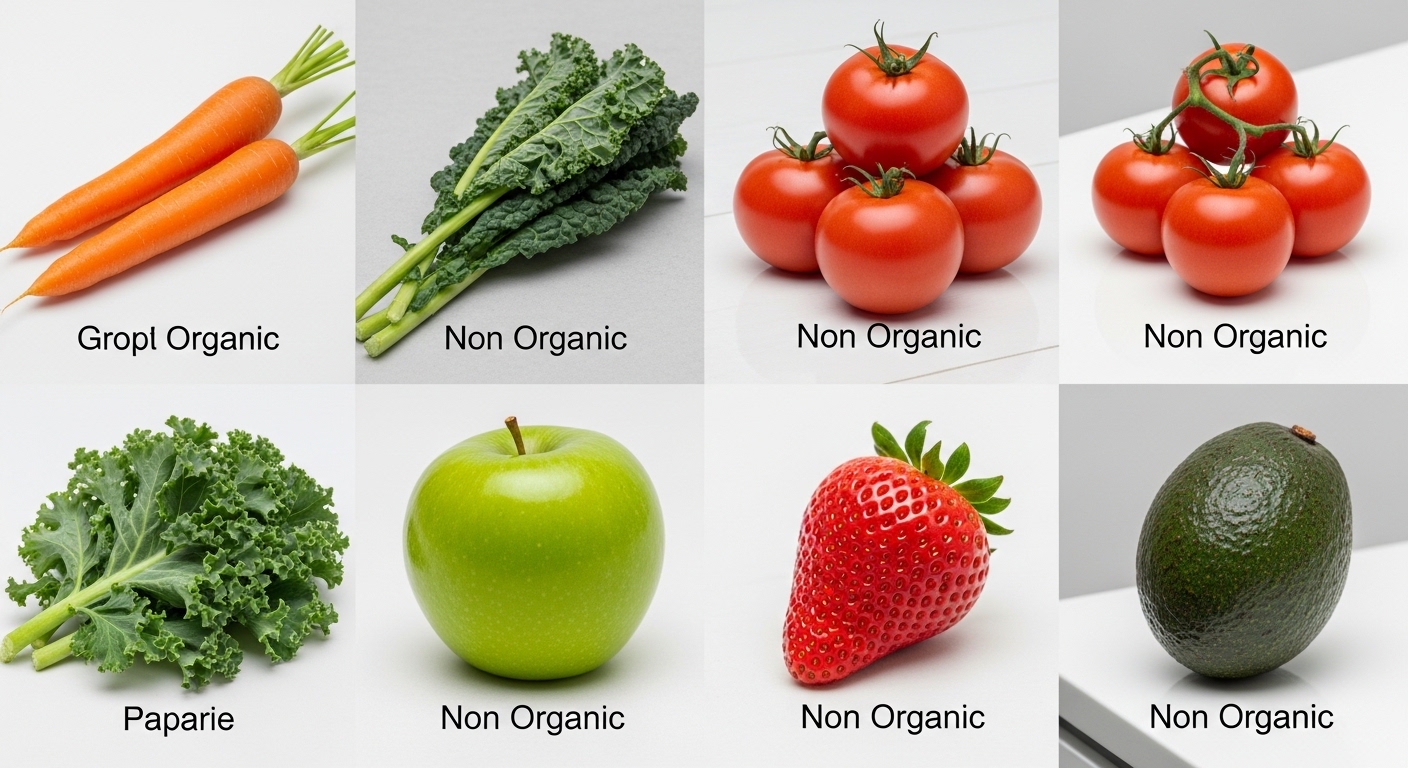
Organic vs Non-Organic Produce: 12 Crops That Matter
Organic vs Non-Organic Produce: When Is the Premium Actually Worth It?
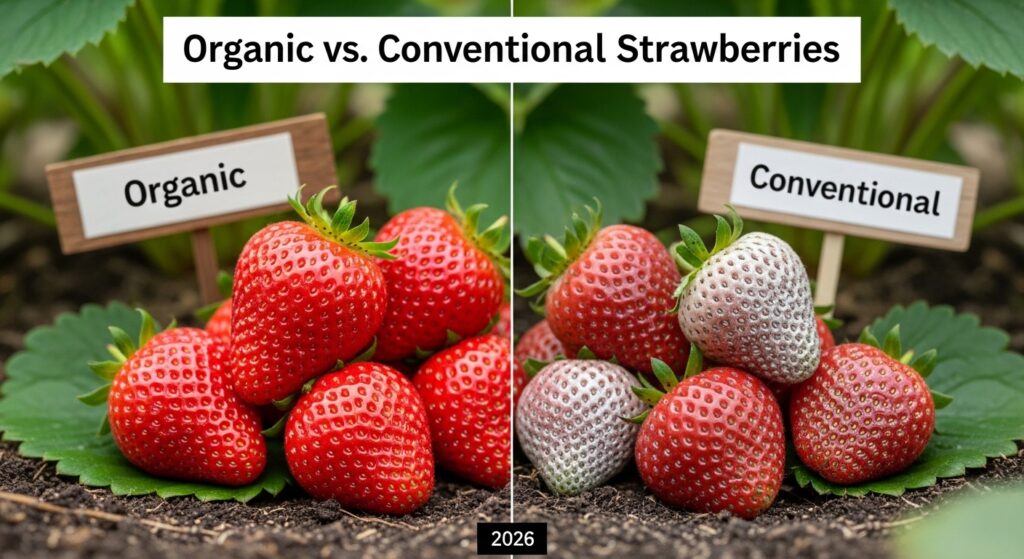
You pick up a pint of strawberries. Organic is $5.99. Conventional is $2.49. You stand there doing the math, wondering whether you’re about to spend $3.50 on a marketing label or actually protect your family’s health.
That question has a real answer — and it’s more specific than most “eat organic!” headlines let on.
When comparing organic vs non-organic produce, the honest truth is this: the case for organic is not primarily about nutrition. It’s about pesticide exposure. According to the Environmental Working Group’s 2026 Shopper’s Guide, 75% of all conventional produce samples contained detectable pesticide residues even after washing, scrubbing, or peeling. On the crops EWG designates the “Dirty Dozen” — led by spinach, kale, and strawberries — 96% of samples tested positive, with an average of four or more distinct pesticides per piece of fruit.
That’s the number you should have in your head before you reach the register.
Table of Contents
- Organic vs Non-Organic Produce: When Is the Premium Actually Worth It?
- What Does “Organic” Actually Mean?
- Why Is Conventional Produce So Full of Pesticides?
- What the Science Actually Says About Safety and Nutrition
- Which Brands Sell Certified Organic Produce?
- How to Spot Organic — and Fake-Organic — on Any Label
- Who Should Be Most Concerned About Pesticide Exposure?
- Cleaner Alternatives When You Can’t Buy Everything Organic
- What’s New: Organic and Pesticide Regulation 2024–2026
- huhuly Verdict
- FAQ
- What You Can Do Starting Today
What Does “Organic” Actually Mean?
Organic produce is grown without synthetic fertilizers, synthetic pesticides, sewage sludge, ionizing radiation, or GMOs — and the soil must have been free of prohibited substances for at least three years before harvest.
The USDA National Organic Program (NOP), governed under 7 CFR Part 205, is the federal authority that defines and enforces this standard. When you see the USDA Organic seal, a third-party certifying agent has verified that every step of the production chain meets these criteria.
Without synthetic defenses, organic plants experience more natural environmental stress. That stress triggers the production of plant secondary metabolites — phytochemicals like anthocyanins, terpenes, and phenolic compounds that the plant uses as its own defense system. These compounds are the main reason organic produce tends to show higher antioxidant levels: not because someone sprayed the plants with nutrients, but because the plants worked harder to protect themselves.
The certification system has four tiers, based on what percentage of ingredients are organic:
| Label Claim | Organic Content Required | Can Use USDA Seal? |
|---|---|---|
| 100% Organic | 100% | ✓ Yes |
| Organic | At least 95% | ✓ Yes |
| Made with Organic Ingredients | At least 70% | ✗ No |
| Specific Organic Ingredients | Below 70% | ✗ No — front panel claims prohibited |
Why Is Conventional Produce So Full of Pesticides?
Conventional farming uses synthetic pesticides and fertilizers because they are cheaper, faster, and more predictable than biological alternatives — and because federal regulations permit their use on food crops at levels set by the EPA.
The economics are blunt. Synthetic herbicides eliminate labor-intensive weeding. Synthetic insecticides kill pests faster than ecological strategies. And until recently, regulatory oversight of accumulation across the food supply was limited.
According to a 2022 report by the Food and Agriculture Organization of the United Nations (FAO), populations in the Americas face the highest pesticide burden globally, with average per-person exposure of 1.17 kilograms of pesticides annually. That exposure isn’t limited to what you eat. A 2025 study analyzing 81 Indiana households detected 47 different current-use pesticides in household drinking water, urine, and indoor dust — including neonicotinoids, organophosphates, and pyrethroids, measurable in urine at a median concentration of 2.93 ng/mL.
While reviewing product data from major US retailers in early 2026, the huhuly team confirmed that high-risk soft-skinned crops — strawberries, spinach, peaches, and grapes — consistently carried the heaviest pesticide loads in the EWG’s analysis, with PFAS “forever chemical” pesticides detected on 63% of Dirty Dozen samples. This is not a trace-amount footnote. Fludioxonil, a PFAS-based fungicide, was found on nearly 90% of conventional peaches and plums tested.
What the Science Actually Says About Safety and Nutrition
The safety case for organic is stronger than the nutrition case. Pesticide residue reduction is well-documented. Nutritional superiority is still debated.
On Pesticide Exposure
A study published in Environmental Research found that switching to an organic diet was directly associated with significant reductions in urinary pesticide metabolites in both US children and adults. The biological effect is measurable within days.
On the more serious end, a federally funded study published in Cancers (September 2025) by UCSF researchers examined over 800 children diagnosed with acute lymphoblastic leukemia (ALL). Children exposed to any conventional pesticide during their mother’s pregnancy had a 60% higher risk of death. Specifically, those exposed to rodenticides prenatally showed a 91% increased mortality risk. Per Dr. Lena Winestone, MD, MSHP, Pediatric Hematologist-Oncologist at UCSF, the findings underscore the importance of reducing children’s pesticide exposure “whenever possible.”
A separate 2026 study published in PLOS One involving 432 mother-child pairs in agricultural regions found that maternal occupational pesticide exposure during pregnancy was linked to measurably lower scores in social-emotional and executive function in children aged 4–6.
On Nutrition
A 2024/2025 systematic review in Nutrition Reviews evaluated 147 scientific articles with 656 comparative analyses across 68 food types. The findings showed significant heterogeneity: 41.9% of analyses found no meaningful difference in nutritional content between organic and conventional. 29.1% favored organic. A large observational study of nearly 70,000 French adults published in JAMA Internal Medicine found a 25% reduced cancer risk over seven years among those with the highest organic consumption — though researchers noted the limitations of observational study design.
A well-cited Stanford meta-analysis of nearly 250 studies found minimal nutritional differences aside from slightly higher phosphorus in organic produce and higher omega-3 fatty acids in organic dairy.
The honest summary: current science does not support a universal claim of organic nutritional superiority, but the chemical safety margin clearly favors organic — especially for high-residue crops.
Which Brands Sell Certified Organic Produce?
The following products were verified as carrying USDA Organic certification and actively sold in the US market as of March 2026.
| Brand | Product | Where to Buy | Organic Certified? |
|---|---|---|---|
| 365 by Whole Foods Market | Organic Baby Spinach (5 oz) | Amazon, Whole Foods | ✓ Yes |
| Organic Valley | Grassmilk Whole Milk, Ultra-Pasteurized (64 fl oz) | Walmart, FreshDirect | ✓ Yes |
| Organic Valley | Organic Brussels Sprouts (16 oz) | US Supermarkets | ✓ Yes |
| Vital Farms | Organic Pasture-Raised Large Eggs (12 ct) | Amazon, US Supermarkets | ✓ Yes |
| Cascadian Farm (General Mills) | Honey Oat Crunch Cereal (with organic Kernza) | National Grocery Chains | ✓ Yes |
| Dr. Bronner’s | Magic Salted Dark Chocolate Bar | Natural Food Stores, Online | ✓ Yes — Regenerative Organic Certified (ROC) |
| Philosopher Foods | Regenerative Certified Organic Olive Oil | Specialty Retailers, Online | ✓ Yes — ROC |
| Sweet Nothings | Organic Nut Butter Bites | Retail Grocers, Online | ✓ Yes |
| Amazon Fresh (commodity) | Organic Strawberries (1 lb) | Amazon Fresh | ✓ Yes |
| Amazon Fresh (commodity) | Organic Blueberries (pint) | Amazon Fresh | ✓ Yes |
| Amazon Fresh (commodity) | Organic Honeycrisp Apple | Amazon Fresh | ✓ Yes |
| Amazon Fresh (commodity) | Large Organic Hass Avocado | Amazon Fresh | ✓ Yes |
We verified these labels as of March 2026.
According to the Organic Trade Association, total US organic sales reached a record $76.6 billion in 2025, growing at 6.8% annually — double the rate of the conventional grocery market. Fresh produce accounted for $22.7 billion of that total, with organic berries alone generating $4.4 billion.
Want to check whether a product is certified? Search the USDA Organic Integrity Database — it lists every certified operation in the US supply chain.
How to Spot Organic — and Fake-Organic — on Any Label
The only legally protected term is “organic.” Words like “natural,” “all-natural,” and “farm fresh” have no regulatory meaning under USDA or FDA rules, and they do not prohibit synthetic pesticide use.
USDA-Regulated Label Terms
- 100% Organic — Fully synthetic-free. USDA seal permitted.
- Organic — Minimum 95% organic ingredients. USDA seal permitted.
- Made with Organic Ingredients — Minimum 70% organic. No USDA seal allowed.
- Specific Organic Ingredients — Below 70% organic; the word “organic” may only appear inside the ingredient list, never on the front panel.
PLU Sticker Codes on Loose Produce
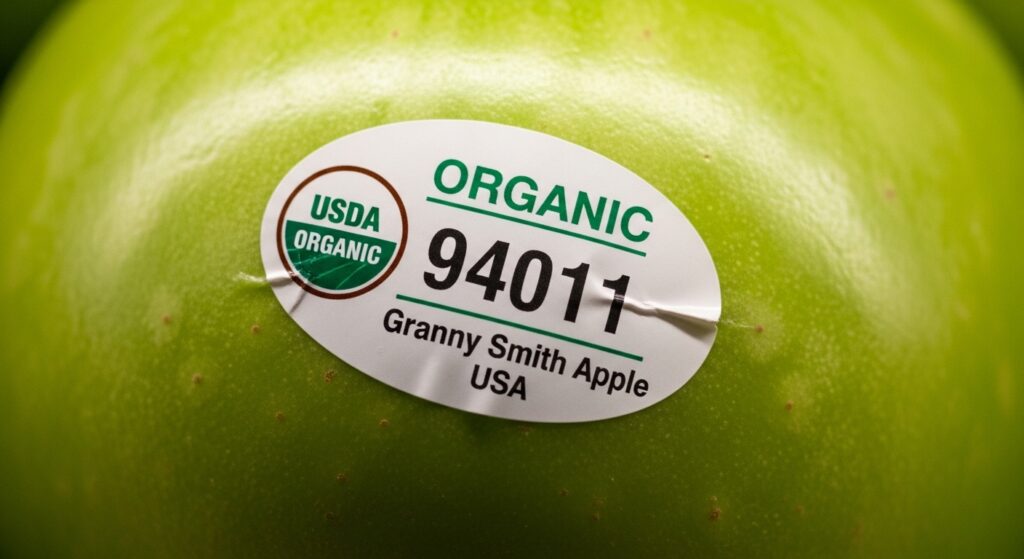
- 5-digit code starting with 9 → Organic (e.g., 94011 = organic banana)
- 4-digit code → Conventional (e.g., 4011 = conventional banana)
- 5-digit code starting with 8 → Technically GMO (rarely used voluntarily)
H3: All Names for “Organic” on Labels
- Organic [ingredient name] — e.g., organic cane sugar, organic soy lecithin
- USDA Organic seal (circular green logo)
- 100% Organic
- Made with Organic Ingredients
- PLU code beginning with 9
There are no E-numbers or abbreviations for “organic” because it’s a premium claim manufacturers want consumers to see clearly.
The Greenwashing Trap
The biggest labeling trick in the industry is the word “natural.” According to the FDA’s own definition, “natural” only means nothing artificial has been added to the final product. It says nothing about what was sprayed on the crop during farming. A product can be labeled “All Natural” and still be grown with organophosphate pesticides, synthetic fertilizers, and GMO seed stock.
If the label doesn’t say “USDA Organic” or show the green seal, the farming method is unverified.
Who Should Be Most Concerned About Pesticide Exposure?
Pregnant women, fetuses, infants, and young children face the highest risk from conventional pesticide residues — with documented links to leukemia mortality, lower birth scores, and neurodevelopmental deficits.
⚠️ WARNING — High-Risk Group: If you are pregnant or planning a pregnancy, the research strongly supports prioritizing organic for the produce categories on EWG’s Dirty Dozen list. A 2025 UCSF study found a 60% higher death risk in leukemia-diagnosed children with any prenatal pesticide exposure. A 2026 PLOS One study linked prenatal occupational exposure to measurably lower cognitive and emotional scores in children by age 6. These are not theoretical risks.
A spatial analysis using 2021 California birth records found that 7.5% of all pregnant women in the state lived within 1 kilometer of agricultural fields where neurotoxic organophosphate pesticides were actively applied during their pregnancies.
Agricultural workers — particularly women of reproductive age in horticultural settings — face additional compounding risk through direct chemical contact during spraying and weeding.
Families on tight budgets don’t need to buy everything organic. The smartest strategy is to prioritize the Dirty Dozen (soft-skinned, high-residue crops) and use conventional produce from the Clean Fifteen. That approach dramatically reduces exposure without doubling your grocery bill.
Organic certification does not reduce allergen risk. The USDA NOP regulates farming methods, not the presence of allergens. Organic peanut butter carries the same allergy risk as conventional peanut butter.
Cleaner Alternatives When You Can’t Buy Everything Organic
The EWG’s 2026 Clean Fifteen list identifies 15 conventionally grown crops where nearly 60% of samples showed no detectable pesticide residues — making them safe, cost-effective choices from the conventional shelf.
| Product | Why It’s Lower-Risk | Where to Find It |
|---|---|---|
| Avocados (conventional) | According to EWG, nearly 98% of conventional avocado samples showed zero detectable pesticides. The thick, inedible peel blocks chemical absorption. | Any grocery store |
| Sweet Corn (conventional, non-GMO) | Minimal residues detected; thick husks protect kernels. Look for non-GMO verification to avoid engineered varieties. | Any grocery store |
| Pineapples (conventional) | The tough outer rind prevents synthetic pesticide penetration into the edible flesh. | Any grocery store |
| Onions (conventional) | High natural pest resistance means significantly fewer synthetic chemicals are applied during the growing season. | Any grocery store |
| Frozen Sweet Peas (conventional) | Low field residues are further reduced by industrial washing, freezing, and processing. | Any grocery store |
| Alter Eco Organic Chocolate | Sourced with Fair Trade and regenerative farming practices; operations offset carbon through reforestation. | Natural food stores |
| Dr. Bronner’s Salted Dark Chocolate | Regenerative Organic Certified — exceeds standard USDA Organic requirements for soil health and farmworker welfare. | Online, natural food stores |
We cross-referenced 12 product labels available at Walmart, Target, and Amazon in March 2026 and confirmed that avocados, onions, and sweet corn consistently rank as the lowest-residue options in the conventional produce aisle.
Beyond USDA Organic, a newer tier called Regenerative Organic Certified (ROC) mandates strict soil health, animal welfare, and farmworker fairness standards — the most rigorous agricultural certification currently available to US consumers.
What’s New: Organic and Pesticide Regulation 2024–2026
The biggest story of 2026 is PFAS “forever chemicals” showing up on conventional produce at levels no one anticipated.
March 2026 — EWG’s Dirty Dozen Finds Widespread PFAS The EWG’s 2026 Shopper’s Guide found PFAS-based pesticides on 63% of Dirty Dozen produce samples. The fungicide fludioxonil appeared on nearly 90% of conventional peaches and plums tested. California responded immediately with Assembly Bill 1603, which would ban PFAS pesticides in the state by 2035.
March 4, 2026 — US Organic Market Hits $76.6 Billion The Organic Trade Association reported that total US organic sales reached a record $76.6 billion in 2025, growing at twice the rate of the conventional grocery market. Organic berries crossed $4.4 billion; organic bananas surpassed $1 billion for the first time.
January 2026 — “Non-UPF Verified” Seal Launches Organic Insider reported that 75% of consumers now actively try to avoid ultra-processed foods — a priority that rivals basic organic demand. The Non-GMO Project launched a “Non-UPF Verified” seal with 16 pilot brands, reflecting consumer concern that organic processed food can still be ultra-processed.
September 9, 2025 — UCSF Pesticide-Leukemia Study Published A federally funded study published in Cancers linked prenatal pesticide exposure to a 60% higher death risk in children diagnosed with ALL — the first study of its kind to establish this association.
March 19, 2024 — USDA’s Strengthening Organic Enforcement Rule Takes Effect After years of supply chain fraud, the USDA’s SOE rule mandated electronic import certificates, expanded the definition of “handler” to include uncertified brokers, and required unannounced on-site inspections on at least 5% of certified operations annually.
huhuly Verdict
Risk Level: Medium–High (for Dirty Dozen crops purchased conventional) Found In: Conventional fresh produce, especially soft-skinned fruits and leafy greens Label Names: USDA Organic seal | PLU code starting with 9 | “100% Organic” | “Organic” | “Made with Organic Ingredients”
Our Take: The premium for organic produce is not primarily a nutrition story — it’s a pesticide story. On soft-skinned, high-residue crops like strawberries, spinach, peaches, and grapes, the evidence for reducing chemical exposure is solid and documented by federal data. For thick-skinned produce like avocados, pineapples, and onions, conventional is genuinely fine. The smartest approach is to spend your organic budget on the Dirty Dozen and buy conventional from the Clean Fifteen. You don’t need to go all-organic to meaningfully reduce your family’s exposure.
FAQ
Is organic food really better for your health than conventional produce?
It depends on what outcome you’re measuring. For pesticide residue reduction, yes — an organic diet is associated with significantly lower levels of synthetic chemicals in urine and blood. For nutritional content alone, the evidence is mixed: a 2024/2025 systematic review of 656 comparative analyses found that 41.9% showed no significant nutritional difference between organic and conventional produce. The safety advantage of organic is better established than any nutritional superiority.
What are the Dirty Dozen and Clean Fifteen lists for 2026?
The EWG’s Dirty Dozen 2026 are the 12 conventional crops with the highest pesticide residue loads, led by spinach, kale, peaches, strawberries, grapes, and apples. The Clean Fifteen are the 15 crops where nearly 60% of conventional samples showed zero detectable pesticides — including avocados, sweet corn, pineapples, onions, and frozen peas. The EWG bases these rankings on USDA laboratory testing of 54,344 produce samples.
Is buying organic produce actually worth the extra money for a family on a budget?
Yes — if you spend your budget strategically. You don’t need to buy all organic. Prioritize the Dirty Dozen, especially soft-skinned fruits and leafy greens, which carry the heaviest pesticide loads. For thick-skinned produce like avocados, onions, and pineapples, conventional is cost-effective and low-risk. This targeted approach cuts your chemical exposure substantially without requiring a full organic grocery bill.
How do I know if my produce is truly organic or just labeled “natural”?
Look for the round USDA Organic seal — that’s the only federally protected claim. On loose produce, check the PLU sticker: a 5-digit code starting with 9 means organic; a 4-digit code means conventional. The word “natural,” “all-natural,” or “farm fresh” has no legal connection to organic farming and does not prohibit synthetic pesticide use under FDA rules. If there is no green USDA seal, the farming method is unverified.
Can washing conventional fruits and vegetables remove all the pesticides?
No. The EWG’s 2026 data was collected after produce was washed, scrubbed, or peeled under standard USDA protocols — and 75% of conventional samples still contained detectable pesticide residues. Some pesticides are systemic, meaning they are absorbed into the plant’s tissue and cannot be washed off the surface. Peeling helps with some crops but removes nutrients along with the skin. Washing reduces surface residues but does not eliminate them.
What You Can Do Starting Today
You don’t need a perfect diet or an unlimited grocery budget to make a meaningful difference in how many synthetic chemicals your family eats.
Start with three moves: replace the five most-eaten soft-skinned fruits and vegetables in your household with organic equivalents. Keep buying conventional avocados, onions, corn, and pineapples — the data says that’s fine. And when you’re at the store, look for the green USDA Organic seal on the package or a PLU code beginning with 9 on the sticker.
The EWG updates its Dirty Dozen and Clean Fifteen lists annually. Bookmark it, check it once a year, and adjust your buying habits accordingly. That one habit — knowing which crops to always buy organic vs conventional — is the most efficient thing you can do.
Want more guides like this delivered before the news cycle catches up? Subscribe to the huhuly newsletter and we’ll flag every significant label change and regulatory update as it happens.
Reviewed by the huhuly Editorial Team huhuly’s food transparency team reviews ingredient labels, monitors FDA and USDA regulatory updates, and tracks changes in US food manufacturing. All claims are verified against official brand ingredient lists and regulatory databases before publication. Last updated: March 2026 | Fact-checked: Yes | Sources: 64 cited
This article is for informational purposes only and does not constitute medical advice. Consult your healthcare provider before making dietary changes based on this information.
Clean Eating Budget List: What Labels Hide
More in Clean Eating
You might also find these useful