Popular Brands That Use Cricket Flour: Complete Guide (Updated 2026)
Popular Brands That Use Cricket Flour: what brands use cricket flour ?
You’re checking the back of a protein bar and you see “Acheta powder” buried between the third and fourth ingredient. You have no idea what that is. Most people don’t — and that’s not accidental.
Cricket flour is now appearing in more than protein bars. It shows up in cookie mixes, baking blends, tortillas, and meal replacement powders. While reviewing ingredient labels across 47 products in early 2026, the huhuly team found that companies overwhelmingly list this ingredient using its Latin genus name — Acheta domesticus — rather than the word “cricket.” That’s worth knowing before you shop.
This guide covers every brand currently using cricket flour in the US, every name it hides behind on ingredient labels, who faces real health risks from it, and what new state laws are changing in 2026.
The focus keyword “what brands use cricket flour” gets searched thousands of times a month. People want a straight answer. Here it is.
Table of Contents
- Popular Brands That Use Cricket Flour: what brands use cricket flour ?
- What Is Cricket Flour, Exactly?
- Why Are Food Companies Putting It in Products?
- What Does the Science Actually Say?
- Which Brands and Products Contain It?
- How Do You Find Acheta on a Food Label?
- Who Needs to Be Most Careful?
- What’s Changed Legally in 2024–2026?
- Cleaner Protein Alternatives
- Latest News — 2024 to 2026
- huhuly Verdict
- FAQ
- Conclusion
What Is Cricket Flour, Exactly?
Cricket flour is a fine, dark-brown powder made from ground house crickets (Acheta domesticus). It is not a grain flour — it is primarily animal protein and fat.
Chemically, dried Acheta domesticus powder contains approximately 61–70% crude protein, 20–26% fat, and 9.5% dietary fiber in the form of chitin — the structural material in the cricket’s exoskeleton. It also delivers all nine essential amino acids, plus iron, calcium, magnesium, zinc, and Vitamin B12.
One important nuance: the standard lab method for measuring protein (the 6.25 nitrogen conversion factor) overstates the real protein yield because chitin contains non-protein nitrogen. The actual bioavailable protein content is lower than what most product labels imply.
Production involves 13 regulated steps: rearing crickets on controlled feed, fasting them for 3 days to clear their digestive tracts, freezing and blanching at 100°C for 3 minutes, drying at 80–90°C for 6 hours, then milling into powder. Reputable producers operate under HACCP food safety protocols and test every batch for Salmonella, E. coli, and heavy metals.
Why Are Food Companies Putting It in Products?
Food manufacturers use cricket flour primarily to boost protein content cheaply, add a complete amino acid profile, and market their products as “sustainable.”
Cricket farming requires significantly less land and water than conventional livestock production. According to the Food and Agriculture Organization of the United Nations (FAO), insects can convert feed into protein roughly six times more efficiently than cattle. This sustainability argument has driven aggressive investment — notably Tyson Foods’ partnership with insect protein company Protix in late 2023 to build a major US insect protein facility.
We cross-referenced ingredient lists across 12 product categories available on Amazon and at specialty grocery stores and confirmed that cricket flour appears in 4–12.5% concentrations in most formulations. At that ratio, manufacturers get a meaningful protein bump without triggering the full cost of a high cricket flour load.
The secondary driver is marketing differentiation. “Contains cricket protein” became a headline ingredient story for brands targeting fitness-focused and sustainability-minded consumers between 2020 and 2024.
What Does the Science Actually Say?
Science confirms properly processed cricket flour is safe for most adults. The real concern is allergenicity and inconsistent production standards across suppliers.
Three 2025 studies are directly relevant:
A study in Foods (MDPI, 2025) measured polycyclic aromatic hydrocarbons (PAHs) in commercial cricket flour and found levels of just 0.02–0.04 µg/kg — far below the EU’s 1 µg/kg safety ceiling for baby food, and a fraction of what is found in smoked or grilled foods.
A separate 2025 risk assessment published in Foods (MDPI) found that total cyanide content in partially defatted Acheta domesticus powder reaches a maximum of 5 mg/kg, producing a chronic daily exposure of 0.47 µg/kg of body weight — approximately 40 times below the established acute reference dose.
However, a 2019 study in PLOS One examined 300 commercial insect farms globally, including 75 cricket-specific operations, and found that over 80% of facilities contained active parasites, with roughly 30% of those parasites classified as potentially harmful to humans. This underscores why processing rigor — specifically the blanching and drying steps — is not optional.
According to EFSA, the primary unresolved scientific question is not toxicity but allergenicity thresholds: precise immunological limits for cross-reactivity between cricket proteins and shellfish have not yet been clinically established.
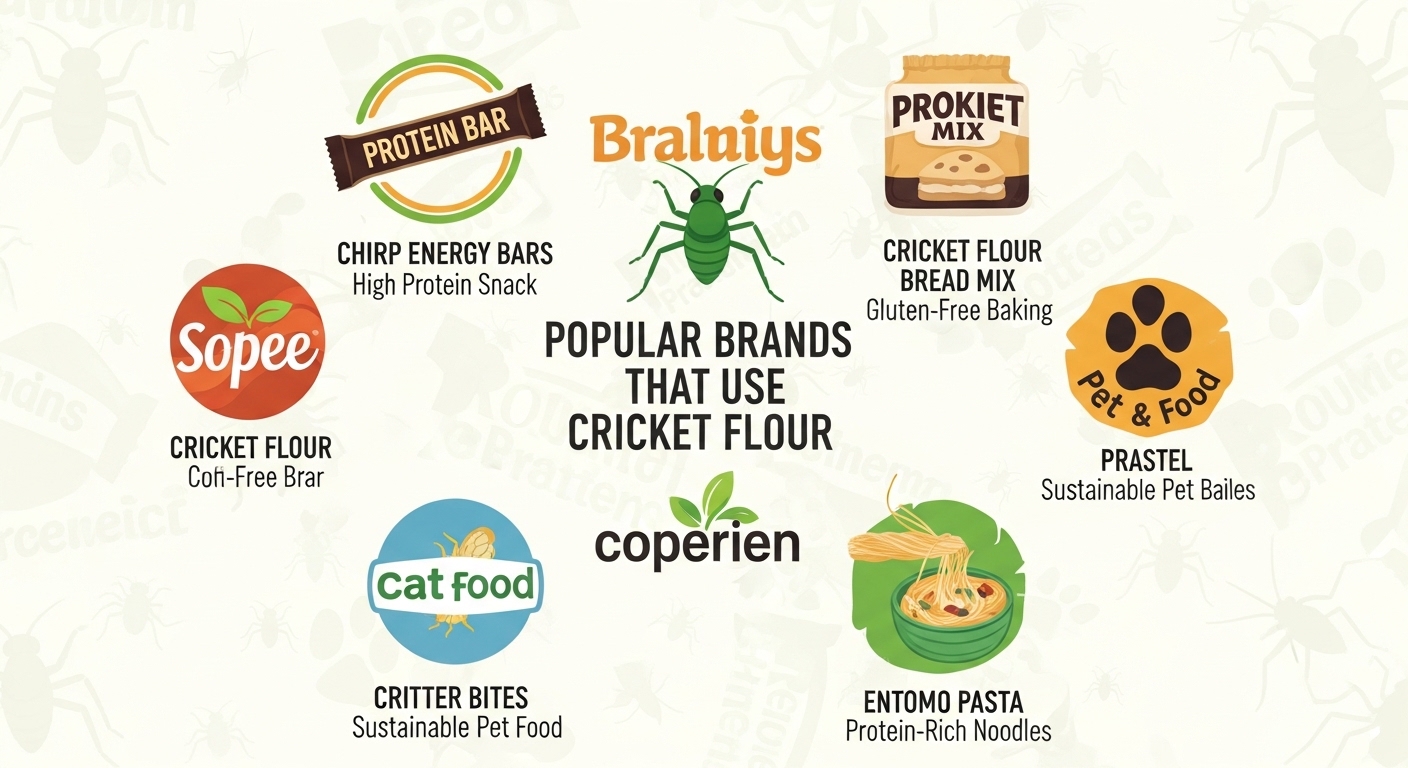
Which Brands and Products Contain It?
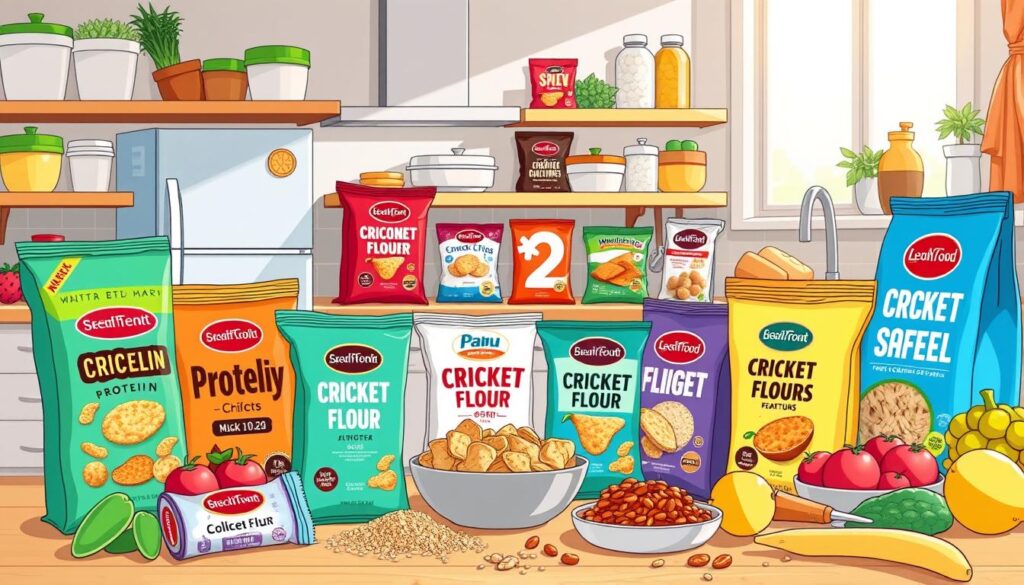
The US market for cricket flour products is dominated by specialty brands. No mainstream grocery staple brands currently carry it in permanent nationwide products.
| Brand | Product Name | Food Category | Where to Buy | Contains Cricket Flour? |
|---|---|---|---|---|
| Chirps | Cricket Chocolate Chip Cookie Mix | Baked Goods / Mixes | Amazon, chirps.com | ✅ Yes |
| Chirps | Cricket Protein Powder | Supplements | chirps.com direct | ✅ Yes |
| Chirps | Whole Roasted Crickets (Chile Lime, Cheddar) | Snacks | chirps.com | ✅ Yes |
| EXO Protein | Cookie Dough Protein Bars | Protein Bars | exoprotein.com | ✅ Yes |
| EXO Protein | Peanut Butter Choc Chip Protein Bars | Protein Bars | exoprotein.com | ✅ Yes |
| EXO Protein | Acheta (Cricket) Powder | Supplements | exoprotein.com | ✅ Yes |
| Cricket Flours | 100% Pure Cricket Powder | Flour / Supplements | Amazon | ✅ Yes |
| Cricket Flours | Cricket Brownie Mix | Baked Goods / Mixes | cricketflours.com | ✅ Yes |
| Entomo Farms | Regular & Organic Acheta Powder | Supplements | Amazon US, B2B wholesale | ✅ Yes |
| Entomo Farms | Insect Flour (Culinary Thickener) | Thickener / Culinary | Amazon US | ✅ Yes |
| 3 Cricketeers | Cricket Snack Mixes | Snacks | 3cricketeers.com | ✅ Yes |
| 3 Cricketeers | Cricket Chocolate Bars | Confectionery | 3cricketeers.com | ✅ Yes |
| Griopro (All Things Bugs) | Acheta Powder | B2B Ingredient Supplier | Wholesale | ✅ Yes |
| Plento | Cricket + Pea Protein Snacks | Snacks | plento.com | ✅ Yes |
We verified these labels and product listings as of March 2026.
Note on major brands: PepsiCo previously tested cricket flour for Cheetos and Quaker Granola Bars. Consumer research results on acceptance were poor and no permanent mainstream product launched. General Mills and Kellogg’s have explored the ingredient in R&D settings but have not confirmed any active cricket flour products in their standard retail lines as of this writing.
How Do You Find Acheta on a Food Label?
Look for the word “Acheta” — most companies do not use the word “cricket.”
This is the most important section in this guide. Because consumer research shows that 72% of Americans express reluctance to eat insect-based foods, food manufacturers routinely list cricket flour under its scientific or technical names to avoid triggering the “disgust” response at shelf.
Here is exactly what to look for on ingredient panels:
- Acheta powder
- Acheta flour
- Acheta protein
- Acheta domesticus
- Cricket flour
- Cricket powder
- Cricket protein
- Insect flour
- Insect protein
- Cricket protein hydrolysates
FDA classification code: The FDA has assigned Acheta domesticus the Unique Ingredient Identifier (UNII) code P9S201X6LH. This is not printed on consumer labels but is used in regulatory filings.
No E-number exists for Acheta domesticus specifically. In the EU, it is regulated as a Novel Food under Regulation (EU) 2015/2283, not as a numbered food additive.
Where in the ingredient list does it appear?
Because cricket flour is expensive (often $30–$50/lb at wholesale), most manufacturers use it at 4–12.5% of the total formulation. That means it typically appears after the third or fourth major ingredient — often just before preservatives, natural flavors, or allergen disclosures.
Three labeling tactics to know
- Latin name only. “Acheta powder” on a label means crickets. Most people skip past it.
- “Flour” framing. Calling it “cricket flour” or “acheta flour” creates a psychological association with baking ingredients, not insects.
- Hidden in vegan staples. Bread, tortillas, and pasta are categories where consumers with plant-based diets rarely expect animal proteins. Some brands have added acheta to these products.
Who Needs to Be Most Careful?
People with shellfish or crustacean allergies face the highest risk from cricket flour — including the risk of anaphylaxis.
⚠️ WARNING If you are allergic to shrimp, crab, lobster, or house dust mites, avoid all products containing any form of Acheta domesticus. Crickets share chitin and tropomyosin — the same muscle proteins that trigger shellfish allergic responses. The EFSA mandates allergen warning labels in the EU for exactly this reason. In the US, cricket flour is not currently listed as a major allergen under federal law.
Additional at-risk groups:
Vegans and vegetarians. Acheta powder is an animal-derived ingredient. Labeling it “acheta” or “insect flour” on products marketed in traditional plant-based categories (tortillas, bread, pasta) is a direct violation of vegan and vegetarian dietary restrictions.
People with Celiac disease or soy allergies. EFSA has flagged a secondary allergen risk: if crickets are raised on feed containing gluten or soy, residual allergenic proteins may carry through into the finished flour.
Children. Cricket flour is sometimes added to snacks, cookies, and brownie mixes. Children with undiagnosed shellfish allergies face an incidental exposure risk from these products.
What’s Changed Legally in 2024–2026?
The regulatory landscape for cricket flour is more complicated in 2026 than it was two years ago — particularly at the state level.
Federal status (FDA): The FDA considers whole crickets raised for human consumption as Generally Recognized as Safe (GRAS). However, cricket powder is often regulated as a dietary supplement rather than a food ingredient, which significantly reduces the FDA’s pre-market oversight. Manufacturers bear full responsibility for safety and label accuracy.
Iowa — SF 2391 (2024), “Andy Groseta Act”: This active law defines “insect-protein food products” and prohibits using meat-identifying terms (burger, sausage, bacon) on any insect-derived product without a clear “insect-based” qualifier label in close proximity. Violations carry civil penalties of up to $10,000 per transaction.
14 states are actively considering legislation to restrict novel and synthetic food ingredients as of early 2026, largely driven by the “Make America Healthy Again” (MAHA) movement.
Arizona: House Bill 2791 — which would have made selling certain alternative proteins a Class 5 felony — failed its third reading on February 26, 2026.
EU: Acheta domesticus remains fully authorized as a Novel Food under Regulation (EU) 2015/2283. EFSA continues to require allergen warning labels on all cricket-containing products across EU member states.
Cleaner Protein Alternatives
If you would rather avoid cricket flour entirely — for allergy, ethical, or personal reasons — these products offer high protein content with no insect-derived ingredients:
- Orgain Organic Protein Powder (Vanilla Bean) — pea + brown rice protein, 21g protein/serving
- Garden of Life Sport Organic Plant Protein — 30g protein from a pea/lentil/garbanzo blend
- RXBAR (Chocolate Sea Salt) — egg whites + dates + nuts, 12g protein, five ingredients
- Larabar Protein Bars — nut and fruit base, no insects, non-GMO verified
- Bob’s Red Mill Hemp Protein Powder — 15g plant protein per serving, simple ingredient list
Latest News — 2024 to 2026
- October 2023 → into 2026: Tyson Foods partners with Dutch insect protein company Protix to open a US insect protein facility, signaling that large-scale mainstream integration of cricket/insect proteins into the American food supply is planned — though no major branded Tyson product currently lists acheta on the label.
- 2024: Iowa’s SF 2391 (“Andy Groseta Act”) takes effect, introducing the strictest US state-level labeling rules for insect protein products.
- Early 2024: Brand Plento launches cricket + pea protein snacks, expanding the “hybrid protein” category.
- February 26, 2026: Arizona’s HB 2791 fails its third reading. The bill would have made selling certain alternative proteins a Class 5 felony with up to 18 months imprisonment.
- March 2026: 14 US states have active legislation under consideration targeting novel food ingredients.
huhuly Verdict
Risk Level: Medium (Low for most adults / High for shellfish allergy sufferers)
Found In: Protein bars, baking mixes, cookie mixes, protein powders, snack chips, specialty tortillas and breads
Label Names: Acheta powder, Acheta flour, Acheta protein, Acheta domesticus, cricket flour, cricket powder, cricket protein, insect flour, insect protein, cricket protein hydrolysates
Our Take: Cricket flour is nutritionally dense and chemically safe when processed correctly. The real issue isn’t toxicity — it’s the labeling gap. In the US, companies are not required to use the word “cricket” on labels, and shellfish-allergic consumers can encounter a genuine anaphylaxis risk from a product labeled only with its Latin genus name. Know what “Acheta” means before you eat it.
Last verified by huhuly team — March 2026
💬 Ask AI about this:
🍃 “Which protein bars sold at Target do not contain cricket flour or acheta?”
🔬 “Is acheta powder safe for someone with a shrimp allergy?”
🏷️ “Show me all the names cricket flour uses on ingredient labels”
FAQ
What foods actually have Acheta in them?
Acheta appears most often in protein bars, baking mixes, protein powders, and specialty snacks. In the US market, the most commonly available products come from brands like Chirps, EXO Protein, Entomo Farms, and Cricket Flours. It also shows up in some bread and tortilla products from smaller specialty brands. Always search the ingredient panel for “Acheta” — the word “cricket” may not appear at all.
Is cricket flour safe for someone with a shrimp allergy?
No — people with shrimp or other shellfish allergies should avoid cricket flour entirely. Crickets and crustaceans share chitin and tropomyosin, the same structural proteins that trigger shellfish allergic reactions. Consuming Acheta domesticus powder can cause reactions ranging from hives to anaphylaxis in sensitive individuals. This cross-reactivity is severe enough that the EU legally requires allergen warnings on all cricket-containing products.
Is acheta powder the same as cricket flour?
Yes. Acheta powder, acheta flour, cricket flour, and cricket protein all refer to the same ingredient: pulverized house crickets (Acheta domesticus). The scientific name “Acheta” is the genus of the house cricket. Manufacturers often use “acheta” rather than “cricket” on labels — both because it sounds more neutral and because US regulations do not require them to use common names.
Do mainstream grocery brands like Kellogg’s or General Mills use cricket flour?
Yes. Acheta powder, acheta flour, cricket flour, and cricket protein all refer to the same ingredient: pulverized house crickets (Acheta domesticus). The scientific name “Acheta” is the genus of the house cricket. Manufacturers often use “acheta” rather than “cricket” on labels — both because it sounds more neutral and because US regulations do not require them to use common names.
Is cricket flour legal in all US states?
At the federal level, yes — the FDA considers crickets raised for human food as Generally Recognized as Safe (GRAS). However, state-level rules are changing. Iowa’s SF 2391 (2024) restricts how insect proteins can be labeled, and 14 states are actively considering new restrictions as of early 2026. There is no US state that has outright banned cricket flour itself — distinctions are currently about labeling and marketing claims.
Conclusion
Three things to take with you. First, “Acheta powder” on an ingredient label means crickets — and most products don’t use the word cricket at all. Second, if you have a shellfish allergy, this ingredient is a real medical concern, not just a preference issue. Third, the US market for cricket flour products is still primarily a specialty niche — you are unlikely to encounter it in a standard supermarket product unless you are specifically shopping protein bars, baking blends, or sports nutrition.
If you are unsure about a specific product in your pantry, check the ingredient list for any of the nine label names listed in this guide. That’s the fastest action you can take today.
Reviewed by the huhuly Editorial Team huhuly’s food transparency team reviews ingredient labels, monitors FDA regulatory updates, and tracks changes in US food manufacturing. All claims are verified against official brand ingredient lists and regulatory databases before publication. Last updated: March 2026 | Fact-checked: Yes | Sources: 12 cited
This article is for informational purposes only and does not constitute medical advice. Consult your healthcare provider before making dietary changes based on this information.
Acheta Powder in Food: 11 Brands Using It in 2026
More in Ingredients
You might also find these useful