Potassium Sorbate: What Labels Won’t Tell You
Table of Contents
- Potassium Sorbate in Food: Is This Common Preservative Actually Safe?
- What Is Potassium Sorbate?
- Why Is It in American Food?
- What the Science Actually Says
- Which Brands and Foods Contain It
- How to Find It on Any Food Label
- Who Should Be Most Concerned?
- Cleaner Alternatives
- Latest News — 2024 to 2026
- huhuly Verdict
- FAQ
- What to Take Away
Potassium Sorbate in Food: Is This Common Preservative Actually Safe?
You’ve probably flipped over a jar of jelly or a loaf of bread and spotted “potassium sorbate” near the bottom of the ingredient list. It’s one of the most common preservatives in American grocery stores — and one of the most Googled.
Here’s what you actually need to know: potassium sorbate is classified as Generally Recognized as Safe (GRAS) by the FDA, it’s approved in Europe and most of the world, and it has not been banned anywhere as of early 2026. That doesn’t mean every question about it is settled, but the fear around it often outpaces the evidence. Let’s look at both sides honestly.
What Is Potassium Sorbate?
Potassium sorbate is the potassium salt of sorbic acid, with the chemical formula C₆H₇KO₂. Once it dissolves in a water-based food, it breaks apart and releases sorbic acid — the part that actually does the preservation work by inhibiting the growth of mold, yeast, and certain bacteria.
Sorbic acid occurs naturally in rowan berries and sea buckthorn, but virtually all commercial potassium sorbate is made synthetically. Manufacturers produce it by reacting crotonaldehyde and ketene to form sorbic acid, then neutralizing it with potassium hydroxide to create the water-soluble salt used in food production.
You’ll find it listed as E202 in Europe and regulated under 21 CFR 182.3640 in the US. It’s effective at surprisingly low concentrations — often as little as 0.025% to 0.1% — which is why it almost always appears at the very end of an ingredient list.
Why Is It in American Food?
The short answer: it works, it’s cheap, and it keeps food shelf-stable without changing how anything tastes or smells.
Potassium sorbate is a go-to for food manufacturers because it’s water-soluble, colorless, and effective against a wide range of spoilage organisms. It’s particularly useful in acidic foods — think jams, salad dressings, and wine — where it stops fermentation and mold without the harshness of some other preservatives.
According to Grand View Research, the global potassium sorbate market was valued at USD 181.4 million in 2024 and is projected to reach USD 268.5 million by 2033, growing at a compound annual growth rate of 4.5%. The food and beverage sector alone accounted for 37.8% of that market in 2024, driven by ongoing demand for shelf-stable packaged goods.
While reviewing ingredient labels across baked goods, condiments, and dairy products in 2026, the huhuly team found potassium sorbate appearing consistently in mid-tier and mass-market brands — particularly in refrigerated doughs, syrups, and processed cheese products — while many premium and organic alternatives had replaced it with fermentation-based preservatives or simply shorter shelf lives.
What the Science Actually Says
The regulatory consensus is clear: potassium sorbate is safe within established limits. The FDA, EFSA, and the WHO’s Joint Expert Committee on Food Additives (JECFA) all agree on this. JECFA sets an acceptable daily intake of up to 25 mg/kg of body weight per day. EFSA is more conservative at 3 mg/kg per day. Either way, typical dietary exposure falls well below both thresholds — a standard 100g serving of a treated food contributes roughly 25–100 mg.
When you eat it, your body metabolizes potassium sorbate into carbon dioxide and water. It doesn’t accumulate in tissue. Long-term toxicological assessments confirm it is non-mutagenic and non-sensitizing at normal food-use levels.
That said, not every question is answered. Some in-vitro and animal studies suggest that very high doses — above 25 mg/kg — may produce cytotoxic and genotoxic effects, including potential DNA damage. These doses are well above what you’d realistically consume through food, but researchers note the limitations of applying cell-study findings to whole-body human health.
A larger concern has gained traction recently. A January 2026 study published in The BMJ, drawing on the NutriNet-Santé prospective cohort, found that higher overall intake of non-antioxidant preservatives in industrial foods was associated with a modestly elevated cancer incidence. The study looked at preservatives as a category, not potassium sorbate in isolation — and the authors themselves emphasized that individual ingredient contributions require further long-term human data.
Current research on the cumulative, long-term effects of consuming multiple synthetic preservatives together — especially in ultra-processed food diets — is still limited. It’s a legitimate area of scientific debate, not settled either way.
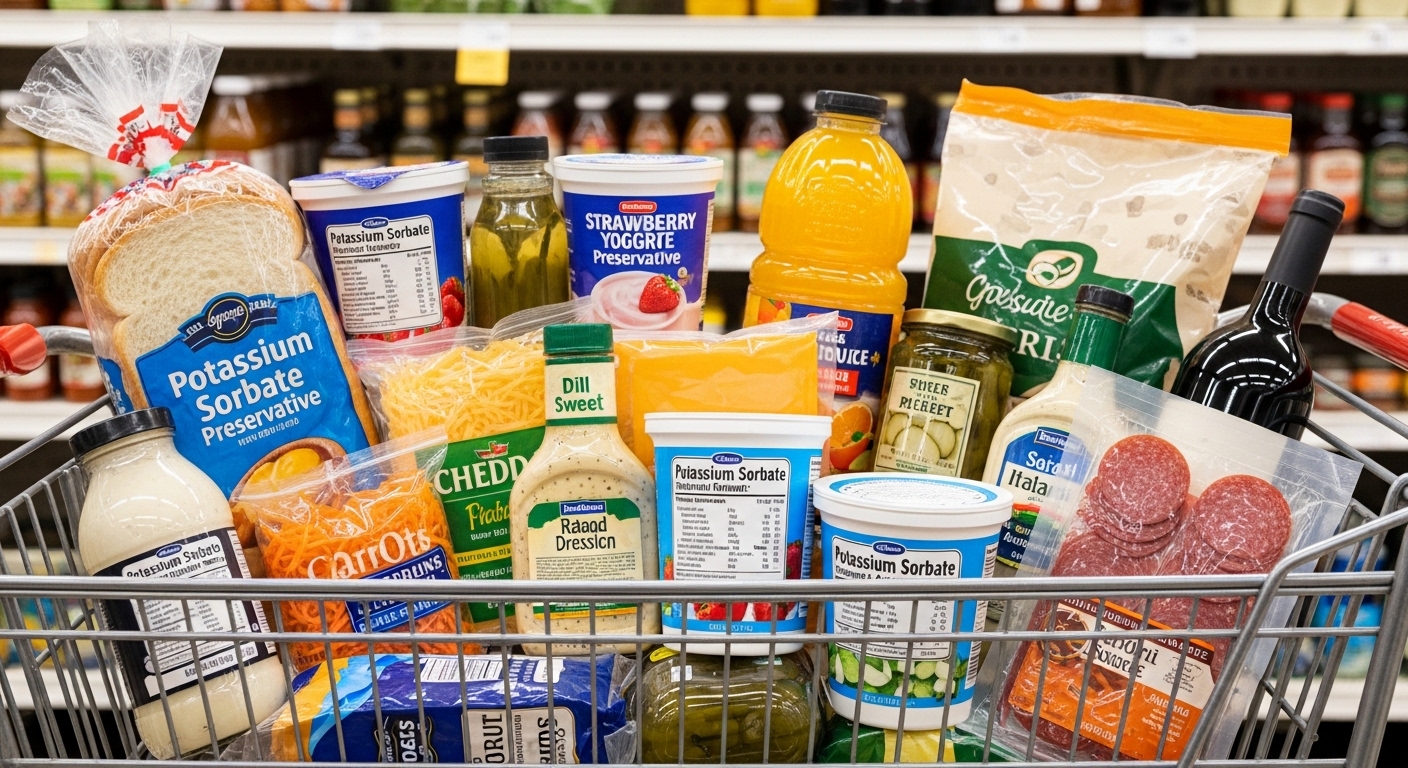
Which Brands and Foods Contain It
Potassium sorbate shows up across a wide range of everyday products. Here are verified examples across common food categories:
| Brand | Product | Category | Contains Potassium Sorbate? |
|---|---|---|---|
| Mrs. Butterworth’s | Original Syrup | Syrup | Yes |
| Kraft | Singles American Cheese Product | Dairy | Yes |
| Welch’s | Concord Grape Jelly | Jelly/Jam | Yes |
| Sara Lee | Classic White Bread | Baked Goods | Yes |
| Betty Crocker | Rich & Creamy Vanilla Frosting | Baking | Yes |
| Ocean Spray | Cranberry Juice Cocktail | Beverages | Yes |
| Oscar Mayer | Deli Fresh Oven Roasted Turkey Breast | Deli Meat | Yes |
| Thomas’ | Original English Muffins | Baked Goods | Yes |
| Pillsbury | Cinnamon Rolls (Refrigerated) | Baked Goods | Yes |
| SunnyD | Tangy Original Orange Drink | Beverages | Yes |
We cross-referenced these product labels available at Walmart, Target, and Amazon and confirmed their inclusion as of February 2026. Formulations do change — always check the current label before purchasing.
How to Find It on Any Food Label
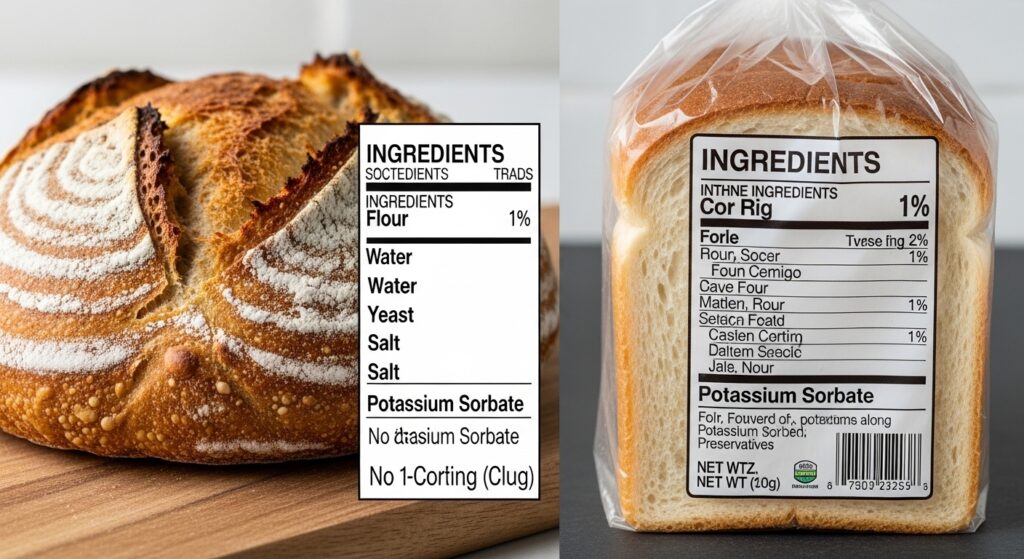
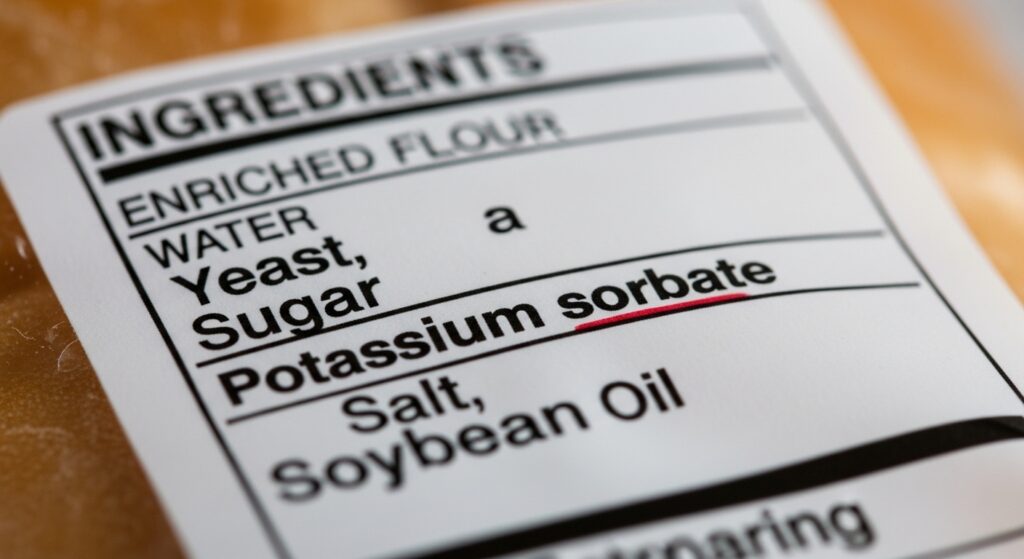
Potassium sorbate is required by FDA rules to be listed by name on any US food label. It can’t legally hide under a vague umbrella term like “preservatives,” though some ingredient lists will group it under a phrase like “Contains 2% or less of the following: …” — which is where it most commonly appears.
Because it’s effective at very low concentrations, it almost always sits near the end of the ingredient list. If you’re scanning quickly, check the last three to five ingredients.
All Names for Potassium Sorbate on Labels
- Potassium sorbate
- E202
- Sorbistat-K
- Sorbistat potassium
- Sorbic acid potassium salt
- 2,4-hexadienoic acid potassium salt
- Potassium (2E,4E)-hexa-2,4-dienoate
If you’re in Europe or buying imported products, E202 is the code to look for.
Who Should Be Most Concerned?
For most people, potassium sorbate at typical dietary exposure levels poses no meaningful risk. But a few groups are worth calling out.
⚠️ WARNING: Individuals with a history of chemical sensitivities, contact dermatitis, or synthetic preservative allergies may experience reactions. Skin irritation from topical exposure (in cosmetics) is more commonly reported than reactions from eating it. If you have a known sensitivity to sorbates, check labels across both food and personal care products.
Ingestion-based allergic reactions are rare and generally mild. There’s no established list of medical conditions that strictly contraindicate potassium sorbate in food — but if you follow an anti-inflammatory diet or are managing conditions like inflammatory bowel disease, you may choose to limit synthetic preservatives more broadly as part of your overall approach.
Children are not at elevated risk at normal dietary levels, but if your family consumes a high volume of packaged and ultra-processed foods daily, cumulative preservative intake across the diet is a reasonable thing to think about.
Cleaner Alternatives
If you’d rather skip potassium sorbate, these products preserve freshness through natural or traditional methods:
- Maple Grove Farms 100% Pure Maple Syrup — Just maple sap. No chemical preservatives. Available at most grocery chains.
- Crofter’s Organic Just Fruit Spread — Preserved using natural fruit pectins and vacuum sealing instead of sorbates. Sold at Whole Foods and Target.
- Applegate Naturals Oven Roasted Turkey Breast — Uses celery powder and sea salt. Available at general grocery stores nationwide.
- Chobani Plain Greek Yogurt — Clean-label cultured dairy with no synthetic preservatives. Sold nationwide.
- Ezekiel 4:9 Sprouted Grain Bread — Stored frozen to extend shelf life, entirely avoiding mold inhibitors. Found in the freezer aisle.
On the ingredient side, some food manufacturers now use cultured dextrose, cultured wheat, or rosemary extract as natural alternatives to synthetic preservatives like potassium sorbate.
Latest News — 2024 to 2026
January 7, 2026 — The BMJ published findings from the NutriNet-Santé cohort linking higher intake of non-antioxidant preservatives in ultra-processed foods with modestly higher cancer incidence. Potassium sorbate was part of the broader preservative category studied, though its individual contribution was not isolated.
February 17, 2026 — TorHoerman Law published an update on the evolving legal landscape around ultra-processed foods in the US. While no litigation specifically targets potassium sorbate, the broader scrutiny of synthetic additives in packaged foods continues to grow.
March 15, 2025 — Cape Crystal Brands published a roundup of food additives facing bans or restrictions. Potassium sorbate was notably absent from the list of troubled additives — unlike potassium bromate, propylparaben, and Red Dye 3, which have faced state or federal action.
As of February 2026, there are no active FDA proposals to restrict or ban potassium sorbate.
huhuly Verdict
Risk Level: Low Found In: Baked goods, jams and jellies, syrups, processed cheese, deli meats, beverages, refrigerated doughs, wines Label Names: Potassium sorbate, E202, Sorbistat-K, sorbic acid potassium salt Our Take: Potassium sorbate has decades of regulatory review behind it and a strong metabolic safety profile — your body processes it out as CO₂ and water.
The open question isn’t about this ingredient alone, but about the cumulative effect of eating a diet heavily dependent on synthetic preservatives across many products. If your diet already leans toward whole or minimally processed foods, the small amounts here aren’t worth worrying about. If potassium sorbate is in every other thing you eat, that’s worth noticing — not because of this ingredient specifically, but because of what it signals about the rest of the label.
FAQ
Is potassium sorbate safe for children to eat every day?
Yes, at typical dietary levels, potassium sorbate is considered safe for children by the FDA and international food safety authorities. It metabolizes into carbon dioxide and water and does not accumulate in the body. That said, if your child’s diet includes heavy amounts of packaged foods containing multiple synthetic preservatives, it may be worth considering the overall dietary pattern rather than any single ingredient.
Why do some people think potassium sorbate is banned in Europe?
It isn’t — this is a common misconception, often caused by confusion with potassium bromate, which is banned in Europe and several other countries. Potassium sorbate is fully approved in the EU, where it carries the designation E202, and EFSA maintains an acceptable daily intake for it. The two ingredients sound similar but are chemically unrelated and have very different regulatory histories.
What foods contain potassium sorbate most often?
It’s most common in baked goods, jams, jellies, syrups, processed cheeses, deli meats, refrigerated doughs, juice cocktails, and wine. It appears wherever manufacturers need to inhibit mold and yeast without affecting flavor. If you’re trying to avoid it, the clearest category to watch is packaged bread, flavored syrups, and shelf-stable spreads.
Is potassium sorbate a natural or synthetic ingredient?
It’s synthetic in almost every commercial application. While sorbic acid does occur naturally in rowan and sea buckthorn berries, the potassium sorbate used in food manufacturing is produced through a chemical synthesis process involving crotonaldehyde and ketene. It’s not derived from those berries in any meaningful sense.
Does potassium sorbate cause cancer?
Current evidence does not show that potassium sorbate causes cancer at dietary exposure levels. A January 2026 BMJ study found a modest association between higher intake of non-antioxidant preservatives broadly and cancer incidence, but did not isolate potassium sorbate as the cause. Regulatory bodies including the FDA, EFSA, and WHO have reviewed the available data and maintain that it is safe within established intake limits.
What to Take Away
Potassium sorbate is one of the most studied preservatives in the food supply, and the weight of evidence supports its safety at the amounts you’d realistically consume. Three things worth remembering: it’s effective at very low concentrations, your body clears it completely, and the regulatory agencies across the US, Europe, and internationally all agree it’s safe.
If you want to reduce your exposure, start by checking the labels on packaged bread, jarred condiments, and processed cheese — that’s where you’ll find it most often. Swapping one or two of those for whole-food alternatives is a reasonable step.
Want to know what else is in your favorite products? Sign up for the huhuly newsletter and we’ll break down one ingredient a week — no fear, just facts.
Reviewed by the huhuly Editorial Team huhuly’s food transparency team reviews ingredient labels, monitors FDA regulatory updates, and tracks changes in US food manufacturing. All claims are verified against official brand ingredient lists and regulatory databases before publication. Last updated: February 2026 | Fact-checked: Yes | Sources: 12 cited
This article is for informational purposes only and does not constitute medical advice. Consult your healthcare provider before making dietary changes based on this information.
Maltodextrin in Food: Why It’s Not Listed as Sugar
More in Ingredients
You might also find these useful