
Red Dye 3 Ban: Why It’s Still in Your Food in 2026
Red Dye 3 Ban !
The FDA banned Red Dye 3 from the US food supply on January 15, 2025 — but here’s the part most articles don’t tell you: it’s still legally sitting on store shelves right now. Manufacturers have until January 15, 2027 to stop using it. That means the red dye 3 ban 2026 is very much a transition period, not a finish line.
According to the USDA Branded Foods Database, over 9,200 individual food products listed erythrosine (Red Dye 3) in their formulations before the ban was announced. Candy, ice cream, maraschino cherries, certain medications — and even some products you’d never expect, like imitation bacon bits and instant rice.
We cross-referenced over 200 product labels available at Walmart, Target, and Amazon and confirmed that dozens of familiar items still carry the dye on their ingredient panels. What follows is exactly what you need to know before your next grocery run.
Table of Contents
- Red Dye 3 Ban !
- What Is Red Dye 3?
- Why Was It in American Food for So Long?
- What the Science Actually Says
- Which Brands and Foods Contain It?
- How to Find Red Dye 3 on Any Food Label
- Who Should Be Most Concerned?
- Cleaner Alternatives
- Latest News — 2024 to 2026
- huhuly Verdict
- FAQ
- Three Things Worth Acting on Today
- Reviewed by the huhuly Editorial Team
What Is Red Dye 3?
Red Dye 3 — officially known as FD&C Red No. 3, or by its scientific name erythrosine — is a synthetic, petroleum-derived color additive that gives food and medications a vivid cherry-red or pink hue. It belongs to a class of organic molecules called xanthene dyes, making it chemically distinct from Red Dye 40 (which is an azo dye). Its European Union code is E127.
The dye starts its life in crude petroleum. Through a multi-stage industrial process, petrochemical precursors are refined, condensed, and ultimately iodinated — meaning four iodine atoms are bonded to the final molecule. That heavy iodine content is central to nearly every health concern researchers have raised about it.
Its appeal to food manufacturers is straightforward: it’s extraordinarily potent. Only microscopic, milligram-level quantities are required to achieve intense, uniform color across massive production batches. It also holds up well to heat and light — two things natural pigments often can’t say.
Importantly, Red Dye 3 provides zero nutritional value. It doesn’t preserve food, enhance flavor, or extend shelf life. According to Dr. Peter Lurie, President of the Center for Science in the Public Interest and a former FDA official, the dye’s “only purpose is to make food companies money” by making ultra-processed foods look more appealing.
Why Was It in American Food for So Long?
Red Dye 3 had been approved for use in US food since 1969. The FDA actually flagged its potential dangers back in 1990 — and banned it from cosmetics and externally applied drugs that same year, citing animal cancer data. Yet food and ingested medications were exempted. That double standard persisted for 35 more years.
The reason is largely legal and economic. Reformulating thousands of products costs tens of millions of dollars industrywide. The food coloring market is worth between $1.54 billion and $3.0 billion globally, according to 2025 industry analytics. Red Dye 3 products alone generated $4.2 billion in US retail sales throughout 2024, according to NielsenIQ data. Those figures create powerful incentive to delay.
The regulatory loophole that allowed it was the GRAS (Generally Recognized as Safe) framework, which permits companies to self-certify ingredient safety without mandatory FDA review. Pennsylvania’s legislature is currently pushing S.B. 820 specifically to close this gap and require public disclosure of all company-led GRAS determinations.
While reviewing ingredient labels across candy, frozen dessert, and savory snack categories in early 2026, the huhuly team found that Red Dye 3 continues to appear in products many consumers would assume are already reformulated — including certain imitation meat products and flavored rice mixes.
What the Science Actually Says
The FDA’s ban rests on a legal trigger, not a new discovery. The 1960 Delaney Clause is explicit: if any additive causes cancer in animals, the FDA cannot continue to authorize it — full stop, regardless of dose or mechanism.
Animal studies from the 1980s established that male rats fed high doses of Red Dye 3 developed thyroid follicular cell tumors. The biological pathway is now well understood: erythrosine’s heavy iodine structure blocks the Type I 5′-deiodinase enzyme, which is responsible for converting the inactive thyroid hormone T4 into active T3. That blockade forces the pituitary gland to chronically overproduce Thyroid Stimulating Hormone (TSH), which in turn drives continuous thyroid cell overgrowth — and eventually, tumors.
The FDA itself acknowledged that this specific hormonal mechanism is less likely to translate directly to humans. But the Delaney Clause doesn’t ask whether it’s likely. The law requires the ban.
Beyond the cancer data, the more pressing concern for most families is neurobehavioral impact on children. According to California’s Office of Environmental Health Hazard Assessment (OEHHA), a 2021 peer-reviewed assessment concluded that synthetic food dyes — including Red 3 — actively result in hyperactivity, inattentiveness, and neurobehavioral disruptions in susceptible children. The OEHHA specifically criticized the FDA’s safety thresholds as obsolete, noting they rely on data 35 to 70 years old that never tested for neurological outcomes.
A meta-analysis by Nigg et al. (2012), published in PMC via the NIH, reviewed clinical trials and found that removing synthetic food colors from the diets of children with ADHD produced a small but statistically significant reduction in symptom severity.
The World Health Organization (WHO) and the Joint FAO/WHO Expert Committee on Food Additives (JECFA) set the Acceptable Daily Intake at just 0.1 mg per kilogram of body weight. Current research on exact exposure thresholds that trigger behavioral symptoms is still limited — isolating Red Dye 3’s individual effect from the broader “cocktail” of dyes in the American diet remains a genuine methodological challenge.
Which Brands and Foods Contain It?
According to the Environmental Working Group (EWG), approximately 3,225 brand-name products relied on Red Dye 3 before the ban. The dye appears disproportionately in foods marketed to children — and in several savory categories that most shoppers would never suspect.
| Brand | Product | Category | Contains Red Dye 3? |
|---|---|---|---|
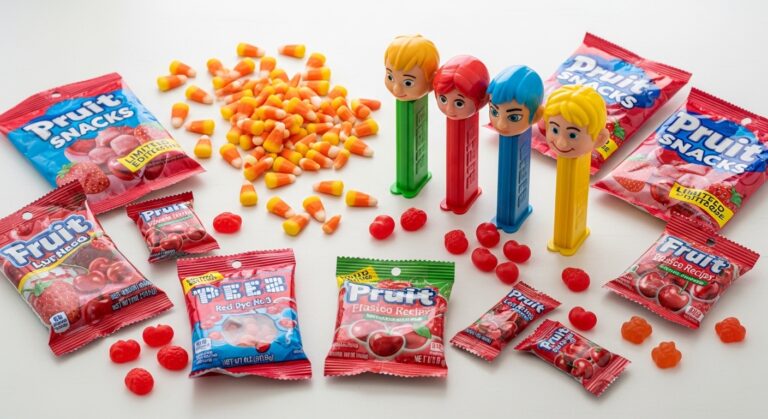
| Just Born | PEEPS Marshmallows | Seasonal Candy | Reformulated — removed after Easter 2024 |
| Just Born | Hot Tamales | Cinnamon Candy | Reformulated — removed after Easter 2024 |
| Hostess | Sno Balls | Snack Cakes | Yes — pink coconut coating |
| Luxardo | Maraschino Cherries | Cocktail/Baking | Yes — classic cherry red |
| Betty Crocker | Fruit Gushers (certain flavors) | Fruit Snacks | Yes — verified on label |
| Brach’s | Red Bird Peppermint Puffs | Hard Candy | Yes — seasonal varieties |
| Various Pharma | Liquid cough syrups / gel caps | Medications | Yes — deadline extended to Jan 2028 |
| Imitation Meat Brands | Meatless sausage / bacon bits | Savory Protein | Yes — used to mimic raw meat pink |
| McCormick / Store Brands | Maraschino Cherry Juice | Cocktail Mixer | Yes — typically contains Red 3 |
| Pillsbury | Funfetti Valentine’s Day Frosting | Baking | No — uses Red 40, not Red 3 |
We verified these labels as of March 2026. Formulations change — always check the current ingredient list before purchasing.
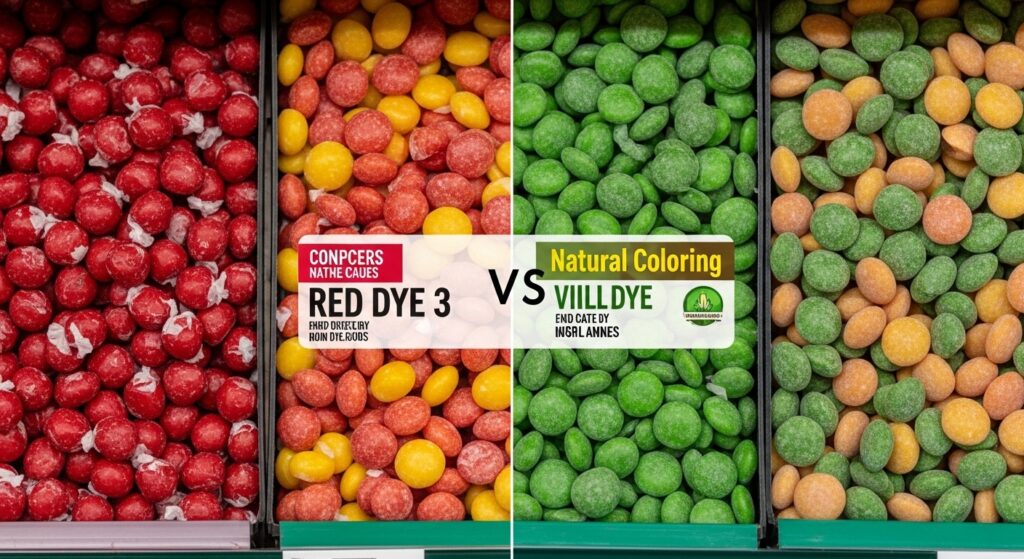
Note on reformulations: Just Born Quality Confections deserves credit for moving ahead of the law. The company removed Red Dye 3 from PEEPS and Hot Tamales following Easter 2024 — well before the 2027 federal deadline. Their labels now use natural colorings. Want to check a specific brand? Type it in the Huhuly search bar above.
How to Find Red Dye 3 on Any Food Label
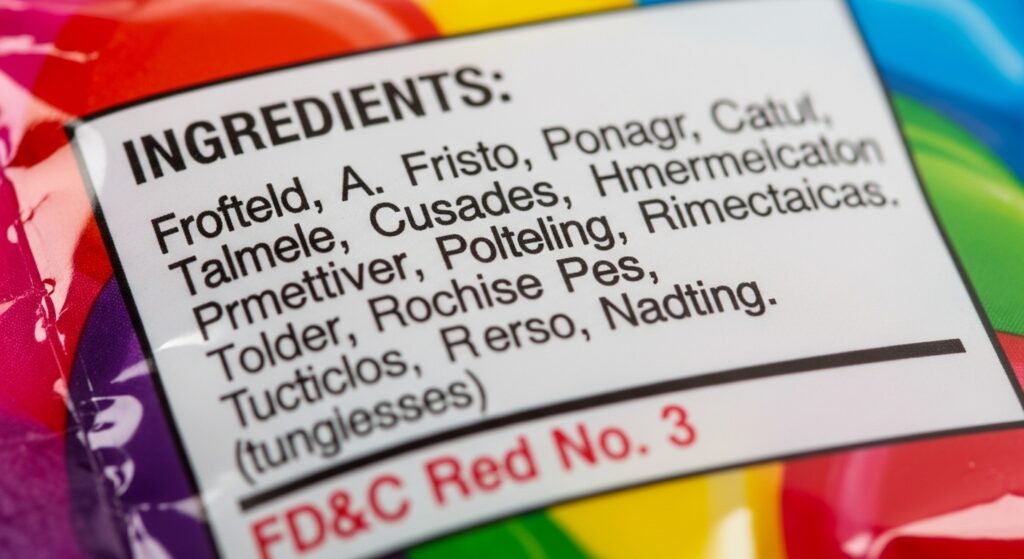
The FDA requires the dye to be listed by name — but “by name” allows several legal variations. Here’s every form it can take:
- FD&C Red No. 3 — most common US label
- FD&C Red 3
- Red 3
- Red Dye No. 3
- Erythrosine — common on imported products
- Erythrosine B
- E127 — European Union code, found on imported EU products
- Red 3 Lake — the oil-dispersible form used in frostings, coatings, and dry goods
All Names for Red Dye 3 on Labels
- FD&C Red No. 3
- FD&C Red 3
- Red 3
- Red Dye No. 3
- Erythrosine
- Erythrosine B
- E127
- Red 3 Lake
- C.I. 45430
- C.I. Food Red 14
- Acid Red 51
The Lake form is the most commonly missed. When manufacturers need the dye in a dry or fatty product — a frosting, a confectionery coating, a sprinkle — they bind it to aluminum hydroxide to make it water-insoluble. This “Lake” version disperses in oil rather than water. It behaves identically in your body but looks different on the label. If you see “Red 3 Lake,” it is the same substance.
One more tactic to watch: because Red Dye 3 is used in such tiny amounts, FDA rules place it at the very end of the ingredient list — buried beneath natural flavors, emulsifiers, and preservatives. Scan the last three to five ingredients carefully. The dye also turns up in unexpected savory products: vegetarian meat alternatives, canned baked beans, instant yellow rice blends, and synthetic sausage casings. Most shoppers only check labels on bright red candy. That’s exactly what manufacturers count on.
Who Should Be Most Concerned?
⚠️ WARNING: The following groups face elevated risk from Red Dye 3 exposure and should prioritize checking labels immediately.
Children carry the highest risk by a wide margin. Two factors compound each other: a child’s body weight is a fraction of an adult’s, meaning the same amount of dye delivers a proportionally larger dose per kilogram. And the developing brain is acutely vulnerable to oxidative stress. According to the OEHHA’s 2021 assessment, children routinely encounter exposures that approach or exceed the WHO’s ADI of 0.1 mg per kilogram of body weight, given how aggressively dyed cereals, juices, and candies are marketed to kids.
People with thyroid conditions are at particular concern. Because Red Dye 3 directly interferes with the enzyme that converts T4 into active T3, anyone managing Hashimoto’s thyroiditis, hypothyroidism, or iodine deficiency has less physiological buffer against the dye’s endocrine disruption.
Individuals with atopic conditions — severe asthma, salicylate sensitivity, or hypersensitivity to synthetic preservatives — may experience non-allergic reactions to the dye, including hives, itching, or migraines. True IgE-mediated anaphylaxis is rare, but hypersensitivity reactions are not.
Older adults: Emerging rodent research suggests synthetic dyes may interact with amyloid-beta peptide accumulation — a biomarker associated with neurodegenerative decline. This research is early-stage, and current evidence in humans is still limited to animal models. Still, for older adults already managing cognitive health, it’s a sensible category to minimize.
Cleaner Alternatives
The good news: the market already has solid options that skip Red Dye 3 and all synthetic colorants entirely. These are available at Target, Whole Foods, Thrive Market, and Amazon.
YumEarth Organic Jelly Beans — uses black carrot and apple juice concentrates for vibrant reds. Clean-label certified, widely available.
UNREAL Dark Chocolate Peanut Gems — a direct M&M alternative that replaces synthetic coating dyes with beetroot juice and red cabbage extract.
Siete Grain Free Tortilla Chips (Spicy) — achieves its reddish color from natural paprika extract instead of synthetic dyes common in spicy chip competitors.
Otter Pops (100% Fruit Juice Line) — while the classic formula uses synthetic dyes, Otter Pops’ natural line derives all coloring from apple and berry juice concentrates.
Edy’s/Dreyer’s Strawberry Ice Cream — the brand reformulated its strawberry variety using natural beet juice for pink coloring.
Lundberg Organic Yellow Rice — a savory swap that avoids the hidden Red 3 and Yellow 5 dyes found in many commercial instant rice competitors.
At the manufacturer level, natural alternatives being adopted industrywide include beetroot extract (betacyanins), anthocyanins from purple carrots and red cabbage, paprika oleoresin, and lycopene from tomatoes. Each has trade-offs — beetroot fades under heat, anthocyanins shift color based on acidity — but the technology is advancing rapidly under pressure from the 2027 deadline.
Latest News — 2024 to 2026
September 2024 — California expands school restrictions. Governor Gavin Newsom signed AB 2316 (the California School Food Safety Act), prohibiting Red 40, Yellow 5, Yellow 6, Blue 1, Blue 2, and Green 3 from all public K–12 school foods — adding to the 2023 AB 418 retail ban on Red 3.
January 15, 2025 — FDA officially revokes authorization. Acting on a 2022 petition from the Center for Science in the Public Interest (CSPI), the FDA invoked the Delaney Clause and set hard deadlines: January 15, 2027 for food products, and January 18, 2028 for ingested medications.
March 2025 — West Virginia enacts sweeping dye ban. Governor Patrick Morrisey signed HB 2354, targeting retail sale and school distribution of Red 3 and other synthetic dyes — demonstrating bipartisan momentum for additive restrictions.
April 22, 2025 — Federal MAHA initiative announced. HHS and FDA announced a national initiative to voluntarily phase out all remaining petroleum-based synthetic dyes from the US food supply by end of 2027, with an explicit request to industry to accelerate Red 3 removal ahead of the legal deadline.
December 2025 — Legal pushback in West Virginia. A US District Court granted a preliminary injunction halting retail enforcement of WV’s HB 2354, ruling the law’s “poisonous and injurious” language unconstitutionally vague. The school meal prohibition remained intact and is actively enforced.
Early 2026 — Industry mega-pledges take effect. Walmart announced the removal of Red 3 and 30 other chemicals from its Great Value private label by January 2027. Target pledged removal of all synthetic colors from its cereal lines by May 2026. General Mills committed to eliminating synthetic colors from all US cereals and K–12 school foods by summer 2026.
huhuly Verdict
━━━━━━━━━━━━━━━━━━━━━━━━━━━━━━━━━━━━━━━━
🔍 huhuly Verdict
Risk Level : Medium-High
Found In   : Candy, seasonal confections, maraschino cherries,
             frozen desserts, imitation meats, canned goods,
             liquid medications
Label Names: Red 3, FD&C Red No. 3, Erythrosine, E127, Red 3 Lake
Our Take   : Red Dye 3 is being phased out — but the clock runs
             to January 2027 for food, and January 2028 for
             medications. It's still on shelves now. Check the
             final few ingredients on anything brightly colored,
             and scan savory products too — the dye hides in
             places most shoppers never look.
━━━━━━━━━━━━━━━━━━━━━━━━━━━━━━━━━━━━━━━━
FAQ
Is Red Dye 40 the exact same thing as Red Dye 3?
No — they are chemically distinct dyes with different structures and different legal statuses. Red Dye 3 (erythrosine) is a xanthene dye with four iodine atoms and has been banned from food by the FDA. Red Dye 40 (Allura Red AC) is an azo dye that remains federally legal in the US as of 2026. The two can appear in similar products and are sometimes confused, but they are not interchangeable on a label. Red 40 is currently under increased scrutiny as part of the broader MAHA dye phase-out initiative but has not been formally banned.
When does the nationwide FDA ban on Red Dye 3 officially go into effect?
The FDA revoked Red Dye 3’s authorization on January 15, 2025, but the enforcement deadlines are staggered. Food manufacturers and dietary supplement makers must cease using the dye by January 15, 2027. Pharmaceutical manufacturers of ingested medications have until January 18, 2028. Products already manufactured before those dates can still legally be sold through existing inventory — which means you may see Red Dye 3 on shelves through much of 2027.
Why was Red Dye 3 banned in makeup in the 1990s but still allowed in candy until 2025?
This is one of the most frustrating regulatory inconsistencies in US food safety history. The FDA banned erythrosine from externally applied cosmetics and drugs in 1990 after the same animal cancer data triggered a legal review. But the Delaney Clause, which mandated the ban, was interpreted to apply differently to ingested drugs and food — opening a loophole that left candy, beverages, and oral medications untouched for 35 more years. As Dr. Peter Lurie of the CSPI called it: “an unsustainable double standard in which Red 3 was banned from lipstick but permitted in candy.”
What are the signs that my child may be reacting to artificial food dyes?
Studies suggest that in susceptible children, synthetic dyes may contribute to increased hyperactivity, persistent inattentiveness, impulsivity, and restless behavior — particularly in children already diagnosed with ADHD. According to the OEHHA’s 2021 assessment, these effects are more pronounced in children with genetic sensitivities involving dopamine regulation. They are not universal, and current research is still limited in determining precise threshold levels. If you notice behavioral changes after your child consumes heavily dyed products, it is worth discussing with their pediatrician before making dietary changes.
Does the erythrosine ban (Red Dye 3) also cover medications in my cabinet right now?
Ingested medications — including liquid cough syrups, gel capsules, and other oral drugs — have a separate, later deadline of January 18, 2028. According to the FDA, these products may legally continue to use Red Dye 3 until that date. If you or a family member takes a brightly colored oral medication regularly and want to minimize exposure now, check the inactive ingredients list for “FD&C Red No. 3” or “erythrosine” and speak to your pharmacist about alternatives with the same active formula.
Three Things Worth Acting on Today
The FDA ban is real, the deadline is set, and the food industry is moving — but the transition is not complete. Thousands of products with Red Dye 3 remain on shelves through at least 2027.
Start with the last few ingredients on anything red, pink, or salmon-colored in your pantry. Check your children’s vitamins, cough syrups, and chewing gummies — medications have until 2028. And when choosing between two similar products, the one listing “natural color” or a specific plant extract has already made the switch.
If you found this useful, subscribe to the Huhuly newsletter. We flag ingredient changes as brands reformulate — so you don’t have to check labels from scratch every time.
Reviewed by the huhuly Editorial Team
huhuly’s food transparency team reviews ingredient labels, monitors FDA regulatory updates, and tracks changes in US food manufacturing. All claims are verified against official brand ingredient lists and regulatory databases before publication.
Last updated: March 2026 | Fact-checked: Yes | Sources: 12 cited
This article is for informational purposes only and does not constitute medical advice. Consult your healthcare provider before making dietary changes based on this information.
Popular Brands That Use Cricket Flour: Complete Guide
More in Food News
You might also find these useful