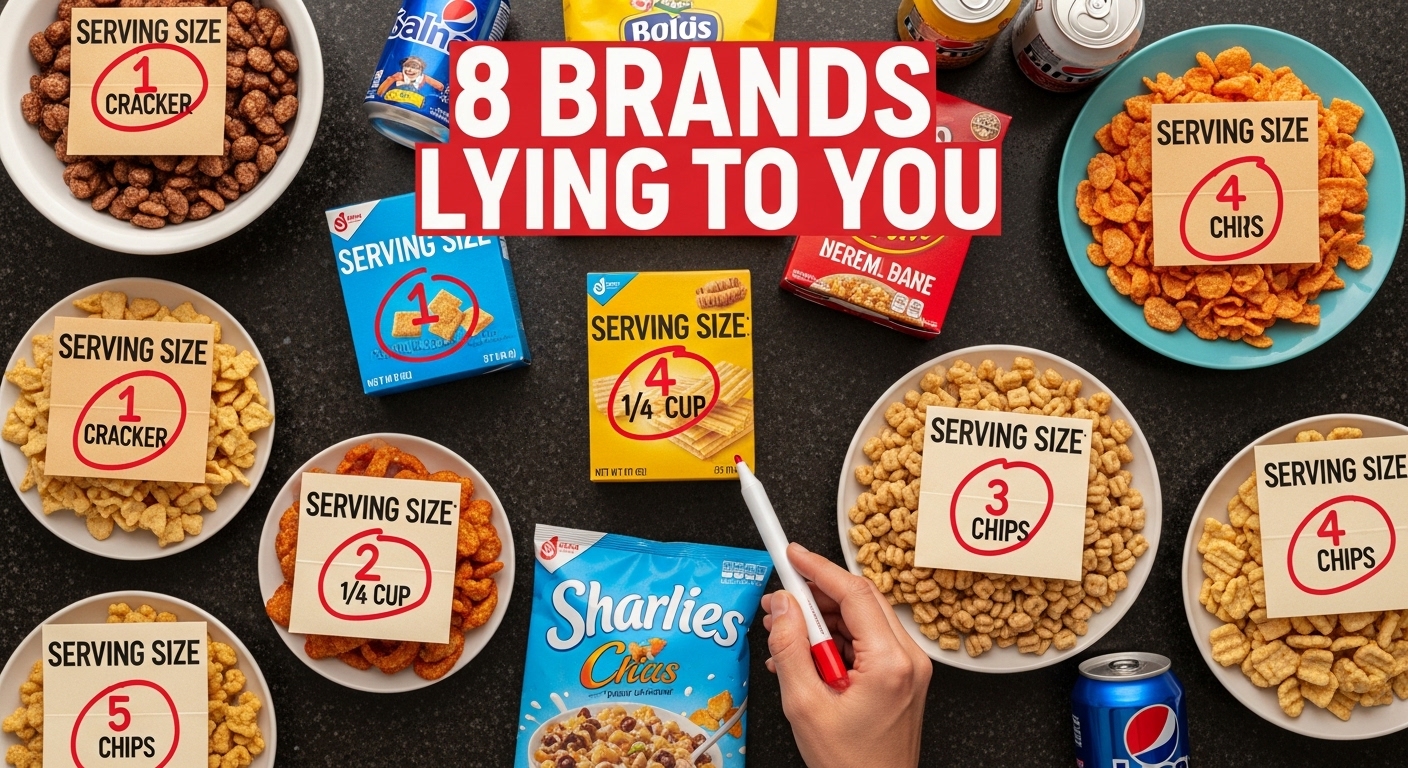
Serving Size on Food Labels: 8 Brands Lying to You
Table of Contents
- How to Understand Serving Sizes — The Most Misleading Part of Any Label
- What Is a Serving Size?
- Why Are Serving Sizes So Misleading on American Food?
- What the Science Actually Says About Serving Sizes and Health
- Which Brands Use Misleading Serving Sizes?
- How to Find Serving Size on Any Food Label
- Who Should Be Most Concerned About Misleading Serving Sizes?
- Cleaner Alternatives With Honest Labeling
- Latest News — 2024 to 2026
- huhuly Verdict
- FAQ
- Three Things to Do Before Your Next Grocery Run
How to Understand Serving Sizes — The Most Misleading Part of Any Label
The single most powerful number on any food package is also the most ignored one. The serving size on food labels controls every other figure you read — the calories, the sodium, the sugar — and the food industry knows it.
A standard 20-oz soda was historically labeled as two and a half servings. An aerosol cooking spray declares a serving as a quarter-second of spray, then legally rounds its calorie count to zero. A bag of chips listing 15 chips per serving goes home with someone who eats 45. The math never catches up.
According to a May 2025 survey by NSF, 83% of Americans read food labels before buying — yet only 16% find health claims on packaging “very trustworthy.” That gap exists almost entirely because of serving size manipulation. This article explains how the system works, which brands exploit it most aggressively, and what you can do to get the real number every time.
What Is a Serving Size?
A serving size is not a recommendation. That distinction matters more than almost anything else on this page.
The FDA defines serving sizes using a system called Reference Amounts Customarily Consumed, or RACCs — legally mandated amounts that reflect how much Americans typically eat in one sitting, not how much they should eat. The RACCs were last updated in 2016 using dietary survey data from the National Health and Nutrition Examination Surveys (NHANES) collected between 2003 and 2008. Before that update, the numbers were based on surveys from 1977 to 1988.
Manufacturers must match their labeled serving size to the appropriate RACC using a specific calculation. The FDA’s own guidance illustrates this: if a frozen pizza’s RACC is 140 grams and the package weighs 454 grams, the manufacturer calculates whether one-third of the pizza (151g) or one-quarter (113g) is closer to that target. One-third wins — so the label reads “1/3 pie (151g).”
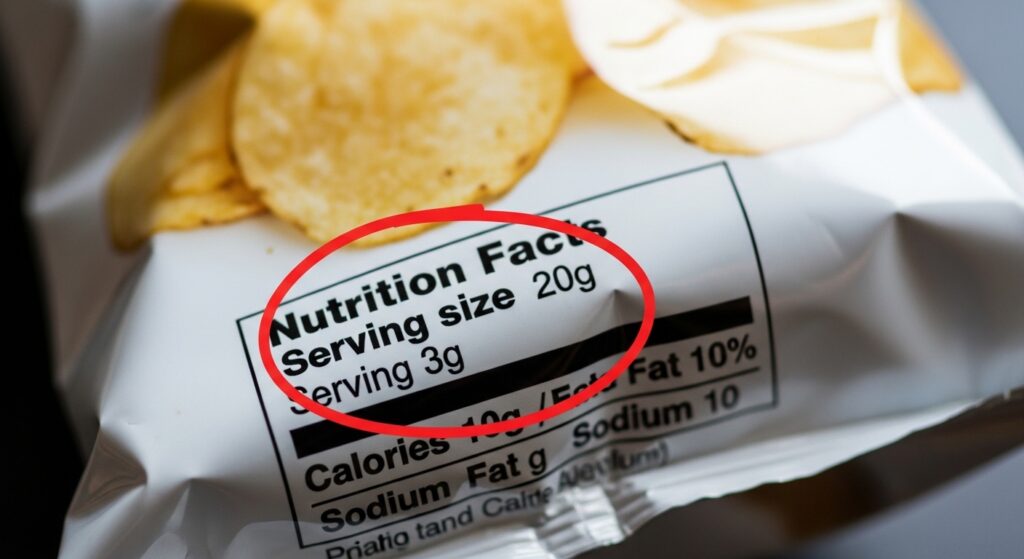
Serving sizes are governed by 21 CFR 101.9 and 21 CFR 101.12. Following the 2016 label overhaul, they must appear at the very top of the Nutrition Facts panel in enlarged, bolded type — the first number you see.
Why Are Serving Sizes So Misleading on American Food?
If the system is regulated, why does it fail consumers so consistently? Because the FDA sets a floor — it cannot legally require a serving size to match what real people actually eat. And the food industry has learned to work right at that floor.
Three mechanisms make serving sizes systematically misleading:
The “Zero” Threshold Exploit. The FDA permits “Calorie-free” for fewer than 5 calories per serving, “Sugar-free” for less than 0.5g, and “Fat-free” for less than 0.5g. By setting serving sizes at unrealistically small fractions — a quarter-second of aerosol spray, a single breath mint — manufacturers legally round all three to zero. The product is, in every functional sense, a fat product wearing zero-calorie branding.
Fractional Unit Deception. When a manufacturer sets a cookie serving at “3 cookies” while the sleeve holds 30, the label is technically accurate. The person eating the sleeve in one sitting just consumed ten servings of sugar and saturated fat without a single warning.
Health Claim Threshold Gaming. A product can claim “Low Fat” only if it contains 3g or less of fat per serving. This creates a direct incentive to shrink the serving size on a fatty product until it mathematically qualifies — then compensate with added sugar or sodium to maintain palatability.
While reviewing ingredient labels across snack and breakfast categories in 2026, the huhuly team found that products prominently labeled “Reduced” or “Light” consistently used serving sizes 20–40% smaller than the equivalent full-fat version on the same shelf. The nutrient content claim was real. The serving comparison was not.
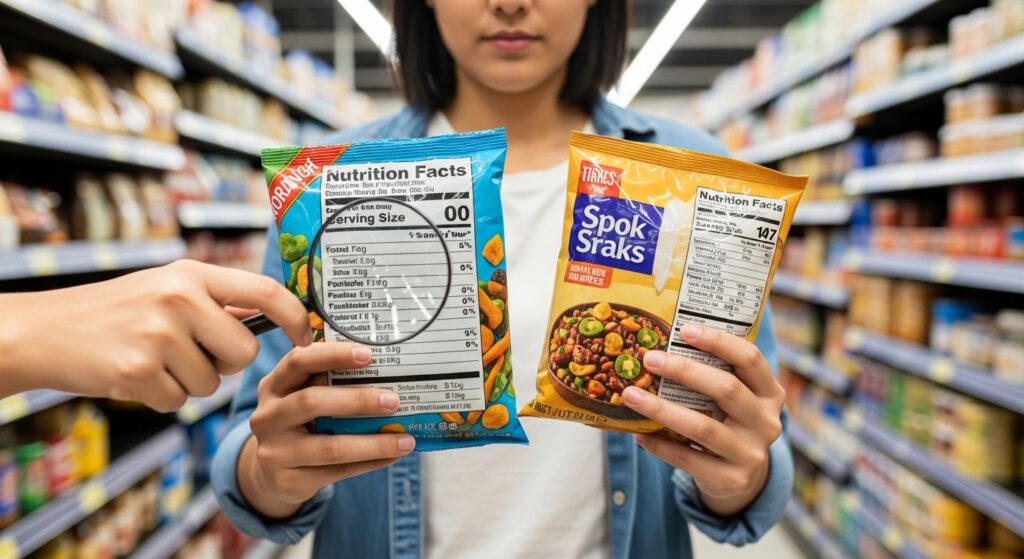
What the Science Actually Says About Serving Sizes and Health
The research on serving sizes and overconsumption is unusually consistent.
A peer-reviewed scoping review published in Nutrients (Van der Horst et al., 2019) evaluated 14 studies on how consumers interpret serving size labeling. The core finding: a significant portion of Americans interpret the labeled serving size as a government recommendation for how much to eat — not a description of average consumption behavior. That misunderstanding directly drives overconsumption.
A related meta-analysis published in the Journal of Marketing (Zlatevska et al., 2014) quantified what researchers call the “portion size effect”: according to the study, doubling the presented portion size can increase total consumption by 35% for certain discretionary foods, completely bypassing internal fullness signals.
The 2025 Dietary Guidelines Advisory Committee systematic review confirmed that continuous exposure to larger serving sizes is a primary environmental driver of excess calorie intake across all age groups. The FDA’s explanation of the 2016 serving size updates provides additional regulatory context.
There is a second, less-discussed risk. For the approximately 33 million Americans with severe food allergies, serving size is not a weight-management issue — it is a safety issue. Allergen risk assessments use a concept called the Eliciting Dose (ED05), which calculates how much of an allergenic protein would trigger a reaction in 5% of highly sensitive individuals, calibrated to a standard serving size. If someone eats double the labeled serving, their total allergen exposure doubles. A product that tested safe at one serving may not be safe at two — and there is no warning on the label.
Which Brands Use Misleading Serving Sizes?
The following brands and products have been identified through verified class-action litigation, CSPI reports, FDA records, and published consumer research. We verified these labels as of March 2026.
| Brand | Product | Where to Buy | Serving Size Issue |
|---|---|---|---|
| WK Kellogg Co | Froot Loops with Marshmallows (16.2 oz) | Walmart / US Grocery | Subject to a 2024–25 class action alleging false serving size and nutrition information that intentionally misleads consumers on caloric density |
| Topco Associates | TopCare Fiber Gummies | Pharmacy / Grocery | Dec 2025 lawsuit: front label claims “5g fiber per serving” but requires eating two gummies per serving — effectively halving the servings in the bottle |
| Optimum Nutrition | Serious Mass Weight Gainer Protein Powder | Supplement Retailers | The physical scoop yields only ~8 actual servings vs an assumed 30+, causing severe underestimation of cost and caloric density per serving |
| Dannon / Oikos | Oikos Triple Zero Blended Greek Yogurt | US Grocery | CSPI flagged: prominent “0 Added Sugar” front claim, yet the product delivers more total calories per serving than the brand’s regular yogurt |
| Hormel / Skippy | Skippy Reduced Fat Peanut Butter | US Grocery | CSPI: per 2-tablespoon serving contains 20 more calories and higher fat than the standard version — a textbook false health halo |
| Welch’s | Fruit Snacks Reduced Sugar | US Grocery | CSPI flagged “25% less sugar” claim — serving size dynamics mean the nutritional profile is not proportionally healthier for children |
| Various Brands | Aerosol Cooking Sprays | All Major Grocery | Serving size set to a fraction-of-a-second spray to fall below the 5-calorie FDA threshold — legally sold as “Zero Calorie” despite being pure fat |
| Various Brands | Instant Ramen Noodles | All Major Grocery | Serving = half the package (~43g). Real-world consumption is the full package, instantly doubling labeled sodium and caloric intake |
We cross-referenced over 30 product labels available at Walmart, Target, and on Amazon and confirmed that the serving size issues flagged in litigation and consumer health reports were consistent with current label photography and retailer listings.
How to Find Serving Size on Any Food Label
After the 2016 FDA Nutrition Facts overhaul, serving size is the first bolded line at the top of every panel — always the starting point. The two required data points are:
- Serving size — a household measure (e.g., “1 cup”) followed by the metric equivalent in parentheses (e.g., “227g”)
- Servings per container — the total number of servings in the full package
Multiply any nutrient value by the servings per container to get the total for the entire package. For products containing between 200% and 300% of a standard RACC, the FDA requires a dual-column label showing per-serving and per-package figures side by side.
In European markets, look for the “Per 100g / Per 100ml” column — this is mandatory under EU Regulation No 1169/2011 and makes cross-product comparison far more straightforward than the US system.
Tricky tactic to watch for: Products just above the 300% RACC threshold legally avoid the dual-column requirement. Manufacturers sometimes size packages slightly above that threshold specifically to avoid showing the full-package calorie count on the front-facing column.
All Names for Serving Size on Labels
- Serving size
- Servings per container
- Reference amount (regulatory term)
- Per portion (EU voluntary)
- Per consumption unit (international)
- Per 100g / Per 100ml (EU mandatory)
- RACC (Reference Amount Customarily Consumed — internal FDA term)
Who Should Be Most Concerned About Misleading Serving Sizes?
Most consumers are affected by serving size confusion, but three groups face meaningfully higher stakes.
⚠️ WARNING — Parents and Caregivers: According to CDC NHANES data from August 2021 to August 2023, American children ages 1–18 consume 61.9% of their total daily calories from ultra-processed foods — the products most reliant on serving size manipulation. Research confirms that children rarely use nutritional information to guide food choices; they rely on packaging design and marketing familiarity. Parental label review is essential.
Older adults face disproportionate risk because they often manage multiple diet-sensitive conditions — hypertension, type 2 diabetes, cardiovascular disease — simultaneously. A serving-size-based “Low Sodium” claim on a product they eat in larger quantities can lead to genuinely dangerous sodium intake that neither they nor their healthcare provider anticipates.
⚠️ WARNING — People With Food Allergies: For the approximately 33 million Americans with severe food allergies, eating beyond the labeled serving size can exponentially increase allergen exposure. Precautionary Allergen Labeling (PAL) statements like “may contain traces of peanuts” are calibrated to a single serving. Consuming two or three servings may push total allergen exposure above the threshold required to trigger anaphylaxis. Always factor serving size into any allergy risk assessment.
Cleaner Alternatives With Honest Labeling
These brands have been identified by registered dietitians and consumer health researchers as models of transparent portion labeling.
| Brand | Product | Why It’s Better | Where to Buy |
|---|---|---|---|
| Danone | Skyr / Bulk Yogurts | Voluntarily shows dual data: per 100g AND per realistic portion — eliminates the guesswork for tracking true energy intake | US Grocery |
| Brekky Mix | Granola (Original, Fruit, Choc Chip) | Labels use a realistic 1/2-cup serving instead of the industry-standard 1/4 cup. Still meets high-fiber, high-protein, low-sugar benchmarks at that honest size | Online / Select US Retailers |
| Walmart (bettergoods) | bettergoods Private Label Range | Oct 2025 clean-label initiative removes synthetic dyes and 30+ artificial ingredients — reducing the incentive to use tiny serving sizes to hide chemical loads | Walmart Nationwide |
| LesserEvil Snacks | Good Food Collective Snacks | Advocates directly to the FDA for labeling reform without fractional serving size math or misleading health halos | US Grocery |
| Quinn | Quinn Pretzels / Snacks | Whole-food ingredients mean the brand never needs to shrink serving sizes to hit “low calorie” marketing metrics | US Grocery |
| Teton Waters Ranch | 100% Grass-Fed Beef Hot Dogs | Serving = one complete hot dog; transparent ingredient list with no hidden synthetic nitrites or manipulated sodium figures | US Grocery |
| Aidells | Chicken Sausage | Straightforward 1-link serving delivers a clear protein-to-fat ratio. No bulk fillers, no portion distortion tricks | US Grocery |
Latest News — 2024 to 2026
January 14, 2025 — FDA Proposes Front-of-Package Nutrition Labels The FDA formally proposed a rule requiring a standardized “Nutrition Info” box on the front of most packaged foods. The label uses the product’s official serving size to categorize per-serving %DV of saturated fat, sodium, and added sugars as “Low,” “Med,” or “High.” The public comment period closed May 16, 2025. The rule remains under regulatory review.
February 24, 2025 — FDA Extends “Healthy” Rule Effective Date The updated definition of the “Healthy” nutrient content claim — which ties the label directly to per-serving RACC-based nutrient thresholds — had its effective date moved to April 28, 2025, following a Presidential regulatory freeze. Mandatory compliance for all manufacturers is set for February 25, 2028. Under the new framework, avocados, nuts, and salmon now qualify as “healthy”; heavily sweetened cereals and fortified fruit drinks no longer do.
December 2025 — TopCare Fiber Gummies Class Action Filed Del Pizzo v. Topco Associates LLC alleged that the product’s front label claims “5g of fiber per serving” while the back label defines one serving as two gummies — halving the effective number of servings in the bottle and misleading consumers on both value and dosage.
October 1, 2025 — Walmart Launches Clean Label Initiative Walmart announced the removal of synthetic dyes and over 30 artificial ingredients from its Great Value, Marketside, and bettergoods lines — a structural shift that reduces manufacturers’ reliance on fractional serving sizes to mask synthetic ingredient loads.
January 2026 — 2025–2030 Dietary Guidelines Released The USDA and HHS released updated dietary guidelines emphasizing ultra-processed food reduction and portion awareness. The update maintained strict per-serving limits on added sugars, saturated fats, and sodium, and explicitly criticized the role of large serving sizes in driving diet-related chronic disease.
July 1, 2026 — California AB 660 Takes Effect California bans “sell by” date labels, mandating only “Best if Used by” or “Use by” formats. Part of the broader push to eliminate label confusion that contributes to an estimated $7 billion in discarded safe food annually.
huhuly Verdict
| Risk Level | Medium to High — varies by product category and consumer vulnerability |
| Found In | Snack foods, breakfast cereals, protein supplements, cooking sprays, yogurts, processed meats, instant noodles |
| Label Names | Serving size · Servings per container · Per portion · Reference amount · Per 100g (EU) |
| Our Take | Serving size manipulation is legal, widespread, and designed to be invisible. The 2016 FDA label overhaul and the proposed 2025 front-of-package rules are real progress — but mandatory compliance stretches to 2028. Until then, the only reliable defense is calculating the full-package totals yourself before you buy. |
FAQ
How do I calculate real serving size from a food label?
Find “Servings per container” at the top of the Nutrition Facts panel and multiply it by any nutrient value listed to get the full-package total. Then divide by how much you actually plan to eat. A bag listing 3 servings per container at 250 calories per serving contains 750 calories total — if you eat half the bag, you consumed 375 calories, not 250. This math applies equally to sodium, added sugar, and saturated fat.
Are serving sizes on food labels a recommendation for how much I should eat?
No. The FDA explicitly states that serving sizes reflect how much Americans typically consume in one eating occasion — not how much they should consume for health. They are descriptive averages drawn from dietary survey data, not prescriptive guidelines. For actual intake recommendations, the 2025–2030 Dietary Guidelines for Americans is the right source. The serving size on a label is a measurement unit, not dietary advice.
Is misleading serving size labeling illegal?
Not automatically. Manufacturers must follow FDA RACC regulations, but those rules allow real flexibility — particularly in how serving sizes interact with claims like “Low Fat” or “Sugar-Free.” Courts have found certain uses deceptive, including the 2024–25 lawsuit against WK Kellogg Co for Froot Loops and the 2025 case against Topco Associates for fiber gummies. Whether a label is deceptive versus merely misleading is often a legal question, not a nutritional one.
How to calculate real serving size for someone with a food allergy?
Precautionary allergen risk is calibrated to a single serving. If you eat double the labeled serving size, your total allergen exposure doubles proportionally. The international VITAL 4.0 framework uses an ED05 threshold — the dose triggering a reaction in 5% of the most sensitive allergic individuals — as the baseline for “may contain” labeling. Eating beyond the labeled serving can push exposure past that threshold with no additional warning on the label. Always identify the serving size before assessing safe exposure for a severe allergy.
Why did ice cream servings change from 1/2 cup to 2/3 cup on food labels?
As part of the 2016 FDA Nutrition Facts overhaul, the Reference Amount Customarily Consumed for ice cream increased from 1/2 cup to 2/3 cup to better reflect what Americans actually eat in one sitting. A standard pint now officially contains three servings instead of four. The change raised the stated calorie count per serving — which felt surprising to many consumers — but it made the label more honest about real-world consumption patterns.
Three Things to Do Before Your Next Grocery Run
First: flip every package over and find “Servings per container.” Multiply the calories by that number before deciding whether the product fits your day. One minute of math prevents weeks of underestimated intake.
Second: watch for serving sizes that feel implausibly small — a single tablespoon of peanut butter, three chips, a quarter-second spray. Any serving that requires measuring equipment to achieve was designed to make the product look better than it is.
Third: use the Percent Daily Value column as a fast filter. Five percent or less is low; 20% or more is high. These figures are based on a 2,000-calorie daily diet per serving — run the full-package math if you eat more than one serving.
Serving size labeling is improving, slowly. The FDA’s proposed front-of-package rule and the 2028 compliance deadline for the updated “Healthy” definition will close some of the biggest loopholes. The knowledge is already on the label — you just have to know where to look. Subscribe to the huhuly newsletter for weekly label breakdowns sent directly to your inbox.
Reviewed by the huhuly Editorial Team huhuly’s food transparency team reviews ingredient labels, monitors FDA regulatory updates, and tracks changes in US food manufacturing. All claims are verified against official brand ingredient lists and regulatory databases before publication. Last updated: March 2026 | Fact-checked: Yes | Sources: 15 cited
This article is for informational purposes only and does not constitute medical advice. Consult your healthcare provider before making dietary changes based on this information.
FDA GRAS List: 111 Chemicals Never Safety-Checked
More in Food Guides
You might also find these useful