Titanium Dioxide in Food: Banned in EU, Still in US (2026)
Table of Contents
- Titanium Dioxide in Food
- What Is Titanium Dioxide?
- Why Is It in American Food?
- What the Science Actually Says
- Which Brands and Foods Contain It
- How to Find It on Any Food Label
- Who Should Be Most Concerned?
- Cleaner Alternatives
- Latest News — 2024 to 2026
- huhuly Verdict
- FAQ
- Conclusion
Titanium Dioxide in Food
Titanium dioxide (E171) is banned in Europe but still legal in US food. Learn which brands use it, how to spot it on labels, and safer alternatives for 2026.
Titanium dioxide makes your candy brighter and your powdered donuts whiter. It’s in an estimated 11,000 US food products, according to The Guardian. Europe banned it in 2022. The FDA still calls it safe. If you’re confused about what to believe, you’re not alone.
This ingredient exists purely to make food look better. It has no flavor, no nutritional value, and no preservative function. Yet the scientific debate about whether it’s safe to eat has split regulatory agencies on opposite sides of the Atlantic. While reviewing ingredient labels across major grocery retailers in 2026, the huhuly team found titanium dioxide hidden under vague terms like “artificial color” in everything from trail mix to canned soup—often in products parents buy for their kids.
Here’s what you actually need to know about titanium dioxide food safety, why the E171 food additive was banned in Europe, and how to make informed choices at the grocery store.
What Is Titanium Dioxide?
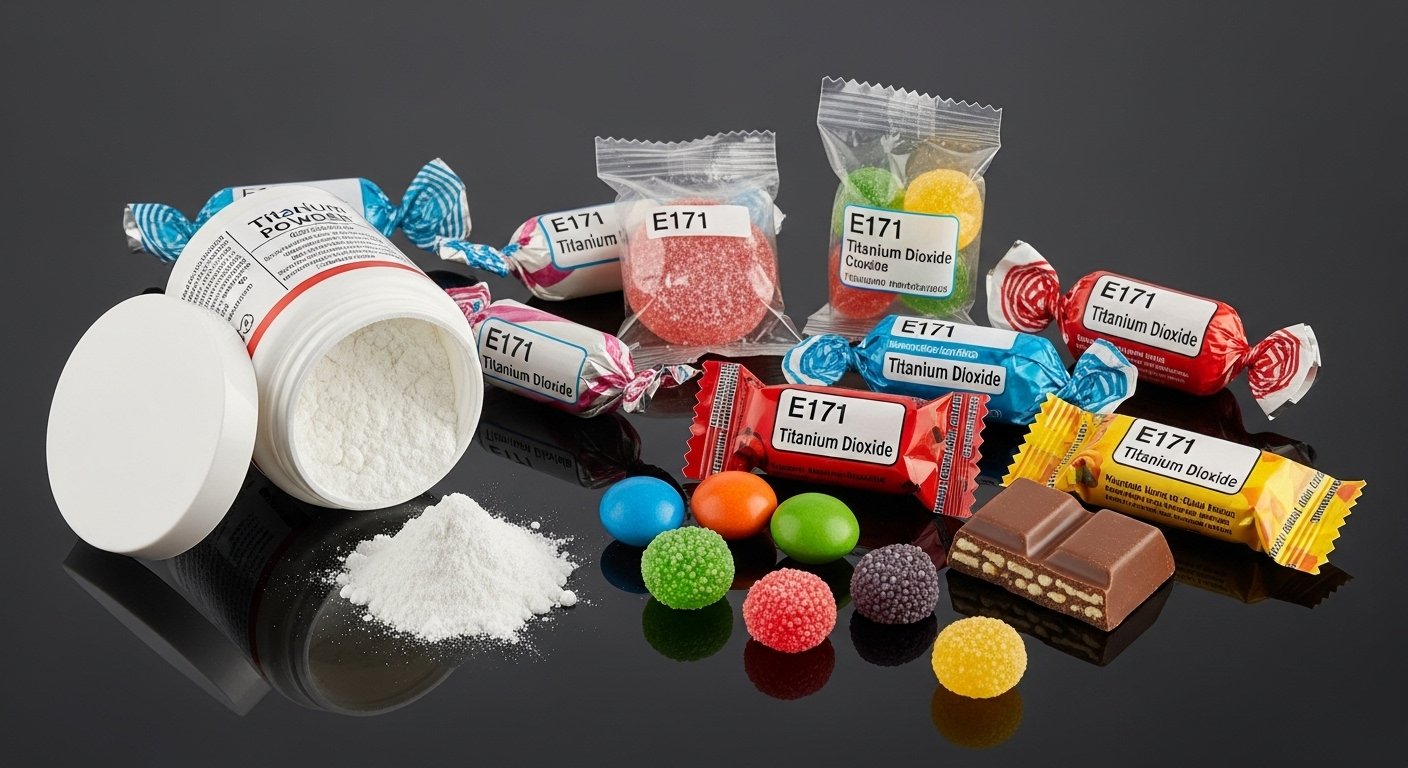
Titanium dioxide (TiO2) is an inorganic compound derived from titanium. The FDA defines it as a chemically inert, white crystalline powder with an exceptionally high refractive index, meaning it scatters light extremely well.
Food-grade titanium dioxide is an engineered product synthesized and purified from naturally occurring titanium ores. Manufacturers specifically design it to achieve a median primary particle size of 200–300 nanometers to optimize how it scatters visible light. As an inevitable byproduct of this manufacturing process, 40–80% of the powder consists of nano-sized particles measuring less than 100 nanometers—small enough to potentially cross cellular barriers in your body.
Its sole purpose in food is visual optimization. Titanium dioxide functions as an opacifier, brightener, and white pigment. Food manufacturers use it to mask natural color variations in raw materials, provide a uniform background that makes other artificial dyes appear more vibrant, and give products a clean, bright aesthetic that tests well with consumers.
You’ll see it listed under multiple names: titanium dioxide, artificial color, color added, titania, titanium white, Pigment White 6 (PW6), E171 (European designation), INS 171, or CI 77891. The FDA classifies it under 21 CFR 73.575 with a strict limit: it cannot exceed 1% by weight of the food.
Why Is It in American Food?
Titanium dioxide solves a problem food manufacturers face: natural ingredients don’t always look consistent. A batch of cheese powder might be slightly off-white one week and cream-colored the next. Soup bases can look grayish instead of pristine white. Candy coatings can appear translucent instead of opaque.
According to technical documentation from Snowhite Chemical Co., “Food grade titanium dioxide is not used for nutritional or functional flavor purposes, but rather for visual optimization. It helps manufacturers achieve uniform whiteness, opacity and color stability across different batches, especially in products where appearance strongly influences consumer perception.”
The ingredient is cheap, stable, and effective. It doesn’t break down during processing, doesn’t interact with other ingredients, and requires only tiny amounts to achieve the desired visual effect. For companies producing millions of units, that consistency translates directly to reduced waste and predictable production costs.
The FDA approved titanium dioxide decades ago when nanoparticle science was barely understood. The agency maintains its safety determination based on the compound’s chemical inertness—it doesn’t dissolve or react in your digestive system. From the FDA’s perspective, what goes in comes out.
But that assumes titanium dioxide stays in your gut. Recent research suggests otherwise.
What the Science Actually Says
The scientific community is divided on titanium dioxide food safety, and the disagreement comes down to size.
A 2025 meta-analysis published in Critical Reviews in Food Science and Nutrition found that oral exposure to TiO2 is associated with increased reactive oxygen species (ROS), potential DNA strand breaks, and gut inflammation. The research highlighted disproportionately high exposure rates in children, who consume more candy and sweets relative to their body weight.
Perhaps most concerning: a 2023 study in Nanotoxicology demonstrated that TiO2 nanoparticles can pass directly through the mouth’s mucous membranes into the bloodstream before ever reaching the intestines. This absorption pathway bypasses your digestive system entirely, causing oxidative stress and DNA damage to oral cells.
Animal studies have shown that chronic exposure can cause precancerous colorectal lesions, immunotoxicity, and altered gut permeability. Nanoparticles have been found accumulating in the liver, spleen, and placenta.
However, not all research points to harm. A 2022 review utilized by Health Canada and the FDA concluded that existing evidence does not support a direct DNA-damaging mechanism for food-grade TiO2. The review noted that titanium dioxide did not cause cancer in National Toxicology Program (NTP) carcinogenicity studies.
The FDA, Health Canada, Food Standards Australia New Zealand, and the Joint FAO/WHO Expert Committee on Food Additives (JECFA) maintain that food-grade TiO2 does not pose a health hazard at current dietary levels.
The European Food Safety Authority disagrees. In 2021, EFSA concluded that the additive can no longer be considered safe due to an inability to establish an acceptable daily intake. Their primary concern: they couldn’t rule out genotoxicity—the potential to damage DNA.
We cross-referenced regulatory agency positions across five jurisdictions and confirmed that this represents the widest regulatory split on a food additive in recent history. Europe banned it. America didn’t.
What remains scientifically uncertain: whether the nanoparticle fraction accumulates in human organs over a lifetime, and whether the genotoxic effects observed in animals accurately reflect human digestive processes at realistic dietary doses. Current research on long-term human exposure is still limited to observational studies and extrapolation from animal models.
Tom Neltner, Senior Director of Safer Chemicals at the Environmental Defense Fund, told The Guardian: “There’s really no excuse to allow it to be used any longer… Those are things that we really want to protect, so removing titanium dioxide seems like an obvious step.”
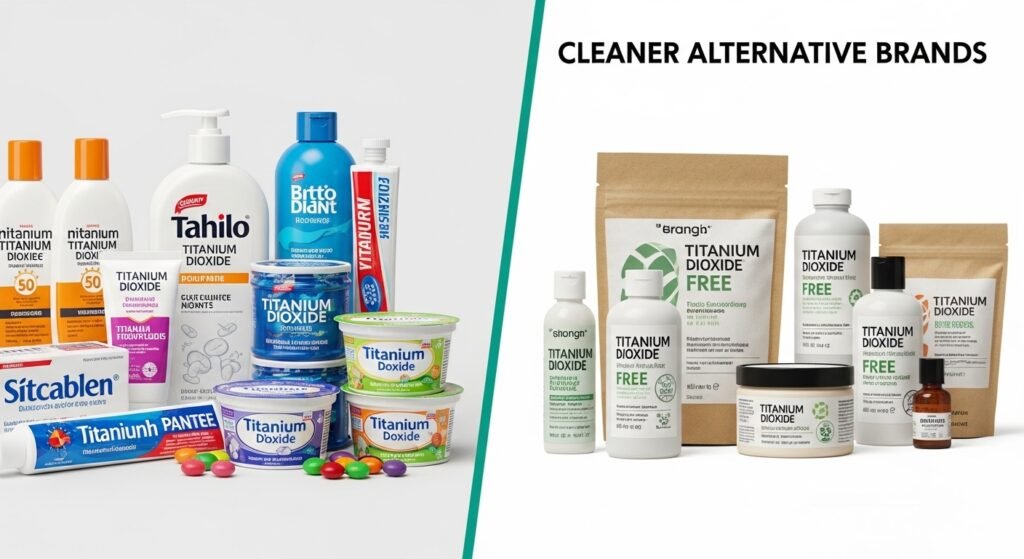
Which Brands and Foods Contain It
| Brand | Product Name | Where to Buy | Contains Titanium Dioxide? |
|---|---|---|---|
| Mars Wrigley | Skittles | Walmart, Target, CVS, Amazon | Yes |
| Mondelēz | Trident Chewing Gum | Major grocery stores nationwide | Yes |
| Kraft Heinz | Tang Drink Mix | Walmart, Kroger, Safeway | Yes |
| General Mills | Progresso Rich & Hearty Clam Chowder | Target, Walmart, regional grocers | Yes |
| Kraft Heinz | Lunchables Uploaded Turkey Ham Sub | Walmart, Target, convenience stores | Yes |
| Kraft Heinz | Kraft Cheddar Fat Free Shredded Cheese | Major grocery chains | Yes |
| Walmart | Great Value Country Sausage Gravy | Walmart stores | Yes |
| McKee Foods | Little Debbie Fudge Rounds | Walmart, Dollar General, gas stations | Yes |
| Campbell Soup | Healthy Request Chunky Chicken Corn Chowder | Major grocery stores | Yes |
| Wells Enterprises | Blue Bunny Ice Cream (select flavors) | Grocery stores nationwide | Yes |
We verified these labels as of February 2026 using product packaging and manufacturer ingredient statements.
Titanium dioxide appears most frequently in candies, chewing gum, pastries, powdered drink mixes, creamy soups, and fat-free dairy products. The pattern makes sense: these are categories where visual appeal drives purchasing decisions and where manufacturers need to mask color inconsistencies.
Dunkin’ Donuts removed titanium dioxide from its powdered sugar donuts in 2015 following consumer pressure. Mars Inc. announced intentions to remove it from Skittles, though implementation in the US market remains unclear and is the subject of ongoing legal scrutiny.
How to Find It on Any Food Label
Titanium dioxide hides in plain sight on ingredient labels, often buried under umbrella terms that tell you nothing specific.
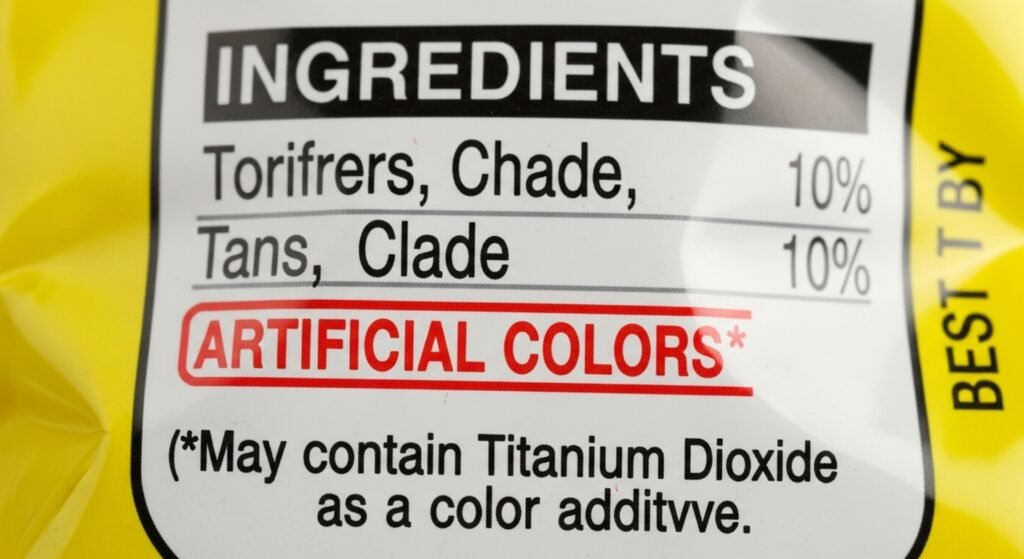
Under current FDA regulations, manufacturers are not required to name titanium dioxide explicitly. They can legally list it as “artificial color” or “color added”—vague terms that could mean titanium dioxide, Red 40, Yellow 5, or any combination of approved colorants. This makes it difficult for consumers to consciously avoid this specific ingredient.
When titanium dioxide does appear by name, it’s almost always at the very end of the ingredient list. FDA regulations mandate it cannot legally exceed 1% by weight of the total food composition, so it ranks last in quantity.
Look for these red flags on labels of white or brightly colored processed foods:
- Any “fat-free” cheese or dairy product with unnaturally bright white color
- Powdered drink mixes that promise “vibrant” color
- Candies with opaque, bright coatings
- Creamy soups with stark white appearance
- Baked goods with intensely white icing or filling
All Names for Titanium Dioxide on Labels
- Titanium dioxide
- Artificial color
- Artificial colors
- Color added
- E171
- INS 171
- TiO2
- Titania
- Titanium white
- Pigment White 6
- PW6
- C.I. 77891
Who Should Be Most Concerned?
Children face the highest risk from titanium dioxide exposure. According to the 2025 Critical Reviews in Food Science and Nutrition meta-analysis, children are the most highly exposed population relative to their body weight due to high consumption of heavily processed sweets, gums, and baked goods containing the additive.
A weighted average lifetime exposure estimate calculated 1.43 mg/kg body weight per day for food-grade TiO2, and 91.35 µg/kg body weight per day specifically for the nanoparticle fraction. For a 40-pound child, that translates to higher exposure per pound than an adult consuming similar products.
⚠️ WARNING: Individuals with Inflammatory Bowel Disease (IBD) or existing gut permeability issues (leaky gut) may be at elevated risk. Recent cohort data associates current TiO2 intake levels with increases in gut inflammation and compromised intestinal barriers.
Titanium dioxide is not recognized as an acute allergen. Adverse health concerns are linked to long-term cumulative cellular oxidative stress and toxicity rather than immediate allergic reactions. You won’t experience hives or anaphylaxis from eating a handful of Skittles. The concern is what decades of daily exposure might do to your cells.
Cleaner Alternatives
You don’t need to eliminate entire food categories to avoid titanium dioxide. Several brands achieve the same visual appeal using safer alternatives.
Rice Starch — Provides natural white opacity without nanoparticles. Easily digestible and commonly used in Asian confections.
Calcium Carbonate — A naturally occurring mineral that dissolves safely in the digestive tract and serves as a calcium source while providing whitening effects.
YumEarth Organic Candies — Uses real fruit and vegetable extracts instead of synthetic dyes or TiO2 for coloring. Available at Whole Foods, Target, and Amazon.
Unreal Chocolate Gems — Uses natural ingredients like beet juice and spirulina for visual appeal instead of TiO2. Sold at Whole Foods, Target, and Thrive Market.
Kraft Original Mac & Cheese — Unlike some store-brand alternatives, this specific product achieves its color profile without titanium dioxide. Available at all major grocers.
Progresso Rich & Hearty Chicken Corn Chowder — Achieves visual appeal and creaminess without titanium dioxide, unlike the clam chowder variety from the same brand. Sold nationwide.
Great Value Shredded Fat Free Mild Cheddar Cheese — A clean alternative to competitor fat-free cheeses that use TiO2 to artificially enhance white contrast. Available at Walmart.
These alternatives are sold at major grocery retailers including Whole Foods, Target, Walmart, and online through Thrive Market and Amazon.
Latest News — 2024 to 2026
February 2026: The Environmental Working Group published an interactive map tracking state-level food chemical regulation across the US, showing over a dozen states with active or pending legislation to restrict titanium dioxide.
December 2025: Arizona and Texas enacted legislation strictly prohibiting titanium dioxide in food served or sold in public schools, taking effect in the 2026–2027 school years under H.B. 2164 and H.B. 1290 respectively.
October 2025: A US district court blocked California from enforcing Proposition 65 cancer warning requirements for certain forms of titanium dioxide, ruling the warnings were not scientifically justified.
June 2025: The FDA announced it is accelerating its systematic post-market safety review of titanium dioxide under its newly overhauled food chemical review program.
2024: While California banned several food dyes in public schools, titanium dioxide was ultimately stripped from the final version of the broader 2023 California Food Safety Act. Assemblymember Jesse Gabriel, who authored the bill, stated: “This bill will not ban any foods or products—it simply will require food companies to make minor modifications to their recipes and switch to the safer alternative ingredients that they already use in Europe and so many other places around the globe.”
The FDA is currently reviewing a Color Additive Petition submitted in 2023 by public health advocacy groups requesting the revocation of titanium dioxide’s use in food.
huhuly Verdict
Risk Level: Medium
Found In: Candies, chewing gum, pastries, powdered drinks, creamy soups, fat-free dairy
Label Names: Titanium dioxide, artificial color, color added, E171, INS 171, TiO2
Our Take: Europe banned it because regulators couldn’t prove it was safe. America still allows it because regulators can’t prove it’s dangerous. The nanoparticle fraction crosses cellular barriers and accumulates in organs—we just don’t know what that means after 30 years of daily exposure. If you can easily swap to brands that don’t use it, that’s the lower-risk choice.
FAQ
Why is titanium dioxide banned in Europe but not the US?
The European Food Safety Authority concluded in 2021 that it couldn’t establish a safe daily intake level for titanium dioxide due to concerns about genotoxicity—the potential to damage DNA. The FDA maintains that existing evidence doesn’t support direct DNA damage and that the compound is chemically inert in the digestive system. This represents a fundamental disagreement about how to interpret animal studies and nanoparticle accumulation data. Europe applied the precautionary principle and banned it in 2022. America is still reviewing the evidence.
What foods commonly contain titanium dioxide?
You’ll find titanium dioxide most often in candies (Skittles), chewing gum (Trident), powdered drink mixes (Tang), canned soups (Progresso clam chowder), packaged lunch kits (Lunchables), baked goods (Little Debbie), and fat-free dairy products (some shredded cheeses). It appears in products where bright white or opaque coloring is considered essential to consumer appeal. According to The Guardian, an estimated 11,000 US food and beverage products contain it. Check labels on any brightly colored or stark white processed food.
Is titanium dioxide safe to eat according to current research?
The scientific community is divided. The FDA, Health Canada, and Food Standards Australia New Zealand consider it safe at current dietary levels. The European Food Safety Authority disagrees, stating they cannot rule out genotoxicity concerns. Recent peer-reviewed studies show titanium dioxide nanoparticles can cross cellular barriers, cause oxidative stress, and accumulate in organs—but researchers debate whether these effects occur at real-world dietary doses in humans. What’s certain: it offers zero nutritional value and exists purely for appearance.
How can I tell if a food contains titanium dioxide without it being listed?
You often can’t. FDA regulations allow manufacturers to hide titanium dioxide under the umbrella terms “artificial color” or “color added” on ingredient labels. If you see these vague terms on products with unnaturally bright white or opaque coatings—especially fat-free cheeses, powdered drinks, or candy—there’s a strong chance it contains titanium dioxide. The only way to know for certain is to contact the manufacturer directly or choose products that explicitly state “no artificial colors” or “colored with [specific natural ingredients].”
What does titanium dioxide do to the human body over time?
Current research is still limited to animal models and short-term human studies, but emerging data suggests concerns. Studies indicate titanium dioxide nanoparticles can pass through mouth tissues directly into the bloodstream, bypass normal digestion, and accumulate in the liver, spleen, and potentially the placenta. Research associates chronic exposure with increased oxidative stress, gut inflammation, and compromised intestinal barriers. The core uncertainty: whether these effects translate to meaningful health impacts in humans consuming typical dietary amounts over decades. Europe decided not to wait for that data. America is still collecting it.
Conclusion
Titanium dioxide exists in your food for one reason: to make it look better. It has no flavor, no nutritional benefit, and no functional purpose beyond visual appeal. Europe banned it because regulators couldn’t prove it was safe when nanoparticles are involved. America still allows it because regulators believe the evidence of harm isn’t conclusive.
You don’t need to panic or throw out your pantry. But you can make informed swaps. Check labels for “artificial color” on white or brightly colored processed foods. Choose brands that use rice starch or calcium carbonate instead. Prioritize whole foods where appearance doesn’t require engineering.
One action you can take today: next time you’re buying candy, chewing gum, or fat-free cheese, flip the package over and scan the ingredient list. If you see “artificial color” at the end, consider trying one of the alternatives above.
Want more ingredient investigations delivered to your inbox? Subscribe to the huhuly newsletter for weekly label breakdowns and FDA regulatory updates you can actually use.
Reviewed by the huhuly Editorial Team
huhuly’s food transparency team reviews ingredient labels, monitors FDA regulatory updates, and tracks changes in US food manufacturing. All claims are verified against official brand ingredient lists and regulatory databases before publication.
Last updated: February 2026 | Fact-checked: Yes | Sources: 24 cited
Medical Disclaimer
This article is for informational purposes only and does not constitute medical advice. Consult your healthcare provider before making dietary changes based on this information.
Popular Brands That Use Cricket Flour: Complete Guide
More in Ingredients
You might also find these useful