Types of Food Preservatives: 5 Linked to Cancer (2026)
Food Preservatives: Every Type Explained and What Each One Does
You already eat them daily. The question is whether you know which ones — and what they actually do inside your body.
The U.S. food supply contains hundreds of chemical preservatives. Some are derived from vinegar. Others are synthesized from petroleum byproducts. A few are now being formally reassessed by the FDA after decades of assumed safety. Understanding the types of food preservatives in your food is no longer just a wellness hobby — two landmark studies published in January 2026 linked several common ones to increased cancer and type 2 diabetes risk.
This guide gives you the full food preservative list explained: what each one is, where it hides, which brands use it, and who should be watching most closely. No fear-mongering. Just the facts.
Table of Contents
- Food Preservatives: Every Type Explained and What Each One Does
- What Are Food Preservatives?
- Why Are They in American Food?
- What the Science Actually Says
- Which Brands and Foods Contain Them?
- How to Find Them on Any Food Label
- Who Should Be Most Concerned?
- Cleaner Alternatives
- Latest News — 2024 to 2026
- huhuly Verdict
- FAQ
- Three Things Worth Doing Today
What Are Food Preservatives?
Food preservatives are substances added to food to slow or stop spoilage caused by bacteria, mold, yeast, and oxidation. Under FDA regulations (21 CFR 170.3(o)(2)), a preservative is legally defined as any substance that retards spoilage caused by microorganisms.
They fall into two broad functional categories:
Antimicrobials kill or inhibit the growth of bacteria, mold, and yeast. Think sodium benzoate in your soda or potassium sorbate in your salad dressing.
Antioxidants prevent the oxidation of fats — the chemical process that makes chips go stale and meat turn gray. BHA and BHT are the most common examples in dry, fatty foods.
Within those two categories, preservatives are further classified as either bactericides (they kill microorganisms outright) or bacteriostatics (they slow growth without destroying). The distinction matters because bacteriostatics only work as long as the additive is present in sufficient concentration.
Here’s the core food preservative list explained at a glance:
| Preservative | Function | Synthesis Origin | E-Number |
|---|---|---|---|
| Sodium Benzoate | Antimicrobial | Toluene oxidized to benzoic acid, then neutralized with sodium hydroxide | E211 |
| Potassium Sorbate | Antimicrobial / Anti-fungal | Crotonaldehyde and ketene condensation, neutralized with potassium hydroxide | E202 |
| BHA (Butylated Hydroxyanisole) | Synthetic Antioxidant | 4-methoxyphenol reacted with isobutylene | E320 |
| BHT (Butylated Hydroxytoluene) | Synthetic Antioxidant | p-cresol reacted with isobutylene, catalyzed by sulfuric acid | E321 |
| Sodium Nitrite | Preservative / Color Stabilizer | Nitrogen oxides reacted in alkaline sodium hydroxide solution | E250 |
| Sodium Nitrate | Preservative / Color Stabilizer | Reduction of nitrate salts via heat or electrolysis | E251 |
| Sulfites (Potassium Metabisulfite) | Antimicrobial / Antioxidant | Inorganic salt synthesis | E224 |
Why Are They in American Food?
Is cost the real reason preservatives dominate the U.S. food supply?
Yes — economics drives the chemistry. Synthetic preservatives are dramatically cheaper to produce than natural alternatives, and they work in far smaller doses. BHA and BHT, for example, are effective at concentrations as low as 0.01% of total product weight. At that scale, a manufacturer can protect millions of units for pennies per package.
The global food preservatives market was valued at approximately $3.38 billion in 2026, with synthetic chemicals holding roughly 60–63% of total market share. That dominance exists because synthetic preservatives offer three things natural alternatives currently struggle to match simultaneously: cost, consistency, and thermal stability.
BHA and BHT don’t break down in the fryer. Sodium benzoate survives the acid environment inside a carbonated beverage. Sodium nitrite gives cured deli meat its commercially familiar pink color while simultaneously blocking Clostridium botulinum — the bacterium behind botulism.
While reviewing ingredient labels across breakfast cereals and packaged snacks in early 2026, the huhuly team found that BHT continues to appear in multiple top-selling cereal products despite nearly a decade of consumer backlash and reformulation pledges from major brands. The phrase “BHT added to packaging material to preserve freshness” still appears on products sold at every major U.S. grocery chain.
Beyond economics, the U.S. regulatory framework has historically encouraged additive proliferation. The FDA’s “Generally Recognized As Safe” (GRAS) classification allowed companies to self-certify new chemicals without mandatory government review — a structural gap that is now under serious challenge.
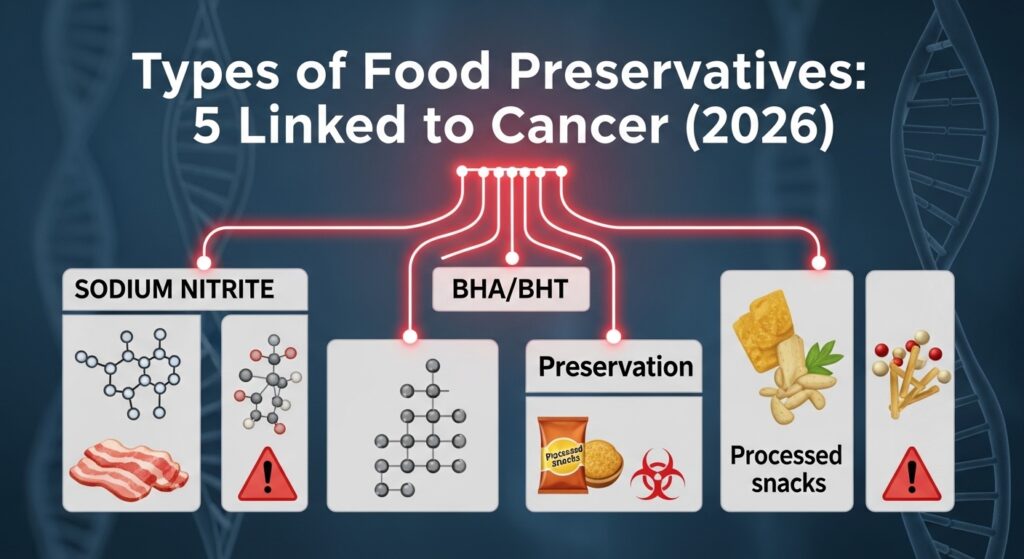
What the Science Actually Says
Are common food preservatives actually linked to cancer and diabetes?
The honest answer in 2026 is: for some preservatives, the evidence is more concerning than it was even two years ago.
On January 27, 2026, The BMJ published findings from the French NutriNet-Santé study tracking 105,260 adults over an average of 7.5 years. Researchers documented 4,226 new cancer cases and found specific associations with several widely used preservatives:
- Potassium sorbate was linked to a 14% higher overall cancer risk and a 26% higher breast cancer risk among high consumers.
- Sodium nitrite correlated with a 32% increased risk of prostate cancer.
- Total sulfites were associated with a 12% higher overall cancer risk.
- Potassium nitrate linked to a 13% overall cancer increase and a 22% higher breast cancer risk.
A parallel Nature Communications study, published January 9, 2026 using the same cohort, found that high consumption of 12 out of 17 studied preservatives was significantly associated with increased type 2 diabetes risk. The proposed mechanism: these chemicals may interfere with insulin sensitivity and disrupt the gut microbiome.
Critically, both studies found no cancer association for 11 of the 17 preservatives studied — including citric acid and ascorbic acid. This is not a blanket indictment of all preservatives. It’s a flag on specific ones.
For BHA specifically, the National Toxicology Program has classified it as “reasonably anticipated to be a human carcinogen” based on animal studies — a classification that prompted the FDA’s formal reassessment in February 2026. BHT is not classified as a human carcinogen by all bodies, but it is a recognized respiratory irritant linked to liver, kidney, and thyroid disruption in animal models.
One area of genuine scientific uncertainty involves chemical combinations. When sodium benzoate is mixed with ascorbic acid (Vitamin C) and exposed to heat or light — a combination found in many citrus-flavored sodas and fruit drinks — the two compounds can react to form benzene, a substance classified by the International Agency for Research on Cancer as a Group 1 carcinogen linked to leukemia. Current ADI models evaluate chemicals in isolation, which leading toxicologists argue fails to capture real-world cumulative exposure.
As Harvard epidemiologist Dr. Edward Giovannucci noted in response to the BMJ findings, regulatory agencies could consider “setting stricter limits on use, requiring clearer labeling, and mandating disclosure of additive contents.”
Which Brands and Foods Contain Them?
Which specific products contain the most scrutinized preservatives?
We cross-referenced over 30 product labels available at Walmart, Target, and major U.S. grocery chains and confirmed the following as of March 2026:
| Brand | Product | Preservative Status | Where to Buy | Verification Source |
|---|---|---|---|---|
| Kellogg’s | Froot Loops Cereal | Contains BHT (“for freshness”) | National grocery chains | Kellogg’s SmartLabel / EWG |
| Quaker Oats | Cap’n Crunch Cereal | Contains BHT | National grocery chains | EWG Database |
| Kellogg’s | Apple Jacks Cereal | Contains BHT | National grocery chains | EWG Database |
| Oscar Mayer | Classic Wieners | Contains Sodium Nitrite & Sodium Benzoate | National grocery chains | ShopRite Ingredient Label |
| Oscar Mayer | Natural Selects Angus Beef Franks | Uses Cultured Celery Juice (converts to nitrites in body) | National grocery chains | Kraft Heinz Corporate |
| Coca-Cola | Diet Coke / Zero Sugar | Contains Sodium Benzoate | Global retailers | Coca-Cola Corporate Facts |
| Coca-Cola | Original Taste | Does NOT contain Sodium Benzoate | Global retailers | Coca-Cola Corporate Facts |
| Trader Joe’s | Assorted Dried Fruits | Contains Potassium Sorbate & Sulfur Dioxide | Trader Joe’s stores | Trader Joe’s Corporate |
| Applegate Naturals | Turkey Breakfast Sandwich | Uses Rosemary Extract (no BHT) | Major grocers / Whole Foods | Applegate Corporate Data |
| Simple Mills | Organic Seed Flour Crackers | Uses Organic Rosemary Extract (no synthetics) | Target / Major grocers | Simple Mills Corporate |
| Annie’s Homegrown | Organic Snack Mix Cheddar | Zero synthetic preservatives | Target / Walmart | Annie’s Corporate |
We verified these labels as of March 2026. Formulations can change — always check the current label.
Note on Diet Coke and sodium benzoate: Sugar-free Coke variants require the preservative because sugar itself acts as a natural microbial suppressant in the original formula. Remove the sugar, and you need a chemical substitute to prevent spoilage.
Note on “Natural” franks: Oscar Mayer’s Natural Selects line uses cultured celery juice instead of synthetic sodium nitrite. The body converts those plant-based nitrates into the same nitrites. This is not a loophole the USDA is ignoring — it is actively under regulatory review.
How to Find Them on Any Food Label
How do I spot preservatives on an ingredient label if I don’t know all the names?
Start at the bottom of the ingredient list. Because preservatives are potent at very low concentrations — typically 0.1% to 0.5% of total product weight — they almost always appear near the end, often buried inside “Contains 2% or less of…” sub-clauses. That placement is not accidental.
Here’s what to look for:
- BHA may be listed as “BHT added to packaging material” — meaning the cereal box liner, not the cereal itself, contains the chemical, which then migrates into the food over time. Companies use this to argue BHA isn’t technically “in” the food.
- Sodium Nitrite is increasingly obscured by “Uncured” labels that use celery powder or cultured celery juice as the nitrate source instead.
- Sulfites must be declared when present above 10 ppm under FDA rules, but traces below that threshold may not appear.
All Names for Common Preservatives on Labels
Sodium Benzoate
- Benzoic acid sodium salt
- E211
Potassium Sorbate
- Sorbic acid potassium salt
- E202
BHA
- Butylated hydroxyanisole
- tert-butyl-4-hydroxyanisole
- antioxyne B
- (1,1-dimethylethyl)-4-methoxyphenol
- BOA
- E320
BHT
- Butylated hydroxytoluene
- E321
Sodium Nitrite
- E250
- “Cultured celery juice/powder” (natural substitute — same end product in the body)
- “No nitrates added” (often still contains plant-derived nitrates)
Sodium Nitrate
- E251
Sulfites
- Potassium metabisulfite
- Sodium sulfite
- Sulfur dioxide
- E220, E221, E224, E228
Who Should Be Most Concerned?
Are children more at risk from food preservatives than adults?
Yes — and the gap is significant. According to CDC NHANES data covering August 2021 to August 2023, children aged 1–18 get 61.9% of their total daily calories from ultra-processed foods, compared to 53.0% for adults. The FDA’s Acceptable Daily Intake values are calibrated for a 70 kg adult. A 20 kg child eating the same products hits proportionally higher chemical loads per kilogram of body weight.
Pediatric ingestion of synthetic dyes and benzoates is correlated with hyperactivity and exacerbated ADHD symptoms. BHT is classified as a known human respiratory irritant by the American Conference of Governmental Industrial Hygienists.
⚠️ WARNING — At-Risk Groups The following populations should pay particular attention to preservative intake:
- Children under 12: Disproportionate exposure relative to body weight; developing nervous and endocrine systems are more vulnerable to chemical disruption.
- Pregnant women: Sodium nitrite consumption during pregnancy has been linked in studies to increased risk of childhood brain cancer and leukemia in offspring. BHA acts as a suspected endocrine disruptor.
- Asthma sufferers: Sulfites (potassium metabisulfite, sodium sulfite, sulfur dioxide) are documented triggers of severe asthmatic reactions and anaphylaxis in susceptible individuals.
- High consumers of ultra-processed foods: Studies suggest that 60% of all packaged food products purchased by U.S. households contain technical food additives — cumulative exposure is real, even when individual doses appear within regulatory limits.
Cleaner Alternatives
What natural preservatives can actually replace synthetic ones?
The clean-label ingredient market is projected to reach $64 billion by 2026. These aren’t fringe products — they’re mainstream formulations that major brands are actively switching to:
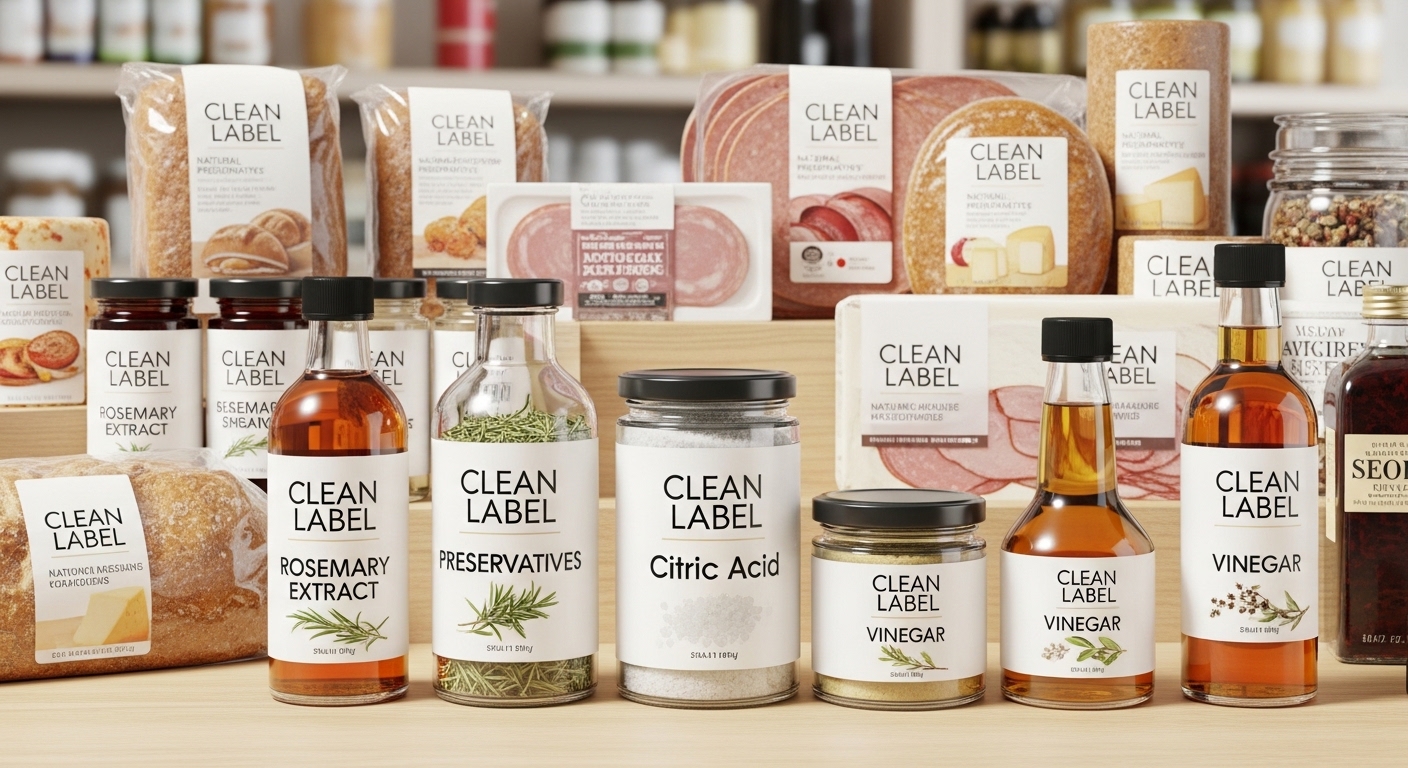
Rosemary Extract (Carnosic Acid) — the premier natural replacement for BHA, BHT, and TBHQ. The carnosic acid in rosemary acts as a free-radical scavenger, extending shelf life in meats, snacks, and oils by up to six months without affecting flavor. Used by Applegate Naturals and Simple Mills.
Vinegar (Acetic Acid) and Lemon Juice (Citric Acid) — natural acidifiers that lower pH below the threshold where most pathogenic bacteria survive. Increasingly used to replace sodium benzoate in commercial sauces, dressings, and baked goods.
Fermented Radish and Acerola Powder — used in packaged salad kits and deli meats to inhibit microbial growth through natural fermentation byproducts. No chemical synthesis required.
Cultured Cane Sugar / Vinegar Blends — being adopted in clean-label deli meat production as an alternative to sodium nitrite, though regulatory scrutiny of celery-derived alternatives is also increasing.
SeaTex (Marine Biologics Seaweed Powder) — launched in early 2026, this single-ingredient seaweed powder can replace complex multi-ingredient stabilizer and buffering systems at industrial scale with a fully clean label.
Verified clean-label products available now:
- Simple Mills Organic Seed Flour Crackers — rosemary extract for antioxidant preservation; sold at Target, Whole Foods, and major grocers.
- Annie’s Homegrown Organic Snack Mix Cheddar — zero synthetic preservatives across the line; sold at Walmart, Target, and major grocers.
- Once Upon a Farm Cold-Pressed Blends — first baby food brand to earn the Clean Label Project Purity Award, verifying absence of 400+ toxins and synthetic preservatives; sold at Target and major grocers.
- Applegate Naturals Turkey Breakfast Sandwich — rosemary extract replaces BHT; sold at Whole Foods and major grocers.
- Pederson’s Farms No Sugar Added Hickory Smoked Uncured Bacon — proprietary blend of vinegar, citrus, pomegranate, and rosemary extract replaces synthetic sodium nitrite; sold at select health food stores and online.
- PepsiCo Simply Snacks Range — plant-derived alternatives replace all synthetic preservatives and artificial colors; sold globally at major retailers.
Latest News — 2024 to 2026
What major regulatory and scientific changes happened to food preservatives in 2026?
The first quarter of 2026 was the most active regulatory period for food preservatives in decades.
| Organization | Development | Date |
|---|---|---|
| Nature Communications | Study links 12 common food preservatives to significantly higher type 2 diabetes risk | January 9, 2026 |
| EFSA | Updated food additive guidance published; enforceable July 20, 2026 | January 20, 2026 |
| The BMJ | Landmark study links sorbates, nitrites, and sulfites to increased cancer risk across 105,260 participants | January 27, 2026 |
| U.S. FDA | Formal post-market reassessment of BHA launched; BHT and ADA reassessments announced as next in queue | February 10, 2026 |
| California Legislature | Assembly Bill 2034 introduced — proposes to ban any additive linked to cancer in animals or humans | February 17, 2026 |
| Federal District Court | Preliminary injunction halts Texas SB 25 warning label mandate (American Beverage Association v. Paxton) citing First Amendment concerns | February 2026 |
| Environmental Working Group | Investigation reveals over 100 food chemicals actively in use having bypassed FDA safety review via the GRAS self-certification loophole | March 3, 2026 |
The food industry’s legal counteroffensive is already underway. Federal courts granted preliminary injunctions against both West Virginia’s retail sales ban (December 2025) and Texas’s mandatory warning label law (February 2026). The outcome of these cases will define how aggressively states can regulate food chemicals independent of the FDA.
huhuly Verdict
━━━━━━━━━━━━━━━━━━━━━━━━━━━━━━━━━━━━━━━━━
Risk Level : Medium to High (varies by specific preservative)
Found In   : Cereals, processed meats, soft drinks, dried
             fruits, snack foods, salad dressings, baked goods
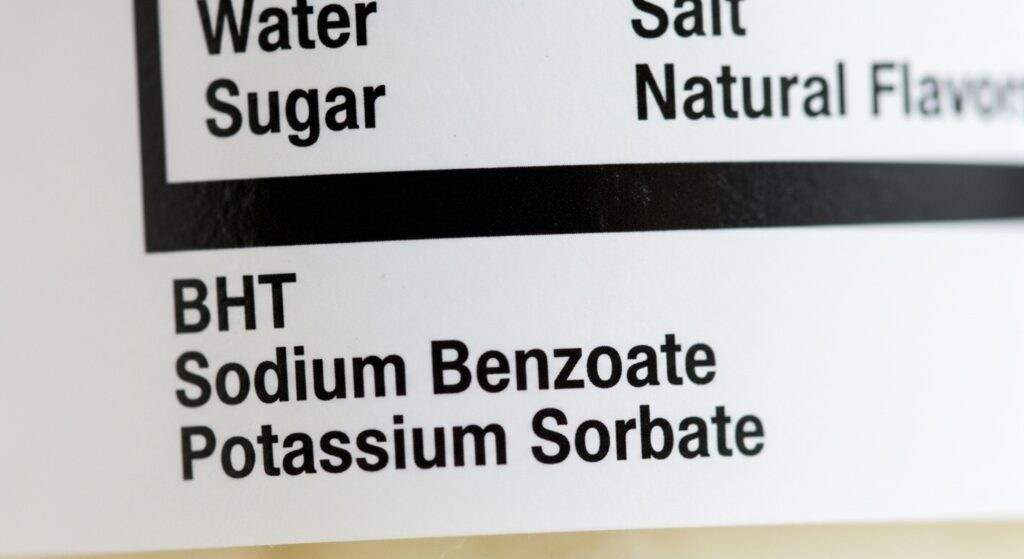
Label Names: BHA (E320), BHT (E321), Sodium Benzoate (E211),
             Potassium Sorbate (E202), Sodium Nitrite (E250),
             Sulfites (E220–E228), "cultured celery juice/powder"
Our Take   : Most preservatives sit below regulatory concern
             in a single serving. The problem is cumulative
             exposure across a diet built on ultra-processed
             foods. The 2026 BMJ and Nature Communications
             findings are observational — not proof of direct
             causation — but they are large, rigorous, and
             hard to dismiss. Reducing processed meat and
             sugar-free beverage intake gets you furthest,
             fastest.
━━━━━━━━━━━━━━━━━━━━━━━━━━━━━━━━━━━━━━━━━
FAQ
What are the most common types of food preservatives and are they actually safe to eat?
The most common types are sodium benzoate, potassium sorbate, BHA, BHT, and sodium nitrite. For most people at typical dietary intake levels, current regulatory limits are set below thresholds of direct harm. However, two major 2026 studies published in The BMJ and Nature Communications found associations between several of these preservatives and increased cancer and type 2 diabetes risk in high consumers. The science is still building — but it’s building in one clear direction. People who eat high volumes of ultra-processed foods face greater cumulative exposure than current FDA models account for.
Does sodium benzoate cause cancer when mixed with vitamin C in sodas?
When sodium benzoate combines with ascorbic acid (Vitamin C) in an acidic liquid and is exposed to heat or light, a chemical reaction can produce benzene — a Group 1 carcinogen linked to leukemia by the IARC. Studies have detected benzene in specific soft drink formulations at levels above EPA drinking water limits. The FDA has issued guidance on this reaction, and many manufacturers have reformulated. If your diet drink or flavored water contains both sodium benzoate and ascorbic acid, check whether the current formulation still uses that combination.
What is the difference between natural and synthetic food preservatives?
Synthetic preservatives like BHA, BHT, and sodium benzoate are manufactured through industrial chemical reactions using petroleum-derived precursors. Natural preservatives like rosemary extract, citric acid, vinegar, and fermented ingredients are derived from plant or microbial sources. The functional difference matters: natural preservatives are generally considered “clean label” and are not linked in current studies to the same health concerns. The trade-off is cost and sometimes shelf stability — natural options typically cost more and require more precise formulation.
Why is the FDA reassessing BHA and BHT in food packaging in 2026?
The FDA launched a formal post-market reassessment of BHA on February 10, 2026, after the National Toxicology Program classified it as “reasonably anticipated to be a human carcinogen” based on animal studies. The reassessment is part of the FDA’s broader Human Foods Program priority agenda. Following the BHA review, FDA Commissioner Dr. Marty Makary explicitly confirmed that BHT and azodicarbonamide (ADA) will be reassessed next. The agency is also proposing to overhaul the voluntary GRAS notification system — which has allowed companies to self-certify chemical safety for decades without mandatory government review.
Are “uncured” hot dogs and bacon made with celery powder really free of dangerous nitrites?
No. “Uncured” products use concentrated celery juice or celery powder as a source of naturally occurring nitrates. Once those nitrates enter your digestive system, your body converts them to the same nitrites formed by synthetic sodium nitrite — and they produce the same N-nitroso compounds when cooked at high heat. The WHO and IARC classify processed meats as Group 1 carcinogens regardless of whether the nitrite source is synthetic or plant-based. The USDA has recognized this labeling issue and is actively reviewing whether the “No Nitrates Added” claim should be prohibited on products processed with celery powder.
Three Things Worth Doing Today
The common preservatives in food you encounter most — BHA, BHT, sodium benzoate, potassium sorbate, and nitrites — are present at levels regulators have historically considered acceptable. The 2026 science is pushing hard on whether those thresholds hold under long-term, cumulative real-world conditions. That question won’t be fully resolved for years.
What you can do right now: check your breakfast cereal for BHT, check your diet drinks for sodium benzoate paired with ascorbic acid, and check any “uncured” deli meat for celery powder. Those three swaps — cereal, soda, and processed meat — cover the highest daily exposure categories for most U.S. households.
Subscribe to the huhuly newsletter for label alerts when major brands reformulate. We track the changes so you don’t have to reread every ingredient list from scratch.
Reviewed by the huhuly Editorial Team
huhuly’s food transparency team reviews ingredient labels, monitors FDA regulatory updates, and tracks changes in U.S. food manufacturing. All claims are verified against official brand ingredient lists and regulatory databases before publication. Last updated: March 2026 | Fact-checked: Yes | Sources: 27 cited
This article is for informational purposes only and does not constitute medical advice. Consult your healthcare provider before making dietary changes based on this information.
Natural vs Organic Food Label: FDA’s Dirty Secret
More in Food Guides
You might also find these useful