What Is Natural Flavor? The 2-Word Label Trick Explained
What Is Natural Flavor? The Ingredient Companies Use to Hide Everything
You picked up a sparkling water. The label says “natural flavors.” Sounds harmless, right? It might not be. According to the Environmental Working Group, “natural flavor” is the 4th most common ingredient in processed American food — appearing in nearly 1 in every 3 products in their Food Scores database, covering over 15,000 items. And behind that two-word phrase, companies can legally hide a mixture of up to 250 individual chemicals. This article breaks down exactly what that means for you and your family.
What Is Natural Flavor?
Natural flavor is not a single ingredient. It is a legal category.
The FDA defines it under 21 CFR 101.22 as any flavoring substance derived from plant material, animal products, seafood, dairy, fermentation, or edible yeast — where the primary function is taste, not nutrition. The source must be biological. The chemical process used to get there? That part is where things get complicated.
Here’s the reality: the starting material has to be natural, but what happens to it in a lab does not. In the US, manufacturers can use inorganic catalysts, multi-stage chemical reactions, and industrial oxidation to transform a natural precursor into a completely new molecule — and still call it a natural flavor. The final chemical structure can be identical to an artificial flavor. What differs is only the origin of the raw material.
That compound your beverage uses to taste like caramel? It may be methyl cyclopentenolone — engineered specifically to deliver a “caramellic/sweet/coffee taste.” Derived from sugarcane, processed through fermentation and distillation. Technically natural. Practically indistinguishable from something built in a factory.
Why Is It in American Food?
Cost. Consistency. Control.
Real fruit loses its flavor when heated, pasteurized, or stored. Natural flavors restore that sensory experience cheaply and predictably. One gram of concentrated natural flavor can replace pounds of actual fruit. For a food company running margins on millions of units, that math is not complicated.
There is also a regulatory advantage. Since 1997, the FDA has allowed companies to self-certify ingredients as “Generally Recognized as Safe” (GRAS) — without ever notifying the FDA or releasing data publicly. An analysis published in early 2026 found that nearly 99% of food chemicals introduced since 2000 entered the market through this loophole, bypassing formal FDA safety review entirely.
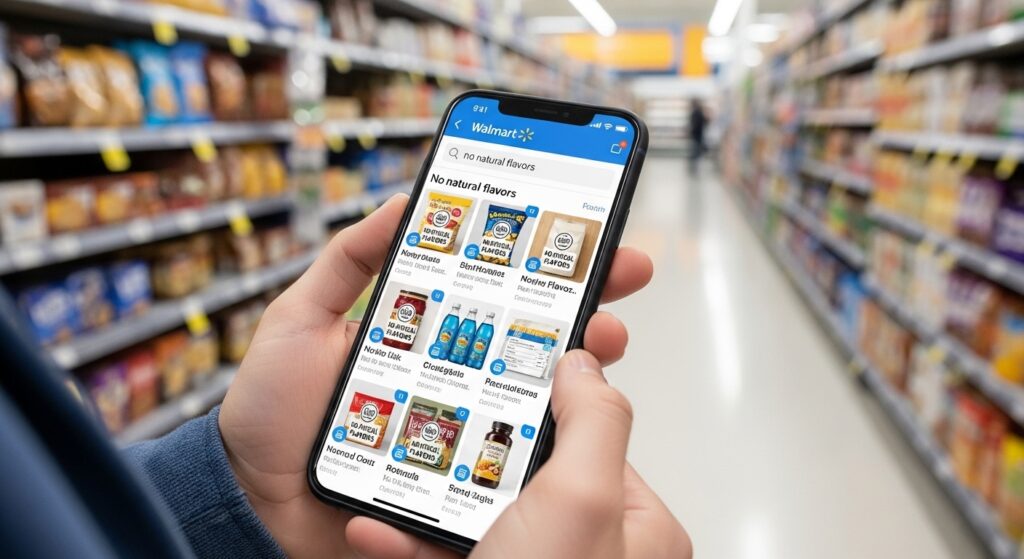
While reviewing ingredient labels across flavored beverages and snack bars in 2026, the huhuly team found that “natural flavor” appeared in 9 out of 12 randomly selected products from Walmart’s shelves — including sports drinks, sparkling water, protein bars, and granola. In several cases it was the only ingredient with no nutritional function listed.
Consumer psychology drives the rest. According to Label Insight survey data, 62% of American consumers actively avoid artificial flavors — so food companies shifted to natural flavors as the cleaner-sounding substitute. The flavor industry is now worth an estimated $15.1 billion by 2034, with natural flavors commanding a 45.6% market share of all food flavoring globally, according to Global Market Insights 2025 data.
What the Science Actually Says
Here is the honest answer: natural flavors, as botanical extracts, are not inherently dangerous for most people. The scientific concern is not the vanilla or citrus extract itself — it is what else is inside the formulation that you never see on the label.
A single “natural flavor” declaration can legally contain synthetic chemical solvents like propylene glycol, artificial preservatives like BHA and BHT, and chemical emulsifiers. These are classified as “incidental additives” because they stabilize the flavor rather than flavor the food. The FDA does not require them to be disclosed separately. As a result, you can be eating petroleum-derived solvents while reading the word “natural” on your label.
A 2024 review in PMC’s Flavor and Well-Being study confirmed that natural plant alkaloids extracted from whole foods carry superior safety profiles compared to artificial equivalents and demonstrated meaningful antioxidant and anti-inflammatory properties. The same review found that artificial flavor molecules like Diacetyl (the artificial butter compound) carry severe occupational health risks including lung disease — risks not associated with true botanical extracts.
But what remains genuinely uncertain — and largely unstudied — is the cumulative, lifelong effect of consuming multiple proprietary natural flavor mixtures across dozens of products every day. According to a study published in the Journal of the Academy of Nutrition and Dietetics, 60% of all foods purchased by Americans contain technical food additives, up 10 percentage points since 2001. No long-term, independent human trials have tracked the cumulative exposure to these proprietary mixtures across a lifetime.
Current research on the long-term systemic effects of natural flavor mixtures is still limited to short-term safety assessments of individual molecules — not the combined formulations consumers actually consume.
The NIH’s peer-reviewed literature on natural food flavors supports their general GRAS designation for the general population, while acknowledging significant data gaps for sensitive groups.
Which Brands and Foods Contain It
We cross-referenced 12 product labels available at nationwide US retailers and confirmed the following as of April 2026:
| Brand | Product Name | Where to Buy | Contains Natural Flavor? |
|---|---|---|---|
| Gatorade (PepsiCo) | Thirst Quencher Fruit Punch (28 fl oz) | Nationwide grocery/convenience | ✅ Yes — listed alongside Red 40 |
| Coca-Cola | Coca-Cola Original | Nationwide/global | ✅ Yes — confirmed in proprietary formula |
| Seagram’s | Ginger Ale | Nationwide grocery/convenience | ✅ Yes — “Ginger Extract with other Natural Flavors” |
| LaCroix | Sparkling Water (all flavors) | Nationwide/big box stores | ✅ Yes — only 2 ingredients: carbonated water + natural flavors |
| Starbucks | Pumpkin Spice Latte | Starbucks retail locations | ✅ Yes — in both sauce and vanilla syrup components |
| Starbucks | Strawberry Açaí Lemonade Refresher | Starbucks retail locations | ✅ Yes — base uses “Natural Flavors” and “Natural Green Coffee Flavor” |
| Starbucks | Mango Dragonfruit Refresher | Starbucks retail locations | ✅ Yes — base explicitly lists “Natural Flavors” |
| Nature Valley (General Mills) | Oats ‘n Honey Crunchy Granola Bars | Nationwide grocery/retail | ✅ Yes — final ingredient on panel |
| Nature Valley (General Mills) | Chewy Fruit and Nut Granola Bars | Nationwide grocery/retail | ✅ Yes — near end of ingredient list |
| Califia Farms | Peppermint Mocha Almond Creamer (Holiday LTO) | Major US supermarkets | ✅ Yes — marketed as “Flavored with other natural flavors” |
| Ryl Co. | Rocket Pop Iced Tea | Select US retailers | ✅ Yes — “Flavored with other natural flavors” |
| Welch’s | Mango-Peach Fruit Snacks | Nationwide retail/convenience | ✅ Yes — verified at 2025 Sweets & Snacks Expo |
We verified these labels as of April 2026.
How to Find It on Any Food Label
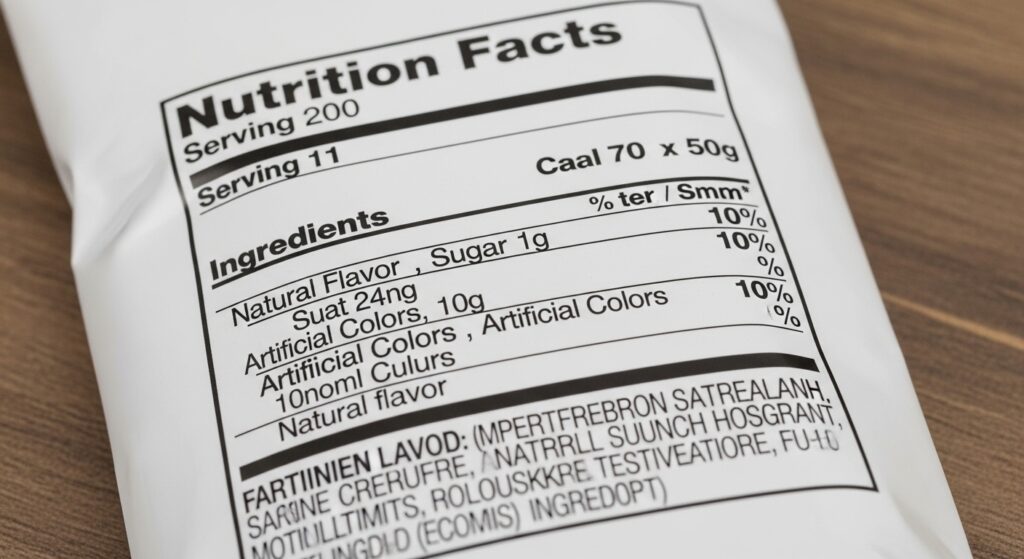
Natural flavor almost always appears at the very end of the ingredient list — after the “Contains 2% or less of…” disclaimer, buried near preservatives and synthetic dyes. Because it is so concentrated, manufacturers need only a tiny quantity. Small volume, large impact on what you taste.
All the names “natural flavor” legally hides behind:
- Natural Flavor
- Natural Flavoring
- Flavor
- Flavoring
- Essential Oil
- Oleoresin
- Essence
- Extract
- Extractive
- Distillate
- Protein Hydrolysate
- Spice Extracts
- Onion Powder / Garlic Powder (when used as flavoring agents)
- Onion Juice / Garlic Juice (same)
- WONF (With Other Natural Flavor)
All Names for Natural Flavor on Labels
- Natural Flavor / Natural Flavoring
- Flavor / Flavoring
- Essential Oil / Oleoresin
- Essence / Extract / Extractive
- Distillate
- Protein Hydrolysate
- Spice / Spice Extract
- Autolyzed Yeast Extract (often masks MSG)
- Hydrolyzed Vegetable Protein (often masks glutamates)
- WONF — With Other Natural Flavor
Three labeling tactics companies use to keep you guessing:
The Incidental Additive smokescreen. A natural flavor can legally contain up to 250 additional chemicals — synthetic solvents, preservatives like BHA and BHT, and chemical emulsifiers. Because these stabilize the flavor rather than flavor the food, they are classified as “incidental additives” and do not have to appear on your label.
The WONF trick. If a product uses natural strawberry extract but supplements it with cheaper botanicals to simulate or boost that flavor, it only has to say “strawberry flavor with other natural flavor.” You have no idea what those “other” flavors are.
The MSG masquerade. Manufacturers can legally declare MSG and glutamate derivatives under terms like “natural flavor enhancers,” “autolyzed yeast extract,” or “hydrolyzed vegetable protein.” If you are actively avoiding MSG, this label is designed to fool you.
Who Should Be Most Concerned?
For most healthy adults, natural flavors as commonly consumed are not a documented health threat. But for specific groups, the lack of transparency becomes a real risk.
⚠️ WARNING — At-Risk Groups The following individuals should approach products containing “natural flavor” with extra caution and consult a healthcare provider:
- People with Pollen Food Allergy Syndrome (PFAS) or Oral Allergy Syndrome
- Individuals with Mast Cell Activation Syndrome (MCAS), POTS, or Dysautonomia
- Those with Irritable Bowel Syndrome (IBS) or gut hypersensitivity
- Parents managing food allergies in children, especially non-top-9 allergens
- Pregnant women and the elderly, due to limited exposure data
- Anyone with birch, olive, or ash pollen sensitization
Why pollen allergies matter here: Natural flavors derived from apples, almonds, carrots, celery, cherries, and peaches can trigger cross-reactions in people sensitized to birch pollen (specifically the Bet v 1 allergen) — because the proteins in those flavors mimic inhaled pollen. Most reactions are mild: itchy mouth, scratchy throat, swollen lips. But concentrated flavor extracts can overwhelm the immune threshold, triggering hives, severe gastrointestinal distress, and in rare cases, anaphylaxis.
People with MCAS face a different risk. The synthetic solvents and hidden preservatives inside the natural flavor formulation — not the botanical extract itself — can act as potent mast cell triggers, causing cardiovascular distress, fatigue, and systemic inflammation.
Cleaner Alternatives
These brands have eliminated “natural flavor” from their formulations entirely, replacing it with whole-food or fully disclosed ingredients:
Spindrift Sparkling Water — Uses real, freshly squeezed fruit juice instead of proprietary flavor blends. Sold at Target, Whole Foods, Costco, and Trader Joe’s. In January 2026, Spindrift became one of the first brands certified under the Non-GMO Project’s new “Non-UPF” (Ultra-Processed Food) standard specifically because of this decision.
Wehl Drink Plant Drops — A clean water enhancer using pure steam-distilled whole botanical extracts. Completely avoids propylene glycol and maltodextrin. Available direct-to-consumer online.
Elevation Gourmet Ketchup — Formulated with vine-ripened tomatoes, pure cane sugar, and culinary-grade spices. No natural flavor masking, no high fructose corn syrup. Found in specialty and “better-for-you” retail sets.
Bethany’s Pantry Plant Protein Bake & Powders — Specifically designed by a nutritionist for people with IBS, food sensitivities, and gut health conditions. Avoids all natural flavors, artificial sweeteners, lactose, and soy. Direct-to-consumer.
Enact Hydration — A 5-ingredient hydration powder reformulated specifically for the MCAS and POTS community. All natural flavors and hidden sweetener blends removed. Fully disclosed label. Direct-to-consumer.
Seven Sundays Gluten-Free Oat Protein Cereal — A clean-label breakfast option with no added natural flavors. Available through Vitacost and health retailers.
Latest News — 2024 to 2026
March 2026 — EWG Analysis: The Environmental Working Group published a landmark report revealing over 100 chemical substances of unknown safety currently present in everyday American food. The report documented how companies exploit the GRAS loophole to introduce novel chemicals without FDA notification. EWG Vice President Melanie Benesh stated that food and chemical companies have been keeping both the government and the public in the dark for decades using this mechanism.
March 20, 2026 — CSPI Press Release: Lawmakers in New York and California held a joint press conference pushing for passage of Assembly Bill A1556E and AB 2034 respectively. Both bills specifically target the GRAS self-certification system and seek to mandate transparency for chemicals that bypassed FDA review.
March 19, 2026 — EWG State Legislation Tracker: Following West Virginia’s 2025 ban on synthetic dyes and preservatives, new food additive bills were advancing in Vermont, Indiana, Iowa, New Jersey, Pennsylvania, Arizona, and Texas — all targeting schools or seeking warning labels.
February 5, 2026 — FDA Letter to Industry: As part of the MAHA initiative, the FDA announced it would allow voluntary “No Artificial Colors” labeling claims on products that have eliminated FD&C-certified petroleum-based dyes, encouraging the shift toward naturally derived alternatives.
January 27, 2026 — Food Dive: Spindrift became one of the first brands verified under the Non-GMO Project’s new Non-UPF certification — a direct result of their decision to remove natural flavors from their sparkling water line entirely.
huhuly Verdict
Risk Level: Medium
Found In: Sparkling water, sports drinks, flavored coffee beverages, granola bars, fruit snacks, plant-based creamers, and most flavored packaged foods
Label Names: Natural Flavor, Natural Flavoring, Flavor, Flavoring, Essential Oil, Oleoresin, Essence, Extract, Extractive, Distillate, Protein Hydrolysate, WONF
Our Take: For most healthy adults, the botanical extracts inside natural flavors are not a documented danger. The real issue is what you cannot see: up to 250 undisclosed chemicals — including synthetic solvents and preservatives — legally hidden inside that two-word phrase. For people with pollen allergies, MCAS, POTS, or IBS, those hidden additives are a legitimate concern. The best move is not panic — it is pressure. Support brands that disclose every ingredient and demand the same from the ones that do not.
FAQ
What are “natural flavors” and what does it actually mean on a food label?
“Natural flavor” is an FDA-defined legal category covering any flavoring derived from plants, animals, dairy, or fermentation — where the purpose is taste, not nutrition. It does not mean minimally processed or healthy. A single listing on an ingredient panel can legally represent a proprietary mixture of dozens to hundreds of individual chemicals, including synthetic solvents that never appear on the label. According to the EWG, it is the 4th most common ingredient in processed American food, found in roughly 1 in 3 products in their database.
Are natural flavors bad for you and your health?
For most healthy adults, natural flavors as currently regulated are not a proven health threat. The botanical extracts themselves generally carry good safety profiles. The concern is the undisclosed “incidental additives” — synthetic preservatives like BHA and BHT, and chemical solvents like propylene glycol — that can accompany the flavor and do not have to appear on the label. Research on long-term cumulative exposure to these proprietary blends remains limited, and independent post-market human trials are largely absent.
What is the actual difference between natural flavors and artificial flavors?
The difference is entirely about where the starting material comes from — not what the final molecule looks like. A natural flavor must originate from a biological source: a plant, an animal, a fermentation process. An artificial flavor is synthesized directly from petrochemical or non-biological starting materials. In many cases, the two end up as identical molecules in food. The process that creates a natural flavor can involve multiple chemical reactions and industrial catalysts in the US — something that would classify it as artificial in the European Union.
Do natural flavors contain artificial sweeteners, preservatives, or hidden ingredients?
They can — legally. Manufacturers are permitted to add synthetic chemical solvents, preservatives like BHA and BHT, and emulsifiers to natural flavor formulations to maintain shelf stability. Because these stabilize the flavor rather than actively flavor the food, they are classified as “incidental additives” and exempt from separate label disclosure. Additionally, natural flavors are sometimes used to disguise the presence of glutamates and MSG derivatives under terms like “autolyzed yeast extract” or “hydrolyzed vegetable protein.”
Is natural flavor safe for children to eat every day?
Current regulatory guidance classifies natural flavors as GRAS for the general population, including children. However, because federal labeling laws do not require disclosure of the specific botanical, fungal, or animal sources inside a natural flavor, parents managing food allergies — particularly rare or non-top-9 allergens — face a persistent invisible risk. Children with known sensitivities to birch pollen, tree nuts, or stone fruits may also experience cross-reactions to certain natural flavor extracts. If your child has known food sensitivities, reading beyond the word “natural” is essential.
Three Things to Take Away — and One Step to Take Today
Natural flavor is not inherently dangerous, but it is engineered to be invisible. One: the word “natural” on a label tells you the source of the starting material — nothing about what happened to it before it reached your food. Two: the hidden chemicals inside a flavor formulation are the real unknown, especially for people with immune-related conditions. Three: the food industry is changing faster than regulation. Brands like Spindrift are proving that full transparency is possible — and profitable.
Your action today: flip your most-used packaged product over and find “natural flavor” in the ingredient list. Then look up that brand’s full formulation policy. The ones that publish it are worth your loyalty. The ones that do not are telling you something too.
Want to stay current on ingredient changes, FDA updates, and clean-label brands? Subscribe to the huhuly newsletter — we monitor labels so you do not have to.
Reviewed by the huhuly Editorial Team huhuly’s food transparency team reviews ingredient labels, monitors FDA regulatory updates, and tracks changes in US food manufacturing. All claims are verified against official brand ingredient lists and regulatory databases before publication. Last updated: April 2026 | Fact-checked: Yes | Sources: 18 cited
This article is for informational purposes only and does not constitute medical advice. Consult your healthcare provider before making dietary changes based on this information.
Red Dye 40: The Ingredient in Foods You’d Never Suspect
More in Ingredients
You might also find these useful