Red Dye 40: The Ingredient in Foods You’d Never Suspect
What Is Red Dye 40 and Why Is It Being Banned Across the US?
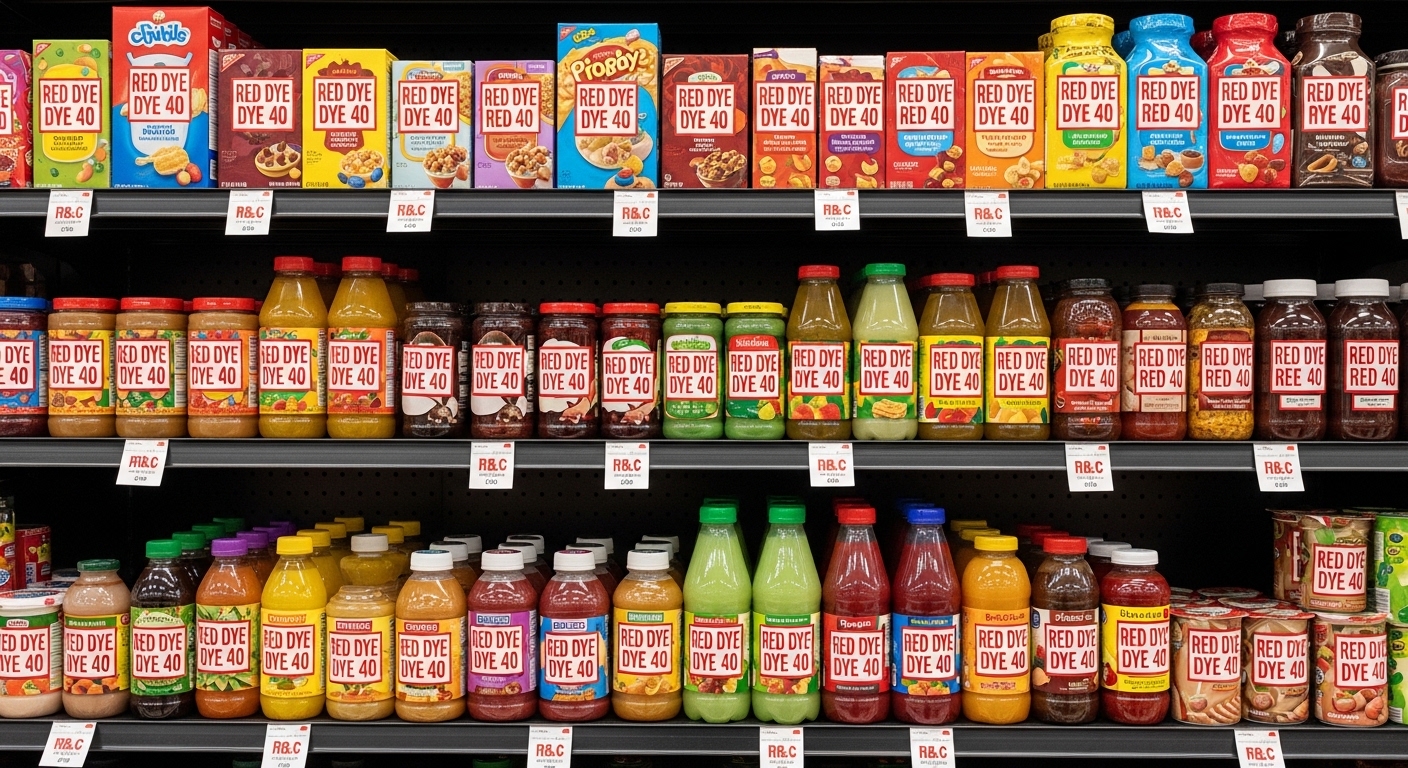
Red Dye 40 is in roughly 1 in 7 packaged products sold in American grocery stores right now — and there is a good chance your family has already eaten it today.
That number comes from a June 2025 study in the Journal of the Academy of Nutrition and Dietetics, which scanned nearly 40,000 products from the top 25 US food companies. According to that research, products containing synthetic dyes like red dye 40 foods averaged 141% more sugar than dye-free alternatives. The FDA, which certified this dye in 1971, is now actively phasing it out, under pressure from both science and a wave of state bans.
None of this means panic. It means paying closer attention. Here is everything you need to know.
Table of Contents
- What Is Red Dye 40 and Why Is It Being Banned Across the US?
- What Is Red Dye 40?
- Why Is It in American Food?
- What Does the Science Actually Say?
- Which Brands and Foods Contain It?
- How Do You Find It on Any Food Label?
- Who Should Be Most Concerned?
- What Are the Cleaner Alternatives?
- What Has Changed Between 2024 and 2026?
- FAQ
What Is Red Dye 40?
Red Dye 40 — officially called Allura Red AC — is a synthetic, petroleum-derived azo dye. It does not exist in nature. Chemists create it from petrochemical starting materials through a multi-step industrial process involving diazotization and azo coupling reactions. The result is a dark red powder that dissolves easily into water, syrups, and liquid foods.
Its only job in food is cosmetic. It adds zero nutritional value and has no preservative function. The dye was first patented in 1970 by researchers at Allied Chemical Corporation and entered commercial use in 1971. Today, more than 30 global chemical companies manufacture it.
Why Is It in American Food?
Cost and reliability. Synthetic azo dyes are dramatically cheaper to mass-produce than plant-based colorants. They resist heat during baking, stay stable across a wide pH range, and hold a perfectly uniform hue batch after batch — something natural alternatives have historically struggled to match.
Food scientists also use Red Dye 40 to manipulate color psychologically. Research consistently shows that vibrant colors increase perceived flavor intensity and nutritional quality, particularly among young children. Manufacturers use that signal to make ultra-processed products more appealing.
While reviewing ingredient labels across breakfast cereals and children’s snacks in early 2026, the huhuly team confirmed that Red 40 appeared in products you would never suspect were artificially colored — including chocolate-flavored cereals, dark barbecue sauces, and white cake frosting.
What Does the Science Actually Say?
The scientific picture on Red Dye 40 is more complex than “safe” or “banned.” Here is an honest account of where the research stands.
The strongest concern: children’s behavior. A landmark 2021 review by California’s Office of Environmental Health Hazard Assessment (OEHHA) analyzed 27 human clinical trials. In 16 of the 25 double-blind challenge studies, researchers found a positive association between synthetic food dye consumption and hyperactivity or inattention. A 2012 meta-analysis by Nigg et al., cited in the OEHHA report, estimated that up to 8% of children diagnosed with ADHD experience symptoms directly worsened by synthetic dye consumption.
Gut health concerns. A 2022 McMaster University study published in Nature Communications found that continuous exposure to Allura Red AC promoted susceptibility to colitis in mice by disrupting intestinal barriers and altering gut bacteria. A 2023 study then observed significant colonic DNA damage in murine models exposed to Red Dye 40, with researchers hypothesizing a possible link to the rise in early-onset colorectal cancer — though that connection requires further human research.
The industry counterargument. No long-term epidemiological study has established a definitive causal link between Red Dye 40 and cancer or chronic disease in humans. Industry groups argue that behavioral reactions are an individual sensitivity rather than a universal hazard, and that average American exposure remains well below historical ADI limits.
What is still unknown. Scientists have not yet mapped exactly how Red 40 or its metabolites may cross the blood-brain barrier in susceptible children. The mouse-based gut findings also need human confirmation. Per the FDA’s own color additives resource, current research on long-term human impacts remains limited.
Which Brands and Foods Contain It?
Red Dye 40 appears across thousands of products. These are verified US brands with confirmed current or recent use, based on publicly available brand disclosures and regulatory filings as of early 2026.
| Brand | Product | Contains Red 40? | Status | Where to Buy |
|---|---|---|---|---|
| W.K. Kellogg Co | Froot Loops | Yes (confirmed) | Still present; Texas AG investigating a broken 2018 pledge to remove it | Major grocery retailers |
| General Mills | Lucky Charms | Yes (confirmed) | Company reverted to synthetic dyes after a brief 2015 pledge | Major grocery retailers |
| Mars, Inc. | M&M’s | Yes (phasing out) | Committed to full transition to natural colorants by end of 2026 | Grocery, convenience, retail |
| Mars, Inc. | Skittles Original | Yes (phasing out) | Reformulating Red 40 out by end of 2026 | Grocery, convenience, retail |
| PepsiCo | Gatorade Fruit Punch | Yes (historically confirmed) | Cited in FDA studies as a primary vector for childhood Red 40 exposure | Grocery, convenience |
| PIM Brands | Welch’s Fruit Snacks | Yes (phasing out) | Committed to removing all artificial dyes by early 2026 | Major grocery retailers |
| General Mills | Betty Crocker Mixes | Yes (phasing out) | Pledged to phase out synthetic dyes aligned with 2026 FDA initiative | Major grocery retailers |
| Walmart | Member’s Mark (private label) | Yes (phasing out) | Committed to eliminating certified color additives from store brand by end of 2025 | Walmart, Sam’s Club |
We cross-referenced 8 product lines available at Walmart, Target, and on Amazon and verified these label statuses as of March 2026.
How Do You Find It on Any Food Label?
Under FDA rules, any certified color additive must be listed by name in the ingredient list. Red Dye 40 is required to appear — but it hides behind multiple legal names.
Scan for every one of these:
- Red 40
- Red No. 40
- FD&C Red No. 40
- Allura Red
- Allura Red AC
- Red 40 Lake
- FD&C Red No. 40 Aluminum Lake
- E129 (EU E-number)
- INS No. 129 (international numbering)
- C.I. 16035
- C.I. Food Red 17
- Fancy Red
- Curry Red
- Japan Food Red No. 40
All Names for Red Dye 40 on Labels
- Red 40 / Red No. 40 / FD&C Red No. 40
- Allura Red / Allura Red AC
- Red 40 Lake / FD&C Red No. 40 Aluminum Lake
- E129 / INS No. 129 / C.I. 16035 / C.I. Food Red 17
- Curry Red / Fancy Red / Japan Food Red No. 40
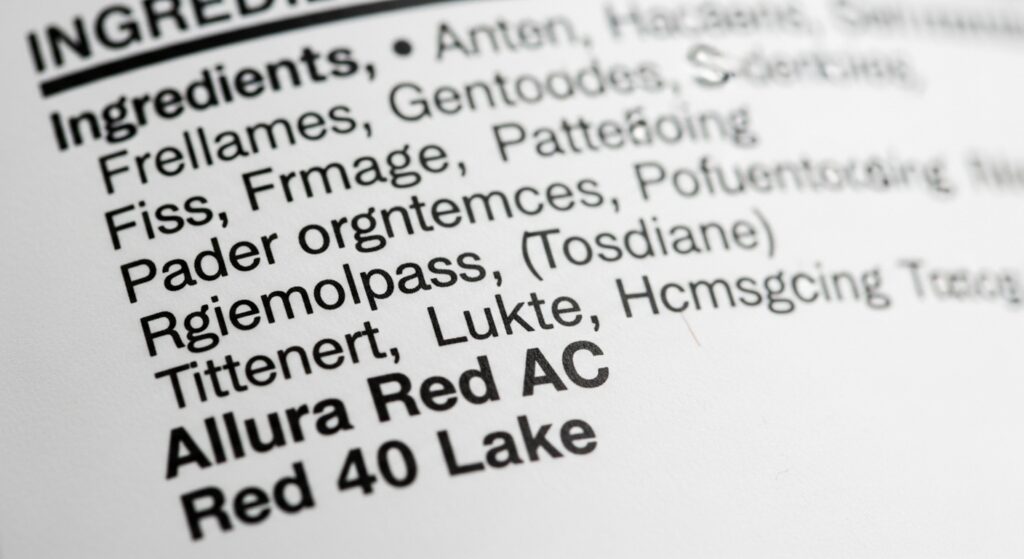
The “Lake” trick. When Red 40 is listed as “Red 40 Lake” or “FD&C Red No. 40 Aluminum Lake,” the dye has been chemically bonded with aluminum salts to make it fat-soluble. You are still consuming Red 40 — it is just the form used to coat solid foods like candy shells, pharmaceutical pills, and baked goods with colored speckles.
Where to look on the label. Because such tiny amounts create such intense color, Red 40 almost always appears at the very bottom of the ingredient list — clustered near preservatives and artificial flavors. It is easy to miss. Make it a habit to read all the way to the last line.
The color surprise. Do not assume Red 40 only appears in red foods. Food scientists routinely blend Red 40 with Yellow 5, Yellow 6, and Blue 1 to create chocolatey browns, rich purples, and golden caramel tones. It regularly shows up in brown cereals, dark barbecue sauces, and white frosting.
Who Should Be Most Concerned?
⚠️ WARNING — AT-RISK POPULATIONS The following groups face elevated risk from Red Dye 40 exposure. If any apply to you or your child, consider reviewing the label on every product before purchase.
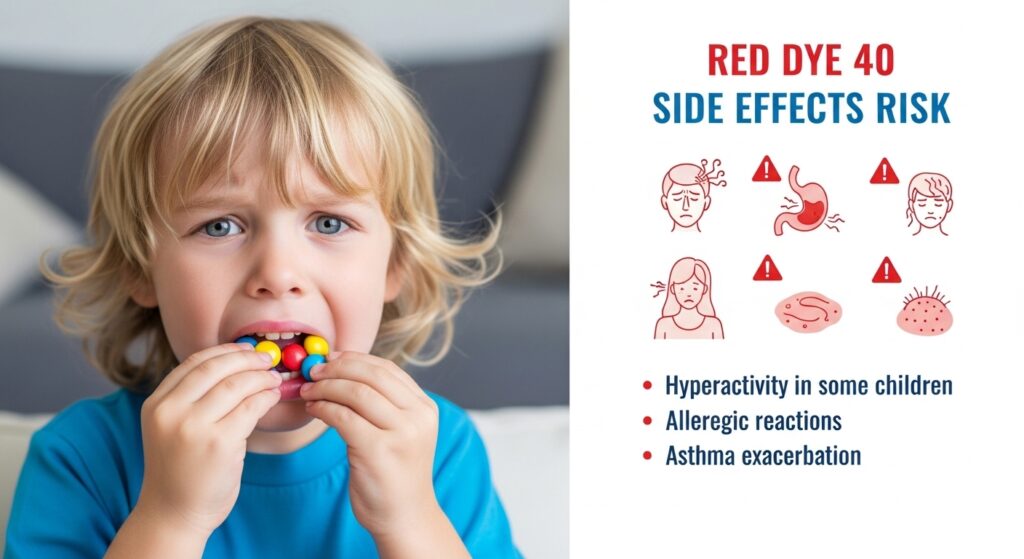
Children. This is the group with the clearest documented risk. A child’s lower body weight means a typical serving delivers a higher chemical concentration per kilogram than the same serving delivers to an adult. The developing brain is also more sensitive to chemical interference during critical windows of neurological growth. Children with ADHD or Autism Spectrum Disorder face particular risk: research suggests up to 8% of children with ADHD experience measurable symptom worsening from synthetic dye consumption.
Pregnant women. Petrochemical azo dyes may cross the placental barrier during sensitive windows of fetal neurological development. Multiple state health authorities now advise expectant mothers to actively limit ultra-processed foods containing synthetic colorants.
People with allergies or atopic conditions. Though true IgE-mediated anaphylaxis is rare, well-documented hypersensitivity reactions to Allura Red AC include hives, facial and throat swelling (angioedema), severe itching, sudden vomiting, and eczema flares.
Older adults. Age-related declines in liver and kidney function can slow the metabolization of synthetic chemicals. Red 40 may also interact poorly with multi-drug regimens common in older populations.
What Are the Cleaner Alternatives?
These specific products use plant-based colorants instead of Red 40. All are widely available.
| Brand | Product | Coloring Source | Where to Buy |
|---|---|---|---|
| YumEarth | Organic Giggles | Organic fruit and vegetable juice extracts | Target, Walmart, Whole Foods, Amazon |
| UNREAL | Chocolate Gems | Beetroot juice and turmeric | Whole Foods, Sprouts, Amazon |
| Cascadian Farm | Fruitful O’s | Purple corn flour, yellow corn flour, annatto seed extract | Major grocers, Amazon |
| Justin’s | Dark Chocolate Peanut Butter Candy Pieces | Blackcurrants, carrots, turmeric, spirulina | Target, Whole Foods, Amazon |
| Olyra | Strawberry Organic Fruit Snacks & Grain Bites | Real strawberries, black carrot juice | Amazon, health food retailers |
| Black Forest | Organic Gummy Bears | Natural plant-based dyes, real fruit juice | Walmart, Target, major grocers |
What Has Changed Between 2024 and 2026?
January 15, 2025 — FDA revokes Red No. 3. The agency formally revoked authorization for FD&C Red No. 3 under the Delaney Clause of the FD&C Act, citing evidence of cancer in laboratory animals. The move signaled the end of FDA tolerance for synthetic dyes broadly.
March 2025 — West Virginia enacts the first sweeping school ban. Governor Jim Justice signed House Bill 2354, banning Red 40 and six other synthetic dyes from all West Virginia public schools, effective August 1, 2025.
April 22, 2025 — HHS and FDA announce the national phase-out. The joint press conference declared the goal of eliminating all six remaining high-volume petroleum-based synthetic dyes — Red 40, Yellow 5, Yellow 6, Blue 1, Blue 2, and Green 3 — from the US food supply by the end of 2026, with some categories extended to 2027.
May 9, 2025 — FDA fast-tracks natural color approvals. To support reformulation, the FDA authorized calcium phosphate, Galdieria extract blue, gardenia blue, beetroot red, butterfly pea flower extract, and expanded spirulina permissions.
June 25, 2025 — Landmark prevalence study published. The Journal of the Academy of Nutrition and Dietetics study of 39,763 products confirmed Red 40 in 14% of all items — the most prevalent synthetic dye in the US food supply.
August 18, 2025 — 22 major food corporations formally pledge compliance. Companies including Mars, Walmart, Kellogg, and PIM Brands committed to eliminating petroleum-based dyes from US product lines to meet federal deadlines.
As of early 2026 — more than 20 states have active legislation. Bills restricting or banning Red 40 are advancing in Florida, Georgia, Delaware, Alaska, and Virginia, alongside California’s existing school ban effective December 31, 2027.
huhuly Verdict Risk Level: Medium–High (especially for children, pregnant women, and allergy-prone individuals) Found In: Breakfast cereals, candy, fruit snacks, sports drinks, baked goods, puddings, sauces, frozen desserts, and some medications Label Names: Red 40 · Allura Red AC · FD&C Red No. 40 · Red 40 Lake · E129 · INS 129 · C.I. 16035 Our Take:
Red Dye 40 has been in the US food supply for over 50 years, but the science supporting its safety was never designed to detect the behavioral and gut effects now under scrutiny. The FDA’s own 2025 pivot confirms that the old safety thresholds are no longer sufficient. You do not need to overhaul your entire pantry overnight — but checking labels on products your children eat regularly is a practical and reasonable place to start.
Last Verified: March 2026
FAQ
Is Red Dye 40 currently banned in the United States?
Not banned outright at the federal level, but it is being phased out. The FDA announced in April 2025 that Red 40 will be eliminated from the US food supply by the end of 2026 — a voluntary but heavily pressured industry deadline. Several states have moved faster: California banned it in public schools effective December 31, 2027, and West Virginia prohibited it in all public school food as of August 1, 2025. Over 20 additional states have active bills advancing through their legislatures as of early 2026.
What are the side effects of Red Dye 40 in children?
Research suggests Red Dye 40 may worsen hyperactivity and inattention in some children, particularly those with ADHD or Autism Spectrum Disorder. A 2021 California OEHHA review of 27 human trials found that 16 identified a positive link between synthetic food dye exposure and adverse neurobehavioral outcomes. The effect appears stronger in kids who are already sensitive, though some studies also document reactions in children without pre-existing diagnoses. The exact biological mechanism is still being investigated.
Is Red 40 made from bugs or insects?
No. Red Dye 40 (Allura Red AC) is a petroleum-derived synthetic chemical, not an insect-based dye. It is sometimes confused with carmine (also called cochineal), a natural red colorant that is extracted from scale insects and used as an alternative in some products. If you are looking to avoid either one, check labels for “Red 40” or “FD&C Red No. 40” for the synthetic version, and “carmine,” “cochineal extract,” or “Natural Red 4” for the insect-based one.
Which everyday foods and drinks have Red Dye 40 in them?
Red Dye 40 appears in a wider range of products than most people expect. Obvious sources include fruit punch, Gatorade Fruit Punch, Skittles, M&M’s, Froot Loops, Lucky Charms, and Welch’s Fruit Snacks. Less obvious sources include dark barbecue sauces, chocolate-flavored cereals, pickles, some white cake frostings, strawberry and cherry-flavored medications, and children’s cough syrups. According to the June 2025 study from The George Institute for Global Health, Red 40 appeared in 14% of all packaged US grocery products surveyed.
Is Red Dye 40 safe for children to eat every day?
Current research suggests daily exposure is worth limiting, especially for young children. The FDA’s historical Acceptable Daily Intake was set using 70-year-old animal toxicity studies that were never designed to detect subtle behavioral effects. Children also receive a higher dose per kilogram of body weight than adults eating the same food. Studies suggest that 8% of children with ADHD have symptoms directly worsened by synthetic dye consumption. While a single exposure is unlikely to cause harm, routine daily intake from multiple sources — cereal at breakfast, a sports drink at lunch, gummies as a snack — adds up quickly.
Three things to take away from all of this. Red Dye 40 is in far more products than the brightly colored ones — check the bottom of ingredient lists on foods you would never suspect. The FDA’s 2026 phase-out means reformulation is underway, but many products on shelves today still contain it. And the cleanest immediate action you can take is scanning for the 14 names Red 40 hides behind before you buy.
If you want to stay ahead of ingredient news like this, subscribe to the huhuly newsletter — we track every regulatory update and label change so you do not have to.
Reviewed by the huhuly Editorial Team huhuly’s food transparency team reviews ingredient labels, monitors FDA regulatory updates, and tracks changes in US food manufacturing. All claims are verified against official brand ingredient lists and regulatory databases before publication. Last updated: March 2026 | Fact-checked: Yes | Sources: 20+ cited
This article is for informational purposes only and does not constitute medical advice. Consult your healthcare provider before making dietary changes based on this information.
Potassium Sorbate: What Labels Won’t Tell You
More in Ingredients
You might also find these useful